

Urban Excavation and Settlement Control Course
About our
The Urban Excavation and Settlement Control Course focuses on the application of specialized techniques in geotechnics, hydrology, and surveying for the safe and efficient execution of excavation projects in urban environments. It covers slope stability analysis, the design of retaining systems, and settlement control management in adjacent structures, integrating knowledge of soil mechanics, drainage, and urban planning. Tools such as geotechnical modeling, deformation monitoring, and compliance with safety regulations are included.
The course provides practical experience in the use of geotechnical instrumentation, the interpretation of field and laboratory tests, and the preparation of environmental impact studies. It provides training in the management of risks associated with excavation in urban areas, including the protection of existing infrastructure and the mitigation of differential settlements. This training prepares professionals such as civil engineers, geologists, and construction technicians, strengthening their skills in the development of safe and sustainable urban projects.
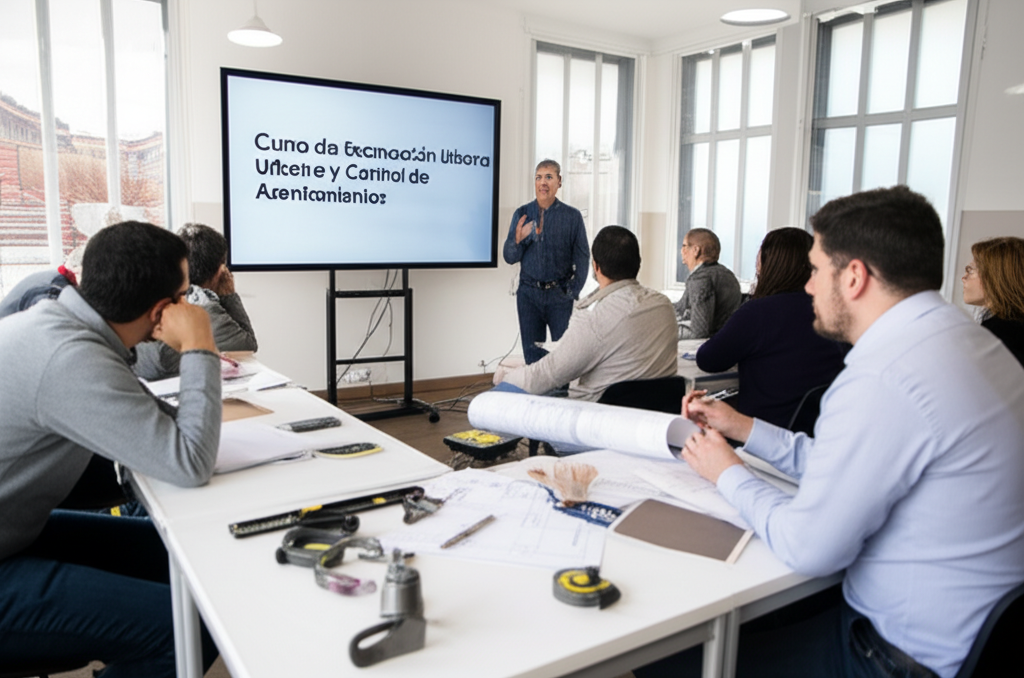
Urban Excavation and Settlement Control Course
- Format: Online
- Duration: 3 months
- Hours: 300 H
- Language: English / Spanish
- Registration date: 23-10-2026
- Start date: 12-12-2026
- Available places: 2
799 $
Competencies and results
What you will learn
1. Mastery of Urban Excavation and Settlement Control: Key Strategies and Practical Application
- Understand advanced excavation techniques in complex urban environments.
- Identify and mitigate risks associated with excavation in densely populated areas.
- Apply settlement control methodologies to minimize impacts on nearby infrastructure.
- Evaluate and select appropriate tools and equipment for urban excavation.
- Develop detailed excavation plans, including resource management and schedules.
- Analyze case studies of successful and unsuccessful urban excavation projects.
- Master strategies for managing different soil types and geological conditions.
- Apply relevant regulations and standards for urban excavation.
- Implement monitoring and control systems to ensure the safety and stability of the excavation.
- Use simulation software and tools to optimize processes excavation.
1. Master's Degree in Urban Excavation: Advanced Techniques and Settlement Management
- Strategic planning and design of excavations in complex urban environments.
- Analysis and management of geotechnical and structural risks in urban areas.
- Proficiency in advanced excavation technologies, including tunneling and microtunneling.
- Application of 3D modeling and simulation techniques to optimize excavation projects.
- Comprehensive management of urban excavation projects, including legal and regulatory aspects.
- Evaluation and mitigation of the environmental and social impact of excavations.
- Use of Geographic Information System (GIS) tools in excavation projects.
- Design and optimization of support and containment systems in urban excavations.
- Slope stability analysis and design of stabilization solutions.
- Management of excavated waste and materials in the context urban.
3. Comprehensive user-oriented design and validation (from modeling to manufacturing)
You will learn to integrate the entire product development process, from initial model conception to final validation, applying user-centered methodologies. You will develop skills in parametric design, ergonomics, simulation, sustainable materials, 3D visualization, and manufacturing management, ensuring efficient, safe solutions that meet current industry standards.
4. Urban Excavation and Settlements: Fundamentals, Management and Effective Control
4. Urban Excavation and Settlements: Fundamentals, Management, and Effective Control
Understand the fundamental principles of urban excavation: geotechnics, hydrology, and retaining structures.
Master project management techniques in urban excavations: planning, scheduling, and cost control.
Apply effective control methods: deformation monitoring, geotechnical instrumentation, and risk management.
Evaluate the environmental and social impact of urban excavations: noise, vibrations, and waste management.
Analyze case studies of settlements and their relationship to urban excavations: soil stability, foundation design, and risk mitigation.
Use specialized software for the design and analysis of urban excavations: geotechnical modeling and analysis. structural.
5. Implementation of Urban Excavation and Settlement Control: An Integrated Approach
5. Implementation of Urban Excavation and Settlement Control: An Integrated Approach
Identify and assess the geotechnical risks associated with urban excavation, including slope instability and settlement potential.
Analyze soil and subsoil characteristics using geotechnical investigation methods such as boreholes, laboratory tests, and in-situ testing.
Design and select excavation support systems, such as diaphragm walls, piles, sheet piles, and anchors, considering site conditions and structural requirements.
Evaluate soil-structure interaction by modeling the behavior of retaining structures and their influence on the surrounding environment.
Develop settlement control plans, including deformation estimation, implementation of geotechnical instrumentation, and definition of corrective actions.
Apply risk mitigation techniques, such as grouting, soil improvement, and slope stabilization.
Manage urban excavation in complex environments, considering the presence of underground infrastructure, adjacent buildings, and environmental restrictions.
Use geotechnical analysis software to simulate soil and structural behavior and optimize excavation design.
Understand the regulations and standards related to urban excavation and settlement control.
Apply sustainability principles in the execution of urban excavations, minimizing environmental impact and promoting resource efficiency.
6. Excellence in Urban Excavation and Settlement Control: Design, Execution and Supervision
6. Excellence in Urban Excavation and Settlement Control: Design, Execution, and Supervision
- Comprehensive planning and design of urban excavations, considering the geology of the terrain and current regulations.
- Mastery of advanced excavation techniques: trenches, tunnels, support methods (sheet piles, piles, diaphragm walls), and water control.
- Analysis and mitigation of geotechnical risks: slope stability, differential settlement, and effects on adjacent structures.
- Implementation of geotechnical monitoring systems: instrumentation (inclinometers, piezometers, pressure cells) and data interpretation.
- Control of settlements and deformations in structures: modeling and prediction of behavior, design of preventive and corrective measures.
- Management of urban excavation projects: resource planning and control Cost control, adherence to deadlines, and on-site safety.
Supervision and management of excavation works: inspection of work, quality control, subcontractor management, and problem-solving.
Legal and regulatory framework applicable to urban excavations: permits, licenses, responsibilities, and insurance.
New technologies and trends in urban excavation: drones, BIM, specialized software, and automation.
Case studies and analysis of successful experiences and lessons learned in real urban excavation projects.
Who this program is for:
Urban Excavation and Settlement Control Course
- Construction, civil engineering, and architecture professionals interested in urban excavation project management.
- Site technicians and supervisors who need to update their knowledge of excavation techniques and settlement control.
- Geotechnical engineers and geologists who wish to specialize in the analysis and mitigation of risks associated with urban excavation.
- Project managers and construction company managers seeking to optimize excavation processes and minimize environmental and social impacts.
- Public officials and technicians from city councils and local administrations involved in the planning and regulation of urban projects.
- Standards-driven curriculum: you will work with CS-27/CS-29, DO-160, DO-178C/DO-254, ARP4754A/ARP4761, ADS-33E-PRF from the first module.
- Accreditable laboratories (EN ISO/IEC 17025) with rotor bench, EMC/Lightning pre-compliance, HIL/SIL, vibrations/acoustics.
- Evidence-oriented TFM: safety case, test plan, compliance dossierand operational limits.
- Mentored by industry: teachers with experience in rotorcraft, tiltrotor, eVTOL/UAM and flight test.
- Flexible modality (hybrid/online), international cohorts and support from SEIUM Career Services.
- Ethics and security: safety-by-design approach, cyber-OT, DIH and compliance as pillars.
Module 1 — Fundamentals of Urban Excavation
1.1 Introduction to Urban Excavation: Definition and Scope
1.2 Legal and Regulatory Framework for Urban Excavation
1.3 Geology and Geotechnics Applied to Urban Excavations
1.4 Surveying and Layout in Urban Environments
1.5 Health and Safety in Excavations: Risk Prevention
1.6 Environmental Impact and Sustainability in Excavation
1.7 Types of Excavation: Classification and Selection
1.8 Machinery and Equipment Used in Excavations
1.9 Planning and Scheduling of Urban Excavations
1.10 Preliminary Studies: Site Reconnaissance and Design
2.2 Definition and Scope of Urban Excavation
2.2 Importance of Settlement Control in the Urban Environment
2.3 Legal and Regulatory Framework for Urban Excavation
2.4 Identifying Key Stakeholders in Excavation Projects
2.5 Soil Types and Their Implications for Excavation
2.6 Common Risks in Urban Excavation
2.7 Health and Safety in Excavation Works
2.8 Basic Tools and Equipment for Excavation
2.9 Introduction to Excavation Project Planning
2.20 Case Studies: Examples of Successful Urban Excavations and Challenges Faced
3.3 Introduction to Comprehensive Urban Excavation Analysis: Conceptual Framework
3.2 Risk Assessment in Urban Excavation Projects
3.3 Strategic Planning Techniques for Settlement
3.4 Modeling and Simulation in Urban Excavation
3.5 Resource and Budget Management in Excavation Projects
3.6 Geotechnical Analysis and Selection of Excavation Methods
3.7 Design of Settlement Control Systems
3.8 Safety Planning in Urban Excavation Works
3.9 Integration of BIM Technologies in Excavation Planning
3.30 Case Studies: Practical Application and Lessons Learned
4.4 Introduction to Urban Excavation Management
4.2 Legal and Regulatory Framework for Excavations
4.3 Planning and Design of Urban Excavations
4.4 Excavation and Earthmoving Techniques
4.5 Quality Control in Excavations
4.6 Risk Management in Urban Excavations
4.7 Health and Safety in Excavations
4.8 Monitoring and Control of Settlements
4.9 Waste Management and Sustainability in Excavations
4.40 Case Studies: Practical Applications and Challenges
5.5 Fundamentals of Urban Excavation: Definitions and Scope
5.5 Preliminary Planning: Site Studies and Environmental Analysis
5.3 Legislation and Regulations Applicable to Urban Excavation
5.4 Types of Settlements: Characteristics and Challenges
5.5 Environmental Impact and Mitigation Measures
5.6 Workplace Safety: Risk Prevention and Protocols
5.7 Basic Tools and Equipment for Excavation
5.8 First Aid and Emergency Response on Construction Sites
5.9 Initial Management of Waste and Excavated Materials
5.50 Introduction to Settlement Control and Soil Stabilization
6.6 Urban Excavation Project Design: Key Principles
6.2 Selection of Excavation Techniques: Adaptation to Different Urban Environments
6.3 Planning and Design of Support Systems: Stability and Safety
6.4 Risk Management in Urban Excavations: Identification and Mitigation
6.5 Supervision of Urban Excavations: Quality Control and Progress Monitoring
6.6 Design of Drainage Systems and Groundwater Control
6.7 Design of Interventions in Environments with Public Utilities
6.8 Design for Sustainability: Environmental Impact and Best Practices
6.9 Documentation and Reporting in Excavation Projects
6.60 Case Studies: Analysis of Successful Projects and Lessons Learned
- Hands-on methodology: test-before-you-trust, design reviews, failure analysis, compliance evidence.
- Software (depending on licenses/partners): MATLAB/Simulink, Python (NumPy/SciPy), OpenVSP, SU2/OpenFOAM, Nastran/Abaqus, AMESim/Modelica, acoustics tools, planning toolchains DO-178C.
- SEIUM Laboratories: scale rotor bench, vibrations/acoustics, EMC/Lightning pre-compliance, HIL/SIL for AFCS, data acquisition with strain gauging.
- Standards and compliance: EN 9100, 17025, ISO 27001, GDPR.
Capstone-type projects
- Urban Planning and Design: 3D modeling, GIS, and flow simulation.
- Excavation Project Management: Budgeting, scheduling, risk management, and control.
- Settlement Control: Geotechnical monitoring, stability analysis, and mitigation.
- Regulations and Legislation: Legal compliance, permits, and site safety.
- Geotechnical Planning: 3D modeling, stability analysis, and risk mitigation.
- Settlement Management: Monitoring, containment design, and control strategies.
- Excavation Optimization: Construction methods, equipment selection, and efficiency.
- Quality Control: Inspection, materials testing, and regulatory compliance.
- 3D Geomodeling and BIM: Precise subsurface modeling; excavation simulation.
- Risk Management: Slope stability analysis; contingency plans.
- Environmental Control: Vibration and dust monitoring; impact mitigation.
- Resource Optimization: Access road design; waste management.
- Settlement Control: 3D Modeling, Risk Analysis, Mitigation Strategies.
- Excavation Management: Detailed Planning, Construction Supervision, Cost and Schedule Control.
- Advanced Techniques: Ground Penetrating Radar, Soundings, Support Systems.
- Regulations and Legislation: Legal Compliance, Permits, and Safety.
Admissions, fees, and scholarships
- Profile: Background in Computer Engineering, Mathematics, Statistics, or related fields; practical experience in NLP and valued information retrieval systems.
- Documentation: Updated CV, academic transcript, SOP/statement of purpose, project examples or code (optional).
- Process: Application → Technical evaluation of profile and experience → Technical interview → Review of case studies → Final decision → Enrollment.
- Fees:
- Single payment: 10% discount.
- Payment in 3 installments: No fees; 30% upon registration + 2 equal monthly payments of the remaining 35%.
Monthly payment: available with a 7% commission on the total; annual review.
Scholarships: based on academic merit, financial need, and promoting inclusion; agreements with companies in the sector for partial or full scholarships.
See “Calendar & Calls for Applications,” “Scholarships & Grants,” and “Fees & Financing” in the SEIUM mega-menu.
Do you have any questions?
Our team is ready to help you. Contact us, and we will respond as soon as possible.
F. A. Q
Frequently asked questions
Yes, we have international certification
Yes: experimental models, real data, applied simulations, professional environments, real case studies.
It is not mandatory. We offer leveling tracks and tutoring.
Completely. It covers e-propulsion, integration, and emerging regulations (SC-VTOL).
Recommended. There are also internal challenges and consortiums.
Yes. Online/hybrid modality with planned labs and visa support (see “Visa & Residence”).