
Virtual reality course in pilot training
About our
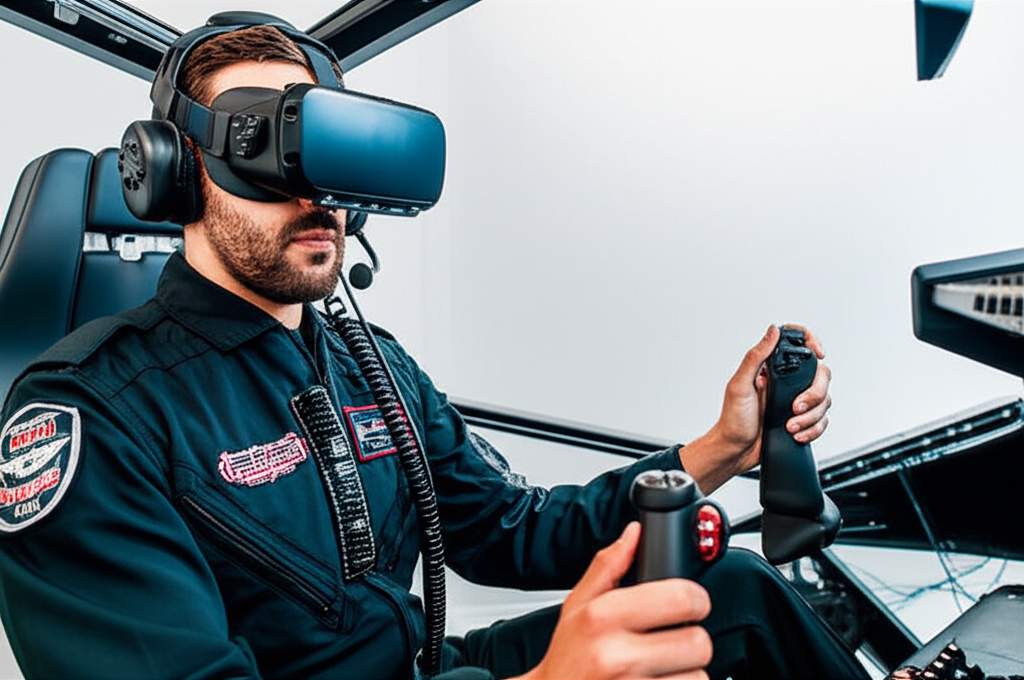
The Virtual Reality in Pilot Training course explores the immersive use of VR in flight simulation to improve training, safety, and efficiency. It focuses on the development of VR-based flight simulators that recreate realistic and challenging environments. immersive visualization, haptic interaction, and flight modeling technologies are analyzed to optimize the pilot experience and learning. The impact of VR on cost reduction and performance improvement compared to traditional simulators is studied.
The course provides hands-on experience in the design and use of VR training scenarios, including emergency situations and specific procedures. The challenges of the validation and certification of VR simulators are addressed to ensure they meet the safety and quality standards required by the aviation industry. The benefits of VR in pilot training at different levels, from commercial pilots to general aviation, are analyzed.
Virtual reality course in pilot training
- Format: Hybrid
- Duration: 3 months
- Hours: 300 H
- Language: English / Spanish
- Registration date: 23-10-2026
- Start date: 12-12-2026
- Available places: 2
249 $
Competencies and results
What you will learn
1. Mastery of Simulation and Virtual Reality Flight for Pilots
- Virtual Air Navigation: Master navigation systems, flight instruments, and standard procedures in immersive virtual reality environments.
- Advanced Flight Simulation: Experience realistic flight physics, controlling airplanes and helicopters in accurate simulations that replicate real-world conditions.
- Specialized Piloting Techniques: Learn to manage emergency situations, perform complex maneuvers, and develop crucial decision-making skills.
- Interaction with Virtual Environments: Adapt your flying skills to different scenarios and weather conditions, from clear skies to severe storms.
- Flight Scenario Design and Development: Create and customize your own flight scenarios to practice and improve your skills in specific areas.
- Flight Data Analysis: Use analytical tools to evaluate your performance, identify areas for improvement, and optimize your piloting skills.
- Use of Virtual Reality Technologies: Explore the Latest virtual reality technologies, including headsets, software, and simulation platforms, to optimize your training.
Virtual Flight Safety: Learn to apply aviation safety principles in virtual environments, including error prevention and risk management.
2. Immersive Experience: Pilot Training with Virtual Reality
- Navigate realistic flight simulations using virtual reality (VR) technology.
- Master flight controls, navigation, and communications in immersive simulated environments.
- Experience emergency situations and learn to react under pressure in a safe environment.
- Understand and apply the principles of aerodynamics and flight mechanics in a practical way.
- Develop quick and accurate decision-making skills in complex scenarios.
- Become familiar with modern aircraft flight instruments and systems through detailed simulations.
- Learn cockpit resource management (CRM) techniques for effective communication and collaboration.
- Improve situational awareness and anticipation skills through flight simulations.
- Gain knowledge about different types of aircraft and their flight characteristics.
- Receive immediate and personalized feedback to optimize performance and correct errors.
3. Comprehensive user-oriented design and validation (from modeling to manufacturing)
You will learn to integrate the entire product development process, from initial model conception to final validation, applying user-centered methodologies. You will develop skills in parametric design, ergonomics, simulation, sustainable materials, 3D visualization, and manufacturing management, ensuring efficient, safe solutions that meet current industry standards.
4. Air Navigation and Immersive Flight Simulations in VR
- Fundamental principles of air navigation, including aerodynamics, meteorology, and navigation systems.
- Aircraft piloting and control techniques, adapted to virtual environments.
- Use of virtual reality (VR) flight simulators to practice flight procedures and decision-making in critical situations.
- Interpretation of flight instruments in VR and understanding of their operation.
- Planning and execution of simulated flights, including fuel management, route planning, and weather considerations.
- Analysis of complex flight scenarios and problem-solving in virtual environments.
- Introduction to virtual reality and its application in flight simulation.
- Development of communication and teamwork skills in simulated environments.
- Exploration of aviation safety and human factors in virtual aviation.
- Hardware and software integration for the creation of immersive flight simulation experiences.
5. Mastery of the VR Environment for Pilot Training
-
You will understand the simulation and analysis of virtual reality (VR) environments applied to pilot training.
-
You will learn to use VR tools for practicing flight procedures, navigation, and emergency management.
-
You will become familiar with creating and customizing VR scenarios to optimize pilot training.
-
You will explore the advantages of VR in reducing costs and increasing safety in flight training.
-
You will master the use of VR interfaces and devices specifically for flight simulation, including controllers, headsets, and tracking systems.
-
You will analyze the impact of virtual reality on improving pilot performance and knowledge retention.
-
You will acquire skills to evaluate the effectiveness of different VR simulations and adapt them to the learning needs of each pilot.
You will understand the principles of immersion and interaction in VR environments to create more realistic and effective learning experiences.
You will learn about the latest trends and technological advances in the field of VR applied to pilot training.
6. Design and Control of Helicopters in VR Environments
- Identify and analyze the effects of flap-lag-torsion couplings on the main rotor.
- Evaluate the whirl flutter phenomenon and its implications for helicopter stability.
- Understand fatigue mechanisms in critical components and mitigation strategies.
- Apply design techniques to dimension composite structures.
- Analyze the behavior of bonded joints using finite element (FE) analysis.
- Optimize the structural design to meet strength and durability requirements.
- Implement damage tolerance methodologies to evaluate damage propagation.
- Apply techniques of non-destructive testing (NDT), including UT/RT/thermography.
Integrate NDT results into structural condition assessment and maintenance.
Who this program is for:
Virtual reality course in pilot training
- Engineers with degrees in Aerospace Engineering, Mechanical Engineering, Industrial Engineering, Automation Engineering, or related disciplines.
- Experts in OEM rotorcraft/eVTOL, MRO (Maintenance, Repair, and Operations), Consultants, and researchers from technology centers.
- Specialists in Flight Testing, Aircraft Certification, Avionics, Flight Control, and Flight Dynamics who wish to deepen their knowledge.
- Representatives of organizations Regulators/authorities and professionals involved in Urban Air Mobility (UAM) / eVTOL, interested in acquiring competencies in regulatory compliance.
Recommended requirements: Prior knowledge of aerodynamics, control systems, and aeronautical structures is recommended. Language level: Spanish/English B2+/C1. We offer bridging tracks to address any knowledge gaps.
- Standards-driven curriculum: you will work with CS-27/CS-29, DO-160, DO-178C/DO-254, ARP4754A/ARP4761, ADS-33E-PRF from the first module.
- Accreditable laboratories (EN ISO/IEC 17025) with rotor bench, EMC/Lightning pre-compliance, HIL/SIL, vibrations/acoustics.
- Evidence-oriented TFM: safety case, test plan, compliance dossierand operational limits.
- Mentored by industry: teachers with experience in rotorcraft, tiltrotor, eVTOL/UAM and flight test.
- Flexible modality (hybrid/online), international cohorts and support from SEIUM Career Services.
- Ethics and security: safety-by-design approach, cyber-OT, DIH and compliance as pillars.
Module 1 — Introduction to VR and Principles of Flight
1.1 Fundamentals of Virtual Reality (VR) in Aviation
1.2 Hardware and Software: VR Platforms for Flight Simulation
1.3 Basic Principles of Flight Dynamics
1.4 Aerodynamics Applied to VR: Wings, Rotors, and Controls
1.5 Navigation Systems and Virtual Instrumentation
1.6 Interaction and Controls in VR Environments
1.7 Safety and Health in the VR Experience
1.8 Environment Design: Creating Virtual Aerial Scenarios
1.9 Programming and Customizing VR Simulators
1.10 Getting Started: Simulator Setup and Calibration
2.2 Principles of Helicopter Design in VR
2.2 Modeling Components and Systems in VR
2.3 Flight Dynamics and Aerodynamics in VR Environments
2.4 Interaction and Control: Virtual Cockpit Design
2.5 Performance and Efficiency Optimization in VR
2.6 Failure and Emergency Simulation in VR
2.7 Designing Custom Helicopters in VR
2.8 Data Integration and Analysis in VR
2.9 Design Testing and Validation in VR
2.20 Practical Applications and Case Studies in VR
3.3 Introduction to Virtual Reality (VR) in Aviation Training
3.2 Aviation Regulations Applicable to Flight Simulators
3.3 Health and Safety Regulations in VR Environments
3.4 Legislation on the Use of VR in Pilot Training
3.5 Quality Standards and Certification for VR Simulators
3.6 Legal Framework for Data Protection in Simulations
3.7 Ethical Considerations in the Use of VR in Pilot Training
3.8 Integrating VR with Existing Flight Training
3.9 Impact of VR on Training Efficiency and Cost
3.30 Future of Regulations and VR in the Aviation Industry
4.4 Principles of Air Navigation: Instruments and Systems
4.2 Flight Planning in Virtual Environments
4.3 Using VR Flight Simulators for Navigation
4.4 Identifying and Troubleshooting Navigation Problems in VR
4.5 IFR/VFR Navigation Procedures in VR
4.6 Meteorology and Its Impact on Simulated Navigation
4.7 Cartography and the Use of Navigation Charts in VR
4.8 Navigation Practices Under Different Conditions in VR
4.9 Global Positioning Systems (GPS) and Their Simulation
4.40 Performance Evaluation and Feedback in Navigation Simulations
5.5 Introduction to VR: Fundamentals and Applications in Aviation
5.5 VR Hardware: Headsets, Controllers, and Platforms
5.3 VR Software: Graphics Engines and Flight Simulators
5.4 VR Environment Design: Scenery Modeling and Texturing
5.5 Interaction in VR: Flight Control and Systems Simulation
5.6 Immersive Experience: Creating Realistic Environments
5.7 Principles of Flight Simulation: Aircraft Physics and Dynamics
5.8 VR Applications in Pilot Training: Advantages and Challenges
5.9 Introduction to Air Navigation in VR
5.50 Safety and Ergonomic Considerations in VR
6.6 Principles of Helicopter Design in VR
6.2 Modeling Helicopter Components and Systems in VR Environments
6.3 Cockpit Design and Ergonomics in VR
6.4 Flight Simulation and Helicopter Dynamics in VR
6.5 Implementing Flight Controls and Management Systems in VR
6.6 Creating Flight Scenarios and Missions in VR
6.7 Interaction and Haptic Feedback in VR
6.8 Optimizing Performance and Efficiency in Helicopter Design in VR
6.9 Evaluating and Analyzing Helicopter Designs in VR
6.60 Practical Applications and Case Studies in Helicopter Design in VR
- Hands-on methodology: test-before-you-trust, design reviews, failure analysis, compliance evidence.
- Software (depending on licenses/partners): MATLAB/Simulink, Python (NumPy/SciPy), OpenVSP, SU2/OpenFOAM, Nastran/Abaqus, AMESim/Modelica, acoustics tools, planning toolchains DO-178C.
- SEIUM Laboratories: scale rotor bench, vibrations/acoustics, EMC/Lightning pre-compliance, HIL/SIL for AFCS, data acquisition with strain gauging.
- Standards and compliance: EN 9100, 17025, ISO 27001, GDPR.
Capstone-type projects
- VR Simulation: Scenarios, aircraft, weather effects, immersive flight dynamics.
- VR Interaction: Controls, instrumentation, communication, navigation, and procedures.
- VR Pilot Training: Emergencies, flight simulation, and decision-making.
- RV Pilot: Immersive flight simulation and air navigation.
- VR Training: Virtual reality scenario design and flight dynamics.
- RV Helicopter: Skill development and control in VR environments.
- Immersion: Pilot training and mastery of the VR environment.
- VR Pilot Simulation: Creation of realistic flight scenarios.
- VR Training: Development of immersive navigation and dynamics simulations.
- VR Pilot Platform: Design of helicopter and airplane control systems.
- VR Skills Assessment: Implementation of VR pilot training.
- VR Pilot: Immersive simulation; varied scenarios; navigation and flight.
- VR Helicopter: Design and control; realistic training; advanced skills.
- VR Instruction: Pilot training; flight dynamics; controlled environments.
- VR Applications: Skills development; performance evaluation; effective training.
Admissions, fees, and scholarships
- Profile: Background in Computer Engineering, Mathematics, Statistics, or related fields; practical experience in NLP and valued information retrieval systems.
- Documentation: Updated CV, academic transcript, SOP/statement of purpose, project examples or code (optional).
- Process: Application → Technical evaluation of profile and experience → Technical interview → Review of case studies → Final decision → Enrollment.
- Fees:
- Single payment: 10% discount.
- Payment in 3 installments: No fees; 30% upon registration + 2 equal monthly payments of the remaining 35%.
Monthly payment: available with a 7% commission on the total; annual review.
Scholarships: based on academic merit, financial need, and promoting inclusion; agreements with companies in the sector for partial or full scholarships.
See “Calendar & Calls for Applications,” “Scholarships & Grants,” and “Fees & Financing” in the SEIUM mega-menu.
Do you have any questions?
Our team is ready to help you. Contact us, and we will respond as soon as possible.
F. A. Q
Frequently asked questions
Yes, we have international certification
Yes: experimental models, real data, applied simulations, professional environments, real case studies.
It is not mandatory. We offer leveling tracks and tutoring.
Completely. It covers e-propulsion, integration, and emerging regulations (SC-VTOL).
Recommended. There are also internal challenges and consortiums.
Yes. Online/hybrid modality with planned labs and visa support (see “Visa & Residence”).