

Ergonomics course in aerospace manufacturing
About our
The Ergonomics in Aerospace Manufacturing course focuses on optimizing efficiency and safety on aerospace production lines. It addresses the application of ergonomic principles to design workstations, tools, and processes that minimize the risk of musculoskeletal injuries and improve performance. It focuses on ergonomic risk assessment, task analysis, and the implementation of practical solutions, such as the use of ergonomic tools, posture optimization, and physical workload management, in compliance with occupational health and safety regulations.
The course provides knowledge of anthropometry, biomechanics, and psychosocial factors that influence worker well-being. It includes the study of job design and the implementation of injury prevention programs in a complex and demanding manufacturing environment such as aerospace, where precision and efficiency are crucial. The program aims to train professionals capable of identifying and mitigating ergonomic risks, improving productivity and quality in the manufacture of aeronautical components.
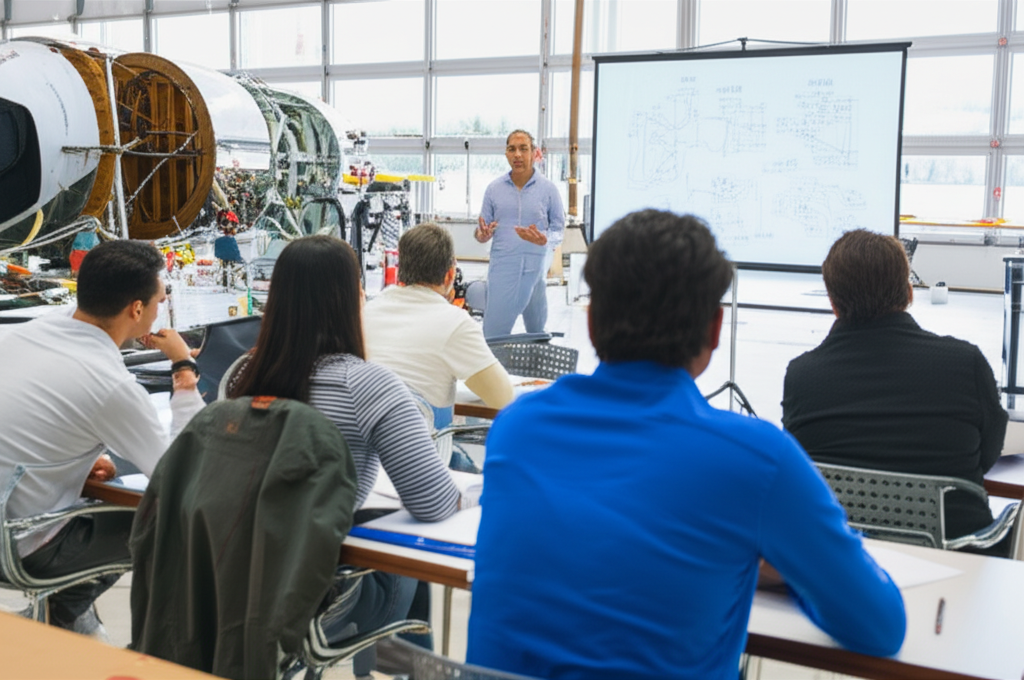
Ergonomics course in aerospace manufacturing
- Format: Hybrid
- Duration: 3 months
- Hours: 300 H
- Language: English / Spanish
- Registration date: 23-10-2026
- Start date: 12-12-2026
- Available places: 3
399 $
Competencies and results
What you will learn
1. Ergonomic Optimization and Safety in Aerospace Manufacturing
- Ergonomics assessment in aerospace production environments to minimize risks and optimize efficiency.
- Application of safety principles in the handling of materials, equipment, and aerospace manufacturing processes.
- Identification and analysis of ergonomic and safety risks specific to the aerospace industry.
2. Advanced Ergonomic Analysis and Design for the Aerospace Industry
- Comprehensive evaluation of ergonomic analysis principles applied to the aerospace industry, including the identification of risk factors and the optimization of human-machine interaction.
- Mastery of advanced ergonomic design methodologies, such as anthropometry, biomechanics, and neuroergonomics, for creating safe and efficient work environments in aircraft and space stations.
- Application of ergonomic simulation and modeling tools to predict and mitigate problems related to posture, physical exertion, and fatigue in different aerospace contexts.
3. Comprehensive user-oriented design and validation (from modeling to manufacturing)
You will learn to integrate the entire product development process, from initial model conception to final validation, applying user-centered methodologies. You will develop skills in parametric design, ergonomics, simulation, sustainable materials, 3D visualization, and manufacturing management, ensuring efficient, safe solutions that meet current industry standards.
4. Ergonomic Implementation: Efficiency and Well-being in Aerospace Production
- Optimization of workstation layouts to minimize fatigue and maximize productivity.
- Application of ergonomic design principles in the selection and use of tools and equipment.
- Evaluation and control of ergonomic risks associated with repetitive movements, awkward postures, and manual handling of loads.
- Integration of ergonomic solutions in the design and planning of aerospace production processes.
- Analysis of the influence of lighting, noise, and temperature in the work environment and their impact on well-being and efficiency.
- Implementation of ergonomics training and awareness programs for personnel.
- Application of ergonomic assessment methodologies, such as task analysis and workplace observation.
- Compliance with ergonomics regulations and standards in the industry Aerospace.
Development of customized solutions to improve ergonomics in specific production areas, such as assembly, inspection, and maintenance.
Evaluation of the effectiveness of ergonomic interventions through the measurement of performance indicators and employee feedback.
5. Aerospace Ergonomics: Risk Prevention and Continuous Improvement in Manufacturing
5. Aerospace Ergonomics: Risk Prevention and Continuous Improvement in Manufacturing
- Understand the fundamental principles of ergonomics and their specific application in the aerospace sector.
- Identify and evaluate ergonomic risks present in aircraft manufacturing and assembly processes.
- Apply ergonomic analysis methods to diagnose problems and propose effective solutions.
- Design and optimize workstations, tools, and equipment to reduce fatigue, musculoskeletal disorders, and improve efficiency.
- Develop and implement continuous improvement programs for ergonomics in the production plant.
- Know and apply the ergonomics regulations and standards relevant to the aerospace industry.
- Analyze the human factors that influence the safety and quality of aerospace products.
- Use simulation tools and techniques to evaluate the ergonomics of designs and processes.
- Promote a culture of safety and well-being in the workplace.
- Evaluate the effectiveness of ergonomic interventions and make adjustments as needed.
6. Ergonomics in Aerospace Manufacturing: Workstation and Tool Design
-
Fundamentals of Ergonomics: Key Principles for Human-Centered Design.
-
Job Analysis in Aerospace Manufacturing: Identifying Ergonomic Risks.
- Ergonomic Workstation Design: Configuring Optimized Workstations.
- Tool Selection and Design: Ergonomic Hand and Power Tools.
- Prevention of Musculoskeletal Injuries (MSIs): Control Strategies and Techniques.
- Ergonomic Risk Assessment and Control: Evaluation Methods and Corrective Measures.
- Human Factors in Manufacturing: Human-Machine Interaction and Interface Design.
- Applications of Ergonomics in the Aerospace Industry: Case Studies and Best Practices.
- Legislation and regulations: Compliance with ergonomic standards.
Continuous improvement: Implementation of an ergonomics management system.
Who this program is for:
Ergonomics course in aerospace manufacturing
- Engineers with degrees in Aerospace Engineering, Mechanical Engineering, Industrial Engineering, Automation Engineering, or related fields.
- Experts in Aerospace Manufacturing from OEMs of rotary-wing/eVTOL aircraft, MROs, consulting firms, and technology research centers.
- Professionals in areas such as Flight Testing, Aeronautical Certification, Avionics, Systems Control, and Flight Dynamics, interested in deepening their knowledge.
- Personnel from Authorities Regulators and specialists in urban air mobility (UAM/eVTOL) who need to acquire skills in regulatory compliance and applied ergonomics.
Recommended Prerequisites: Basic knowledge of aerodynamics, control systems, and aeronautical structures. Proficiency in English or Spanish (B2+ / C1). Bridging tracks are provided to address any training gaps.
- Standards-driven curriculum: you will work with CS-27/CS-29, DO-160, DO-178C/DO-254, ARP4754A/ARP4761, ADS-33E-PRF from the first module.
- Accreditable laboratories (EN ISO/IEC 17025) with rotor bench, EMC/Lightning pre-compliance, HIL/SIL, vibrations/acoustics.
- Evidence-oriented TFM: safety case, test plan, compliance dossierand operational limits.
- Mentored by industry: teachers with experience in rotorcraft, tiltrotor, eVTOL/UAM and flight test.
- Flexible modality (hybrid/online), international cohorts and support from SEIUM Career Services.
- Ethics and security: safety-by-design approach, cyber-OT, DIH and compliance as pillars.
1.1 Fundamentals of Ergonomics in the Aerospace Industry
1.2 Human-Centered Design: Principles and Applications
1.3 Human Factors and Their Impact on Manufacturing
1.4 The Role of Ergonomics in Safety and Productivity
1.5 Relevant Ergonomic Legislation and Standards
1.6 Anthropometry and Biomechanics: Application in Workstation Design
1.7 Ergonomic Risk Assessment: Methods and Tools
1.8 Tool and Equipment Design: Ergonomic Considerations
1.9 Prevention of Musculoskeletal Injuries (MSIs)
1.10 The Future of Ergonomics in Aerospace Manufacturing
2.2 Key Principles of Ergonomic Design
2.2 Task and Workload Analysis in Manufacturing
2.3 Ergonomic Workstation Design
2.4 Selection and Use of Hand Tools
2.5 Tool and Equipment Design
2.6 Human Factors in Control and Display Design
2.7 Ergonomic Risk Assessment
2.8 Material Handling System Design
2.9 Lighting and Work Environment Design
2.20 Implementation of Ergonomics Programs
3.3 Introduction to Ergonomics Applied to Aerospace Manufacturing
3.2 Ergonomic Principles in Workstation Design
3.3 Ergonomic Tool Design for Aerospace Manufacturing
3.4 Ergonomic Risk Assessment in Manufacturing Processes
3.5 Ergonomic Assessment Methods in the Aerospace Industry
3.6 Ergonomic Adaptation of Workstations and Tools
3.7 Design of Efficient and Safe Work Processes
3.8 Human Factors and Their Impact on Safety and Productivity
3.9 Implementation of Ergonomic Solutions: Case Studies
3.30 Continuous Improvement and Monitoring of Ergonomics in Aerospace Manufacturing
4.4 Integrating Ergonomics: Implementation Phases in Aerospace Production
4.2 Designing Ergonomic Workstations: Practical Applications
4.3 Selecting and Adapting Ergonomic Tools for Specific Tasks
4.4 Implementing Ergonomic Management Systems: Key Steps
4.5 Training and Awareness: Developing an Ergonomic Culture
4.6 Continuous Monitoring and Evaluation: Ergonomic Performance Indicators
4.7 Designing Work Processes: Ergonomic Optimization on the Production Line
4.8 Implementing Solutions for Preventing Musculoskeletal Injuries
4.9 Improving Efficiency and Productivity Through Ergonomics
4.40 Case Studies: Successful Implementation of Ergonomics in the Aerospace Industry
5.5 Introduction to Ergonomics and Safety in Aerospace Manufacturing
5.5 Identifying Ergonomic Risks in the Workplace
5.3 Principles of Safe Workstation Design
5.4 Proper Use of Tools and Equipment
5.5 Prevention of Musculoskeletal Injuries (MSIs)
5.6 Human Factors and Their Impact on Safety
5.7 Safety Standards and Regulations
5.8 Designing Safe Work Procedures
5.9 Safety Training and Awareness
5.50 Case Studies: Incident Analysis and Lessons Learned
5.5 Introduction to Advanced Ergonomic Analysis
5.5 Task and Process Analysis Methods
5.3 Designing Ergonomic Workstations
5.4 Movement and Posture Analysis
5.5 Applying Ergonomic Design Software Tools 5.6 Physical and Mental Workload Assessment
5.7 Psychosocial Factors in Ergonomic Design
5.8 Lighting and Work Environment Design
5.9 Cognitive Ergonomics and Interface Design
5.50 Case Studies: Ergonomic Design of Aerospace Systems
3.5 Introduction to Ergonomic Design in Aerospace Manufacturing
3.5 Tool and Equipment Design
3.3 Workstation and Assembly Station Design
3.4 Posture and Movement Assessment
3.5 Ergonomic Assessment Methods: OWAS, RULA, REBA
3.6 Design of Ergonomic Performance Indicators
3.7 User-Centered Design
3.8 Fatigue and Stress Assessment
3.9 Prototype Design and Usability Testing
3.50 Case Studies: Design and Evaluation of Work Environments in the Aerospace Industry
4.5 Introduction to Ergonomic Implementation
4.5 Strategies for Continuous Improvement
4.3 Implementing Ergonomic Changes in the Workplace
4.4 Designing Training Programs
4.5 Measuring and Evaluating the Effectiveness of Ergonomic Interventions
4.6 Managing Change and Resistance to Change
4.7 Effective Communication and Employee Engagement
4.8 Designing an Ergonomic Management System
4.9 Cost-Benefit Analysis of Ergonomic Interventions
4.50 Case Studies: Implementing Ergonomic Programs in the Aerospace Industry
5.5 Identifying and Analyzing Ergonomic Risks
5.5 Designing Risk Controls: Hierarchy of Controls
5.3 Preventing Musculoskeletal Injuries (MSIs)
5.4 Designing Continuous Improvement Programs 5.5 Monitoring and tracking of worker health.
5.6 Implementation of safety management systems.
5.7 Analysis of ergonomics-related incidents and accidents.
5.8 Design of key performance indicators (KPIs).
5.9 Design of ergonomic audits.
5.50 Case studies: risk prevention and continuous improvement programs in the aerospace industry.
6.5 Ergonomic design of workstations.
6.5 Selection and design of hand tools.
6.3 Design of electric and pneumatic tools.
6.4 Design of workstations for specific tasks.
6.5 Design of seating and support systems.
6.6 Design of lighting and environmental systems.
6.7 Design of material handling systems.
6.8 Design of human-machine interfaces (HMIs).
6.9 Design of personal protective equipment (PPE). 6.50 Case Studies: Workstation and Tool Design in the Aerospace Industry
7.5 Principles of Anthropometry and Biomechanics
7.5 Designing Appropriate Working Postures
7.3 Principles of Grip and Force Design
7.4 Principles of Reach and Sight Design
7.5 Design of Control and Visual Systems
7.6 Design of Information Systems
7.7 Principles of Thermal Environment Design
7.8 Principles of Noise and Vibration Design
7.9 Principles of Lighting Design
7.50 Applying Ergonomic Principles to Aerospace Product Design
8.5 Ergonomic Assessment Methods
8.5 Adapting Workstations to Individual Needs
8.3 Evaluating Efficiency and Productivity
8.4 Evaluating Employee Satisfaction 8.5 Implementation of corrective measures.
8.6 Monitoring and evaluation of the effectiveness of the measures.
8.7 Design of rehabilitation and return-to-work programs.
8.8 Adaptation of workstations for people with disabilities.
8.9 Design of ergonomic risk assessments.
8.50 Case studies: ergonomic assessment and adaptation in the aerospace industry.
6.6 Ergonomic Design Principles in Aerospace Workstations
6.2 Ergonomic Design of Hand Tools and Equipment
6.3 Selection and Adaptation of Ergonomic Tools for Manufacturing
6.4 Design of Ergonomic Workstations: Dimensions and Adjustments
6.5 Ergonomic Risk Assessment in Workstations
6.6 Design of Support and Assistance Systems for Repetitive Tasks
6.7 Ergonomic Considerations in the Selection of Materials and Components
6.8 Lighting and Visual Environment Design for Manufacturing
6.9 Integration of Ergonomics into Manufacturing Process Design
6.60 Case Studies: Successful Ergonomic Workstation and Tool Design
- Hands-on methodology: test-before-you-trust, design reviews, failure analysis, compliance evidence.
- Software (depending on licenses/partners): MATLAB/Simulink, Python (NumPy/SciPy), OpenVSP, SU2/OpenFOAM, Nastran/Abaqus, AMESim/Modelica, acoustics tools, planning toolchains DO-178C.
- SEIUM Laboratories: scale rotor bench, vibrations/acoustics, EMC/Lightning pre-compliance, HIL/SIL for AFCS, data acquisition with strain gauging.
- Standards and compliance: EN 9100, 17025, ISO 27001, GDPR.
Capstone-type projects
- Ergonomic Workstation Design: Task analysis, tool selection, and workstation design to optimize efficiency and reduce injuries in aerospace manufacturing.
- Ergonomic Process Assessment and Redesign: Applying ergonomic principles to improve production, safety, and worker well-being in the aerospace industry.
- Implementation of an Ergonomic Continuous Improvement Program: Proactive identification and mitigation of ergonomic risks in aerospace production.
“`html
- Workstation Optimization: Ergonomic design of assembly stations, stress and posture analysis, risk reduction.
- Tool Analysis: Design and selection of ergonomic tools, evaluation of their impact on worker health.
- Process Evaluation and Adaptation: Implementation of ergonomic improvements in production lines, optimization of workflow.
- Injury Prevention: Design of safety protocols, training, and reduction of occupational risks.
“
- Optimized Workstation Design: 3D modeling, biomechanical evaluation, selection of ergonomic tools.
- Workflow and Risk Analysis: Identification of critical tasks, REBA/RULA analysis, improvement proposals.
- Implementation of Ergonomic Solutions: Prototyping, usability testing, validation of production improvements.
- Safety Protocol Design: Risk assessment, checklist creation, staff training.
“`html
- Ergonomic Design and Evaluation of Workstations: Analysis of workstations, selection of ergonomic tools, and recommendations for improving efficiency and safety.
- Ergonomic Risk Analysis in Manufacturing: Identification of risk factors, development of prevention strategies, and proposals for continuous improvement.
- Implementation of Ergonomic Solutions: Design and adaptation of tools and equipment to optimize productivity and reduce injuries.
“
Admissions, fees, and scholarships
- Profile: Background in Computer Engineering, Mathematics, Statistics, or related fields; practical experience in NLP and valued information retrieval systems.
- Documentation: Updated CV, academic transcript, SOP/statement of purpose, project examples or code (optional).
- Process: Application → Technical evaluation of profile and experience → Technical interview → Review of case studies → Final decision → Enrollment.
- Fees:
- Single payment: 10% discount.
- Payment in 3 installments: No fees; 30% upon registration + 2 equal monthly payments of the remaining 35%.
Monthly payment: available with a 7% commission on the total; annual review.
Scholarships: based on academic merit, financial need, and promoting inclusion; agreements with companies in the sector for partial or full scholarships.
See “Calendar & Calls for Applications,” “Scholarships & Grants,” and “Fees & Financing” in the SEIUM mega-menu.
Do you have any questions?
Our team is ready to help you. Contact us, and we will respond as soon as possible.
F. A. Q
Frequently asked questions
Yes, we have international certification
Yes: experimental models, real data, applied simulations, professional environments, real case studies.
It is not mandatory. We offer leveling tracks and tutoring.
Completely. It covers e-propulsion, integration, and emerging regulations (SC-VTOL).
Recommended. There are also internal challenges and consortiums.
Yes. Online/hybrid modality with planned labs and visa support (see “Visa & Residence”).