

SAR payloads course on satellites
About our
The Satellite SAR Payloads course explores the design, operation, and application of satellite-borne synthetic aperture radar (SAR) systems. It covers the acquisition, processing, and analysis of SAR data for various applications, such as environmental monitoring, natural resource management, and maritime surveillance, including calibration and image georeferencing. It focuses on practical knowledge of SAR technologies, from signal generation to interpretation of SAR products, complemented by the study of satellite platforms and their components, such as antennas and transmission systems.
The course provides experience in using specialized software for SAR data simulation and processing. Advanced SAR imaging techniques are explored, including interferometry (InSAR) and polarimetry, and their applications in studying phenomena such as ground deformation and land cover classification. The course includes case study analysis and the development of practical projects related to SAR remote sensing, preparing participants for roles in the Earth observation and geospatial industries.
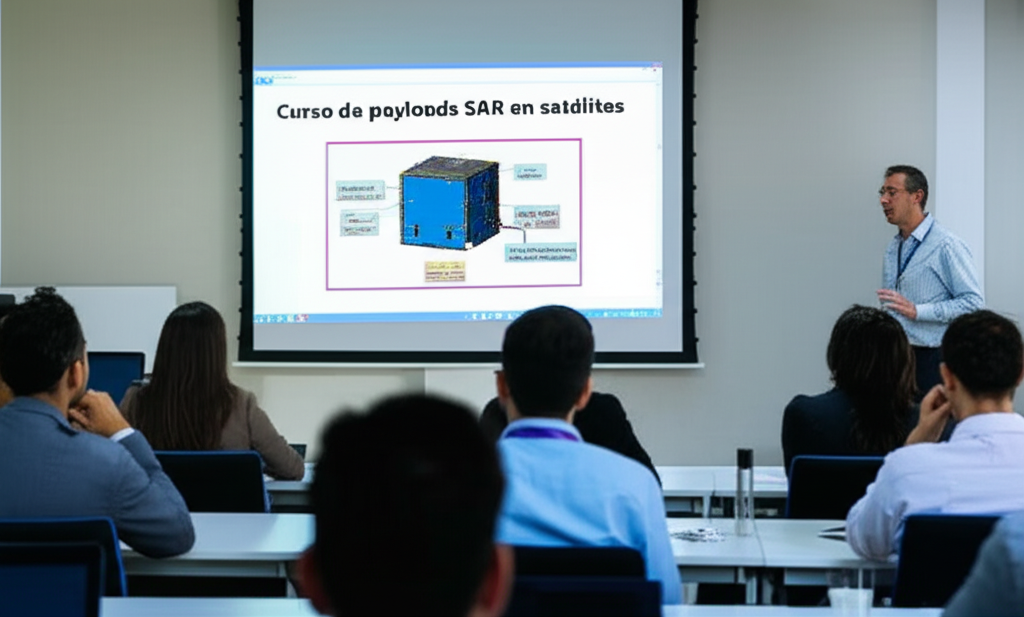
SAR payloads course on satellites
- Format: Hybrid
- Duration: 3 months
- Hours: 300 H
- Language: English / Spanish
- Registration date: 23-10-2026
- Start date: 12-12-2026
- Available places: 2
575 $
Competencies and results
What you will learn
1. **Advanced Analysis of SAR Payloads: Design, Operation and Satellite Applications**
- In-depth study of SAR data analysis techniques, including signal processing methods and geometric correction.
- Detailed design of SAR payloads, encompassing component selection, system architecture, and subsystem integration.
- Comprehensive understanding of SAR payload operation, including mission planning, data acquisition, and platform control.
- Extensive exploration of satellite applications of SAR data, such as detecting changes in the Earth’s surface, environmental monitoring, and disaster management.
- Analysis of the limitations and challenges of SAR systems, such as interference, noise, and spatial resolution.
- Familiarization with the latest technologies and trends in the field of SAR payloads, including the development of new sensors and processing algorithms.
- Mastery of specialized tools and software for the analysis and processing of SAR data.
Practical application of acquired knowledge through simulation exercises and real-world case studies.
2. **Comprehensive Mastery of Rotor Modeling and Performance in Aerospace Systems**
- Delve into the principles of rotor aerodynamics, including the study of airfoils and their impact on overall performance.
- Model and simulate the dynamic behavior of rotors, encompassing stability analysis and transient response under various flight conditions.
- Apply advanced finite element analysis (FEA) techniques to evaluate the structural integrity of rotors, considering static, dynamic, and thermal loads.
- Understand aeroelastic coupling phenomena, such as flutter, and develop strategies to mitigate their effects.
- Optimize rotor design to improve aerodynamic efficiency, reduce noise, and minimize fuel consumption.
- Evaluate and select suitable composite and metallic materials for rotor manufacturing, considering factors such as strength, stiffness, and durability.
- Master Understand fatigue and cumulative damage analysis methods and apply design criteria based on damage tolerance.
Use specialized software for rotor modeling, simulation, and analysis, including tools for design optimization.
Understand the regulations and certification standards applicable to aerospace rotor systems.
Explore the latest trends in rotor research and development, such as actively controlled rotor systems and innovative designs.
3. Comprehensive user-oriented design and validation (from modeling to manufacturing)
You will learn to integrate the entire product development process, from initial model conception to final validation, applying user-centered methodologies. You will develop skills in parametric design, ergonomics, simulation, sustainable materials, 3D visualization, and manufacturing management, ensuring efficient, safe solutions that meet current industry standards.
4. **Deep Exploration of SAR Payloads: Fundamentals, Operation and Applications in Satellites**
4. **In-Depth Exploration of SAR Payloads: Fundamentals, Operation, and Applications in Satellites**
- Understand the fundamental principles of SAR (Synthetic Aperture Radar) technology: from signal generation and processing to high-resolution imaging.
- Explore the key components of SAR payloads: antennas, transmitters, receivers, and data processing subsystems.
- Analyze the different architectures of SAR payloads: including X, C, L, and P-band SAR, and their respective advantages and disadvantages for various applications.
- Study the operation of SAR payloads in orbit: mission planning, resource management, and instrument calibration.
- Understand the applications of SAR data in various disciplines: geology, oceanography, agriculture, environmental monitoring, disaster management, and national security.
- Learn about the processing of SAR imaging: from error correction to the generation of final products (interferometry maps, digital elevation models).
Explore the latest trends in SAR technology: including full-polarization SAR, dual-band SAR, interferometric SAR (InSAR), and real-time synthetic aperture SAR (RT-SAR).
Evaluate the design and implementation of SAR payloads for future space missions: considering technological challenges and end-user needs.
Delve into the simulation and modeling of SAR payloads: to optimize performance and mission planning.
Analyze specific case studies: to demonstrate the utility and impact of SAR data in the real world.
5. **SAR Payload Optimization: Principles, Deployment, and Satellite Data Analysis**
- Understand the fundamentals of **SAR (Synthetic Aperture Radar) Payload Optimization**.
- Explore the key principles of SAR system design and operation.
- Learn about SAR payload **deployment** techniques, including airborne and satellite platforms.
- Master SAR satellite data **analysis** methods, such as calibration, georeferencing, and interferometry.
- Study advanced applications of SAR data, such as change detection, elevation model generation, and object classification.
- Gain knowledge of SAR signal processing and image enhancement techniques.
- Evaluate the performance of SAR systems and optimize acquisition parameters.
- Apply the acquired knowledge in real-world case studies and projects. practical.
Become familiar with the tools and software specialized in SAR data analysis.
Understand the limitations and challenges associated with using SAR payloads.
6. **Design, Operation and Analysis of SAR Payloads: Satellite Strategies and Applications**
6. **Design, Operation, and Analysis of SAR Payloads: Strategies and Satellite Applications**
- Fundamental principles of SAR (Synthetic Aperture Radar) systems.
- Architecture and key components of a SAR payload: transceivers, antennas, signal processing subsystems.
- SAR antenna design: considerations of frequency, polarization, gain, and radiation pattern.
- SAR signal processing: pulse compression, image formation, georeferencing, and interference correction.
- SAR payload operation: mission planning, data acquisition, control, and monitoring.
- SAR data analysis: image interpretation, information extraction, applications in different fields.
- Design strategies for performance optimization and noise reduction.
- Introduction to techniques Interferometry SAR (InSAR) and its applications.
Modeling and simulation of SAR systems for performance evaluation and design optimization.
Case studies of satellite SAR applications in different areas: environmental monitoring, disaster management, agriculture, etc.
Who this program is for:
SAR payloads course on satellites
- Graduates in Aerospace Engineering, Mechanical Engineering, Industrial Engineering, Automation, or related fields.
- Professionals with experience in the aerospace sector, especially those involved in the design, development, operation, and analysis of SAR (Synthetic Aperture Radar) payload systems on satellites.
This includes, but is not limited to: Systems Engineers, Software Engineers, Data Scientists, and Geospatial Information Analysts.
Researchers and academics in relevant areas, such as remote sensing, signal processing, physics, applied mathematics, and telecommunications engineering, who wish to deepen their knowledge in the SAR field.
Technology professionals working on the development of software, hardware, or services related to SAR data analysis, including the development of image processing algorithms, analysis platforms, and visualization tools.
Intelligence analysts and end users (governments, security agencies, humanitarian aid organizations, etc.) who wish to improve their ability to use SAR data for land monitoring, change detection, and disaster response.
Recommended requirements: Basic knowledge of remote sensing, signal processing, programming (Python preferred), and linear algebra. A B2+/C1 level of English is valued, as course materials and communication will be in English.
- Standards-driven curriculum: you will work with CS-27/CS-29, DO-160, DO-178C/DO-254, ARP4754A/ARP4761, ADS-33E-PRF from the first module.
- Accreditable laboratories (EN ISO/IEC 17025) with rotor bench, EMC/Lightning pre-compliance, HIL/SIL, vibrations/acoustics.
- Evidence-oriented TFM: safety case, test plan, compliance dossierand operational limits.
- Mentored by industry: teachers with experience in rotorcraft, tiltrotor, eVTOL/UAM and flight test.
- Flexible modality (hybrid/online), international cohorts and support from SEIUM Career Services.
- Ethics and security: safety-by-design approach, cyber-OT, DIH and compliance as pillars.
Module 1 — Introduction to SAR Payloads: Principles and Applications
1.1 Fundamentals of SAR Payloads: Principles and Key Concepts
1.2 Essential Components of SAR Payloads: Design and Operation
1.3 Types of SAR Payloads: Classification and Characteristics
1.4 Applications of SAR Payloads: Uses and Benefits
1.5 Advantages and Limitations of SAR Payloads
1.6 Principles of SAR Remote Sensing: Interaction with the Earth
1.7 SAR Data Processing: From Signal to Image
1.8 SAR Data Calibration and Validation: Ensuring Quality
1.9 Satellite Platforms for SAR Payloads: Design and Operation
1.10 Future Trends in SAR Payloads: Innovations and Challenges
2.2 eVTOL and UAM: Electric Propulsion, Multiple Rotors
3.2 Emerging Certification Requirements (SC-VTOL, Special Conditions)
4.3 Energy and Thermal in E-Propulsion (Batteries/Inverters)
5.4 Design for Maintainability and Modular Swaps
6.5 LCA/LCC in Rotorcraft and eVTOL (Footprint and Cost)
7.6 Operations & Vertiports: Airspace Integration
8.7 Data & Digital Thread: MBSE/PLM for Change Control
9.8 Tech Risk and Readiness: TRL/CRL/SRL
20.9 IP, Certifications, and Time-to-Market
22.20 Case Clinic: Go/No-Go with Risk Matrix
3.3 SAR Payload Fundamentals: Principles and Key Concepts
3.2 Satellite Systems: Components and Architectures
3.3 Satellite Orbits: Types and Selection for SAR Missions
3.4 Radar-Ground Interaction: Reflection and Scattering of SAR Signals
3.5 SAR Mission Design: Requirements and Planning
3.6 Types of SAR Payloads: Characteristics and Applications
3.7 Introduction to SAR Data Processing: Image Formation
3.8 Applications of SAR Data: Introduction to Remote Sensing
3.9 Challenges and Trends in SAR Technology
3.30 Case Studies: Examples of Successful SAR Missions
6.4 SAR Sensor Fundamentals: Principles and Operation
6.2 SAR Optics and Antenna Design
6.3 SAR Satellite Operation: Orbit and Geopositioning
6.4 SAR Data Acquisition and Processing
6.5 SAR Applications: Terrestrial and Marine Monitoring
6.6 SAR Data Analysis: Techniques and Tools
6.7 SAR Data Calibration and Validation
6.8 SAR Interferometry: Techniques and Applications
6.9 SAR in the Detection of Change and Natural Disasters
6.40 Case Studies: Practical SAR Applications
5.5 Introduction to SAR Remote Sensing
5.5 Operating Principles of Synthetic Aperture Radar (SAR)
5.3 Components of a Satellite SAR System
5.4 SAR Frequency Bands and Their Applications
5.5 Satellite Orbits and Their Impact on SAR Data Acquisition
5.6 SAR Data Acquisition Geometry
5.7 SAR Data Processing: Interferometry and Polarimetry
5.8 Applications of SAR Data in Different Fields
5.9 Challenges and Limitations of SAR Data
5.50 Future Trends in Satellite SAR Technology
5.5 Introduction to Rotor Modeling
5.5 Rotor Element Theory (BEM)
5.3 Airflow Models and Airfoils
5.4 Rotor Performance Modeling: Thrust, Power, and Efficiency
5.5 Rotor Wake Analysis
5.6 Ground Effects and Their Modeling
5.7 Rotor Optimization Techniques
5.8 Rotor Model Validation and Calibration
5.9 Flight Scenario Simulation
5.50 Practical Applications of Rotor Modeling in Aerospace Systems
3.5 Fundamentals of SAR Payload Deployment
3.5 SAR Data Acquisition Techniques
3.3 SAR Mission Programming
3.4 SAR Data Calibration and Validation Strategies
3.5 SAR Data Processing: Techniques and Tools
3.6 Information Extraction from SAR Data
3.7 Specific Applications of SAR Data Deployment and Exploitation
3.8 Analysis of Case Studies of Successful SAR Missions
3.9 Challenges and Solutions in SAR Payload Deployment
3.50 Future Trends in Deployment and Exploitation SAR Data
4.5 Fundamentals of SAR Payloads
4.5 Key Components of a SAR Payload
4.3 Operation of a SAR System
4.4 Design and Operation Parameters
4.5 Applications in Earth Observation
4.6 Applications in Oceanography
4.7 Applications in Disaster Management
4.8 Case Studies: Specific Applications
4.9 Challenges and Limitations of SAR Technology
4.50 Future Advances and Trends in SAR Payloads
5.5 Introduction to SAR Payload Optimization
5.5 Optimization Principles in SAR Systems
5.3 Design of Optimized SAR Payloads
5.4 Deployment and Scheduling of Optimized Missions
5.5 SAR Data Analysis Techniques
5.6 Methods for Analyzing and Processing Optimized SAR Data
5.7 Applications of Optimized SAR Data
5. 8. Evaluation of the Quality of Optimized SAR Data
5.9 Case Studies: Optimization in Practice
5.50 Future Trends in SAR Payload Optimization
6.5 SAR Payload Design: Initial Considerations
6.5 Selection of Components and Subsystems
6.3 SAR Antenna Design
6.4 Integration and Testing of SAR Payloads
6.5 Operation and Control of SAR Payloads
6.6 Mission Planning and Data Acquisition
6.7 SAR Data Processing and Calibration
6.8 SAR Data Analysis: Techniques and Tools
6.9 Applications of SAR Data
6.50 Case Studies: Design and Operation of SAR Payloads
7.5 Principles of SAR Systems
7.5 Components and Operation of SAR Payloads
7.3 Types of SAR Systems and Their Applications
7. 4 Applications in Earth observation
7.5 Applications in cartography and geology
7.6 Applications in environmental monitoring
7.7 Applications in resource management
7.8 Challenges and limitations of SAR systems
7.9 Future trends in SAR technology
7.50 Case studies: Practical applications of SAR payloads
8.5 Propeller and rotor modeling: fundamentals
8.5 Aerodynamic modeling of rotors
8.3 Analysis and optimization methods
8.4 Rotor wake analysis
8.5 Rotor design and optimization
8.6 Simulation and performance analysis
8.7 Rotor performance optimization
8.8 Applications of rotor modeling
8.9 Practical cases of modeling and optimization
8.50 Trends in rotor modeling and optimization
6.6 Fundamentals of SAR Payloads and Their Components
6.2 SAR System Design: Architectures and Specifications
6.3 Satellite Orbits and Their Impact on SAR Coverage
6.4 SAR Antenna Design and Their Influence on Resolution
6.5 SAR Data Analysis: Image Processing and Generation
6.6 Applications of SAR Images: Mapping and Monitoring
6.7 SAR Mission Planning and Acquisition Strategies
6.8 Validation and Calibration of SAR Systems
6.9 Case Studies: Advanced SAR Applications
6.60 Future of SAR Technology and Emerging Trends
2.6 Fundamental Principles of Rotor Aerodynamics
2.2 Computational Modeling of Rotors: CFD and Finite Elements
2.3 Rotor Performance Analysis: Lift and Drag
2.4 Rotor Design Optimization: Efficiency and Noise
2.5 Rotor Material Selection and Manufacturing
2.6 Effects of Rotor-Wake Interaction
2.7 Modeling and Simulation of Complex Rotor Systems
2.8 Stability Analysis and Control of Rotor Systems
2.9 Rotor Applications in Aerospace Systems
2.60 Advanced Rotor Optimization Techniques
3.6 Fundamentals of SAR Payload Deployment
3.2 Launch and Placement Techniques for SAR Satellites
3.3 Satellite Platform Control and Management
3.4 SAR Data Acquisition Techniques: Modes and Configurations
3.5 SAR Signal Processing: Correction and Calibration
3.6 SAR Data Exploitation: Analysis and Interpretation
3.7 SAR Mission Planning Strategies
3.8 Geometric Correction and Georeferencing Techniques
3.9 SAR Data Applications in Different Sectors
3.60 Challenges and Future Trends in SAR Deployment
4.6 Fundamentals of SAR Payloads: Operation and Components
4.2 Types of SAR satellites and their characteristics
4.3 SAR system architectures: design and operation
4.4 SAR data processing techniques
4.5 Applications of SAR images: examples and case studies
4.6 Satellite Earth observation systems and SAR
4.7 SAR data calibration and validation
4.8 Challenges and opportunities in the use of SAR data
4.9 Integration of SAR data with other information sources
4.60 Future trends in SAR technology and satellites
5.6 Principles of SAR payload optimization
5.2 Design and development of efficient SAR systems
5.3 SAR payload deployment and operation techniques
5.4 SAR data analysis and processing for optimization
5.5 Applications of optimization in different satellite scenarios
5.6 Performance metrics and SAR data analysis
5.7 Strategies for Continuous Improvement in SAR Systems
5.8 Resource and Cost Optimization in SAR Projects
5.9 Case Studies: Examples of Successful Optimization
5.60 Future Trends in SAR Payload Optimization
6.6 SAR System Design: Specifications and Requirements
6.2 SAR Payload Operation: Mission Control and Management
6.3 SAR Data Analysis: Image Processing and Interpretation
6.4 SAR Data Acquisition Strategies: Planning and Execution
6.5 SAR Applications in Different Scenarios and Sectors
6.6 SAR System Calibration and Validation
6.7 Integration of SAR Data with Other Information Sources
6.8 Case Studies: Advanced SAR Analysis and Applications
6.9 Challenges and Opportunities in the Use of SAR Technology
6.60 Future of SAR Technology: Trends and Developments
7.6 SAR Payload Fundamentals: Operating Principles
7.2 Implementation SAR Systems: Components and Architecture
7.3 SAR Applications in Satellite Earth Observation
7.4 SAR Data Processing: Techniques and Algorithms
7.5 SAR Image Analysis and Interpretation
7.6 Case Studies: Examples of Specific Applications
7.7 Integrating SAR Data with Other Information Sources
7.8 Challenges and Opportunities in the Use of SAR
7.9 Future Trends in SAR Technology
7.6 Impact of SAR on Research and Development
8.6 Rotor Modeling: Theory and Advanced Methods
8.2 Rotor Performance Optimization: Techniques and Strategies
8.3 Rotor Aerodynamics Analysis
8.4 Rotor Simulation and Computational Analysis
8.5 Rotor Design and Material Selection
8.6 Rotor-Wake Interaction Effects and Models
8.7 Rotor System Control and Stability
8.8 Rotor Applications on Different Platforms Aerospace
8.9 Noise and Vibration Analysis in Rotors
8.60 Advances and Trends in Rotor Modeling and Optimization
- Hands-on methodology: test-before-you-trust, design reviews, failure analysis, compliance evidence.
- Software (depending on licenses/partners): MATLAB/Simulink, Python (NumPy/SciPy), OpenVSP, SU2/OpenFOAM, Nastran/Abaqus, AMESim/Modelica, acoustics tools, planning toolchains DO-178C.
- SEIUM Laboratories: scale rotor bench, vibrations/acoustics, EMC/Lightning pre-compliance, HIL/SIL for AFCS, data acquisition with strain gauging.
- Standards and compliance: EN 9100, 17025, ISO 27001, GDPR.
Capstone-type projects
- SAR Payload: Design, simulation, data processing; target detection, terrain analysis.
- SAR Antenna Design: Optimization, EM modeling, calibration, performance analysis.
- SAR Systems: Mission planning, uplink/downlink, onboard/ground processing.
- SAR Applications: Environmental monitoring, disaster detection, mapping, change analysis.
- SAR Data Cube: Automated pipeline; multi-temporal analysis; change detection.
- 3D SAR Payload: Geospatial reconstruction; terrain modeling; geospatial applications.
- SAR Data Fusion: Multi-sensor integration; advanced algorithms; geospatial information.
- SAR Simulation: Realistic modeling; complex scenarios; results validation.
- SAR Payloads: Simulation and data analysis; applications in Earth observation; satellite performance optimization.
- Rotor Modeling: CFD; aerodynamic analysis; design optimization; aerospace applications.
- SAR Payload Optimization: Algorithms, models, and data validation.
- Rotor Modeling & Performance: CFD, BEM, structural analysis, and optimization.
- SAR Data Exploitation: Processing, classification, analysis, and applications.
- Aerospace: HIL and SIL simulations and data analysis.
Admissions, fees, and scholarships
- Profile: Background in Computer Engineering, Mathematics, Statistics, or related fields; practical experience in NLP and valued information retrieval systems.
- Documentation: Updated CV, academic transcript, SOP/statement of purpose, project examples or code (optional).
- Process: Application → Technical evaluation of profile and experience → Technical interview → Review of case studies → Final decision → Enrollment.
- Fees:
- Single payment: 10% discount.
- Payment in 3 installments: No fees; 30% upon registration + 2 equal monthly payments of the remaining 35%.
Monthly payment: available with a 7% commission on the total; annual review.
Scholarships: based on academic merit, financial need, and promoting inclusion; agreements with companies in the sector for partial or full scholarships.
See “Calendar & Calls for Applications,” “Scholarships & Grants,” and “Fees & Financing” in the SEIUM mega-menu.
Do you have any questions?
Our team is ready to help you. Contact us, and we will respond as soon as possible.
F. A. Q
Frequently asked questions
Yes, we have international certification
Yes: experimental models, real data, applied simulations, professional environments, real case studies.
It is not mandatory. We offer leveling tracks and tutoring.
Completely. It covers e-propulsion, integration, and emerging regulations (SC-VTOL).
Recommended. There are also internal challenges and consortiums.
Yes. Online/hybrid modality with planned labs and visa support (see “Visa & Residence”).