
Space Radiation and SEE Course
About our
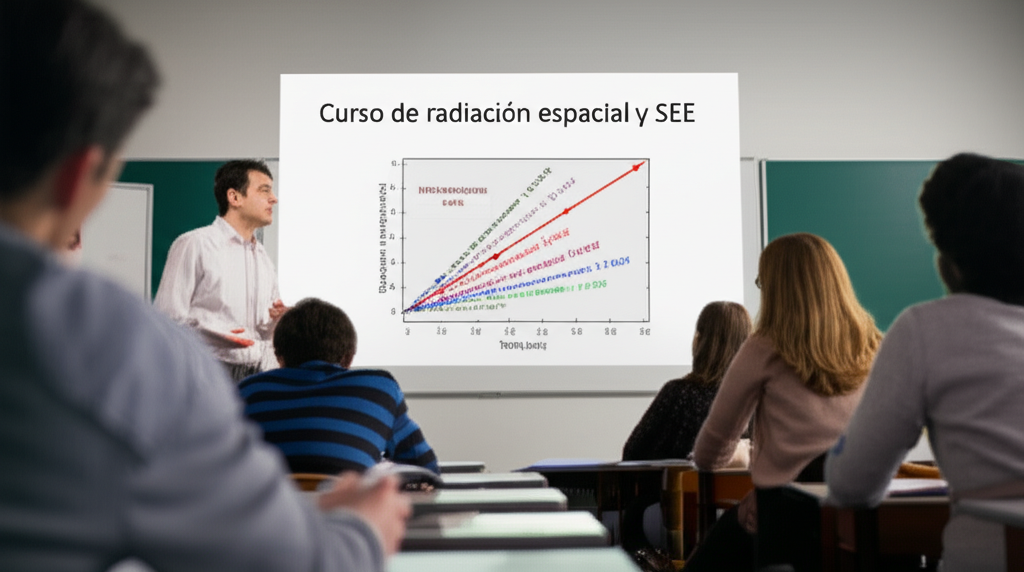
The Space Radiation and SEE Course explores the effects of space radiation on electronic components and systems. It focuses on understanding radiation damage mechanisms, such as total dose effects, single event effects (SEE), and total ionizing dose (TID). The course teaches analysis, simulation, and mitigation techniques, ranging from component selection to fault-tolerant system design. It covers industry standards and case studies relevant to space applications, such as satellites and space exploration. The program provides practical knowledge on the use of simulation tools and specialized software to assess the vulnerability and reliability of electronic systems in the space environment. It focuses on developing skills to design and test systems that operate reliably under high-radiation conditions, crucial for mission survival. The training prepares engineers and technicians for roles in the aerospace industry, defense, and space research.
Space Radiation and SEE Course
- Format: Hybrid
- Duration: 3 months
- Hours: 300 H
- Language: English / Spanish
- Registration date: 23-10-2026
- Start date: 12-12-2026
- Available places: 2
725 $
Competencies and results
What you will learn
1. Domain of Space Radiation and Effects on Electronics: SEE Course
- Understand the fundamentals of space radiation and its origins: charged particles, cosmic rays, and electromagnetic radiation.
- Identify the effects of space radiation on electronic components: degradation, failures, and transient effects.
- Analyze the interaction of radiation with semiconductor materials and how it affects their performance and reliability.
- Evaluate the different types of space radiation and their dose levels in different environments (low Earth orbit, geostationary orbit, interplanetary space).
- Apply modeling and simulation techniques to predict the behavior of electronic systems in radiation environments.
- Design and select radiation-resistant electronic components (rad-hard components and mitigation of effects).
- Implement radiation protection strategies, including shielding and design techniques.
- Use specialized tools and software for the analysis of space radiation and
- Evaluate the reliability of electronic systems.
- Interpret radiation test data and evaluate the performance of electronic systems in radiation environments.
- Understand the relevant regulations and standards for radiation protection in space applications.
2. Advanced Analysis of Space Radiation and SEE: A Comprehensive Course
- Understand the fundamentals of space radiation and its sources.
- Identify the effects of space radiation on electronic components and systems.
- Evaluate the space radiation environment and its variations.
- Analyze the interaction of radiation with matter and the mechanisms of damage.
- Study the effects of single-event exposures (SEEs) on devices and circuits.
- Learn about SEE mitigation and radiation hardening techniques.
- Become familiar with the relevant standards and regulations for space radiation and SEE.
- Use simulation and analysis tools to assess the impact of radiation.
- Apply design techniques to improve radiation resistance.
- Understand radiation testing and characterization.
3. Comprehensive user-oriented design and validation (from modeling to manufacturing)
You will learn to integrate the entire product development process, from initial model conception to final validation, applying user-centered methodologies. You will develop skills in parametric design, ergonomics, simulation, sustainable materials, 3D visualization, and manufacturing management, ensuring efficient, safe solutions that meet current industry standards.
4. Assessment and Mitigation of Space Radiation: SEE Course
4. Space Radiation Assessment and Mitigation: SEE Course
- Understand the fundamentals of space radiation and its sources: solar particles, galactic cosmic rays, and the Earth’s magnetosphere.
- Identify the effects of space radiation on electronic systems, materials, and living organisms.
- Evaluate the risks associated with space radiation in crewed and uncrewed space missions.
- Analyze space radiation modeling and simulation techniques.
- Design radiation mitigation strategies, including shielding, component selection, and mission management.
- Implement radiation protection measures for astronauts and space equipment.
- Become familiar with space industry regulations and standards related to radiation.
- Apply specialized tools and software for radiation assessment and mitigation space.
Study case studies of space missions and their challenges related to radiation.
Develop skills for planning and executing safe and radiation-protected space missions.
5. SEE Course: Impact of Space Radiation on Electronic Devices
5. SEE Course: Impact of Space Radiation on Electronic Devices
Understand the fundamentals of space radiation and its different components (protons, electrons, heavy ions, cosmic rays).
Identify the mechanisms of interaction between radiation and matter and the effects on electronic devices (ionization, atomic displacement, dose effects, Single Event Effects – SEE).
Analyze the effects of radiation on semiconductors, integrated circuits, memories, and other electronic components.
Evaluate the radiation sensitivity of different technologies and device designs.
Learn the testing methodologies and characterization of space radiation.
Understand the techniques of Radiation mitigation and protection (shielding, fault-tolerant design, component selection).
Apply simulation tools to study the impact of radiation on electronic devices.
Study the impact of radiation on complete space systems (satellites, probes, space stations).
Analyze the regulations and standards of the space industry related to radiation (ESA, NASA, etc.).
Develop strategies for component selection and the design of electronic systems resistant to space radiation.
6. In-depth Understanding of Space Radiation and SEE: Specialized Course
6. In-Depth Understanding of Space Radiation and SEE: Specialized Course
- Understand the fundamentals of space radiation: types of radiation, sources, and effects on electronic devices and systems.
- Analyze the Single Event Effect (SEE) phenomenon: understand the mechanisms of radiation interaction with matter and the effects on electronic components (SEU, SEL, SET, etc.).
- Evaluate the susceptibility of components to radiation and SEE: identification of critical components and risk analysis methodologies.
- Design radiation-resistant systems: mitigation strategies, component selection, circuit design, and shielding.
- Use simulation and analysis tools: SEE simulations and performance analysis in radiation environments.
- Interpret radiation test data and validate designs: irradiation tests, results analysis, and validation of system robustness.
- Understand the relevant regulations and standards: application of space regulations and rules related to radiation and the SEE.
- Apply knowledge to practical cases: case studies of space missions and electronic systems in radiation environments.
Who this program is for:
Space Radiation and SEE Course
- Graduates in Aerospace Engineering, Mechanical Engineering, Industrial Engineering, Automation Engineering, or related fields.
- Professionals in OEM rotorcraft/eVTOL, MRO, consulting, and technology centers.
- Flight Testing, certification, avionics, control, and dynamics seeking specialization.
- Regulators/authorities and UAM/eVTOL professionals requiring compliance skills.
Recommended requirements: foundation in aerodynamics and control and structures; ES/EN B2+/C1. We offer bridging tracks if you need them.
- Standards-driven curriculum: you will work with CS-27/CS-29, DO-160, DO-178C/DO-254, ARP4754A/ARP4761, ADS-33E-PRF from the first module.
- Accreditable laboratories (EN ISO/IEC 17025) with rotor bench, EMC/Lightning pre-compliance, HIL/SIL, vibrations/acoustics.
- Evidence-oriented TFM: safety case, test plan, compliance dossierand operational limits.
- Mentored by industry: teachers with experience in rotorcraft, tiltrotor, eVTOL/UAM and flight test.
- Flexible modality (hybrid/online), international cohorts and support from SEIUM Career Services.
- Ethics and security: safety-by-design approach, cyber-OT, DIH and compliance as pillars.
1.1 Origin and Nature of Space Radiation
1.2 Types of Particles and Radiation Sources
1.3 Interaction of Radiation with Matter
1.4 Effects of Radiation on Electronic Devices
1.5 Single Event Effects (SEE) Mechanisms: SEU, SEL, SET
1.6 Basic Concepts of SEE and Their Impact on Reliability
1.7 Introduction to SEE Detection Techniques
1.8 Space Radiation Simulation Methodologies
1.9 Regulations and Standards Related to Space Radiation
1.10 Applications of Space Radiation in Naval Environments: Introduction
2.2 Fundamentals of Space Radiation: Types and Sources
2.2 Interaction of Radiation with Matter: Key Mechanisms
2.3 Effects of Radiation on Electronic Components: SEE and Damage
2.4 Design of Radiation-Resistant Circuits: Strategies
2.5 Radiation Testing: Methodology and Results Analysis
2.6 Modeling and Simulation of SEE: Tools and Techniques
2.7 Naval Applications of Electronics: High-Risk Environments
2.8 Regulations and Standards: Radiation Defense
2.9 Mitigation of Effects: Shielding and Tolerant Design
2.20 Case Studies: Failures and Solutions in Naval Systems
3.3 Sources of Space Radiation: Sun, cosmic rays, radiation belts
3.2 Types of Space Radiation Effects: Space Exposure Effects (SEE), cumulative effects
3.3 Modeling Space Radiation: Environments and simulations
3.4 SEE Mechanisms: Particle-matter interactions in semiconductors
3.5 Electronic Devices and Their Susceptibility: Design factors
3.6 SEE Analysis Techniques: Simulation and experiments
3.7 Design for Radiation Tolerance: Redundancy and shielding
3.8 SEE Testing: Methodologies and standards
3.9 SEE Mitigation: Component selection and protection
3.30 Naval Applications: Electronic systems in space environments
4.4 Fundamentals of Space Radiation: Introduction to Key Concepts
4.2 Sources of Space Radiation: Threat Analysis
4.3 Single Event Effects (SEE) Mechanisms: How Radiation Affects Electronics
4.4 Radiation Modeling and Simulation: Tools and Techniques
4.5 SEE Assessment Techniques: Methodologies and Tests
4.6 Radiation-Tolerant Design: Mitigation Strategies
4.7 Component Selection: Criteria and Considerations
4.8 System Design Evaluation: Vulnerability Analysis
4.9 Impact on Naval Systems: Applications and Challenges
4.40 Case Studies: Experiences and Best Practices
5.5 Introduction to Space Radiation and its Components
5.5 Interactions of Space Radiation with Matter
5.3 Effects of Singular Energy Events (SEEs) on Electronic Devices
5.4 SEE Mechanisms: Single Event Upsets (SEUs), Single Event Latch-up (SELs), Single Event Burnout (SEBs), Single Event Gate Rupture (SEGRs)
5.5 SEE Modeling and Simulation
5.6 Design of Radiation-Resistant Electronic Systems
5.7 SEE Testing and Device Characterization
5.8 SEE Mitigation: Techniques and Strategies
5.9 SEE Applications in Naval Environments
5.50 Trends and Future of Space Radiation and SEE Research
6.6 Fundamental Concepts of Space Radiation
6.2 Mechanisms of SEE (Single Event Effects)
6.3 Sources of Space Radiation and Their Characterization
6.4 Impact of Radiation on Electronic Devices
6.5 SEE Vulnerability Analysis
6.6 SEE Mitigation Techniques
6.7 Design of Radiation-Tolerant Electronic Systems
6.8 Testing and Validation of Systems under SEE
6.9 Applications in Naval Environments
6.60 Future Trends in SEE Research
- Hands-on methodology: test-before-you-trust, design reviews, failure analysis, compliance evidence.
- Software (depending on licenses/partners): MATLAB/Simulink, Python (NumPy/SciPy), OpenVSP, SU2/OpenFOAM, Nastran/Abaqus, AMESim/Modelica, acoustics tools, planning toolchains DO-178C.
- SEIUM Laboratories: scale rotor bench, vibrations/acoustics, EMC/Lightning pre-compliance, HIL/SIL for AFCS, data acquisition with strain gauging.
- Standards and compliance: EN 9100, 17025, ISO 27001, GDPR.
Capstone-type projects
- SEE Naval Electronics: Design and simulation of electronic systems resilient to space radiation.
“`
- SEE Analysis on Naval Platforms: Design of electronic systems resilient to space radiation, considering SEE courses.
- SEE Assessment and Mitigation: Implementation of course-based strategies, including analysis and mitigation design for naval environments.
- SEE Impact on Devices: Study of the effect of radiation, correlating it with courses and their applications.
“
“`html
- SEE Analysis in Naval Electronics: Vulnerability assessment and mitigation in systems, including resilient circuit design and simulation testing for courses 1, 2, 3, 4, 5, 6, 7, and 8.
“
- SEE Shielding: Design and simulation of radiation protection for naval electronic components.
- SEE Analysis: Modeling and simulation of the impact of space radiation on onboard systems.
- SEE Mitigation: Strategies and techniques for reducing SEE effects on naval equipment.
- SEE Testing: Design and implementation of radiation testing on electronic devices.
Admissions, fees, and scholarships
- Profile: Background in Computer Engineering, Mathematics, Statistics, or related fields; practical experience in NLP and valued information retrieval systems.
- Documentation: Updated CV, academic transcript, SOP/statement of purpose, project examples or code (optional).
- Process: Application → Technical evaluation of profile and experience → Technical interview → Review of case studies → Final decision → Enrollment.
- Fees:
- Single payment: 10% discount.
- Payment in 3 installments: No fees; 30% upon registration + 2 equal monthly payments of the remaining 35%.
Monthly payment: available with a 7% commission on the total; annual review.
Scholarships: based on academic merit, financial need, and promoting inclusion; agreements with companies in the sector for partial or full scholarships.
See “Calendar & Calls for Applications,” “Scholarships & Grants,” and “Fees & Financing” in the SEIUM mega-menu.
Do you have any questions?
Our team is ready to help you. Contact us, and we will respond as soon as possible.
F. A. Q
Frequently asked questions
Yes, we have international certification
Yes: experimental models, real data, applied simulations, professional environments, real case studies.
It is not mandatory. We offer leveling tracks and tutoring.
Completely. It covers e-propulsion, integration, and emerging regulations (SC-VTOL).
Recommended. There are also internal challenges and consortiums.
Yes. Online/hybrid modality with planned labs and visa support (see “Visa & Residence”).