

Solar park inspection course with UAV
About our
The Solar Park Inspection with UAVs course trains participants in the use of drones for solar panel inspection, efficiently identifying faults and anomalies. It covers everything from flight planning to data analysis obtained using thermal and visual cameras, optimizing predictive maintenance. Current legislation and the use of specialized software to generate detailed reports and improve the energy efficiency of the installations are also addressed.
The course provides practical skills for the early detection of defects, such as hot spots and shadows, which affect the performance of solar parks. It focuses on image processing and data interpretation, enabling participants to make informed decisions about the repair and optimization of systems. Hands-on practice with equipped drones and analysis software is included for comprehensive training.
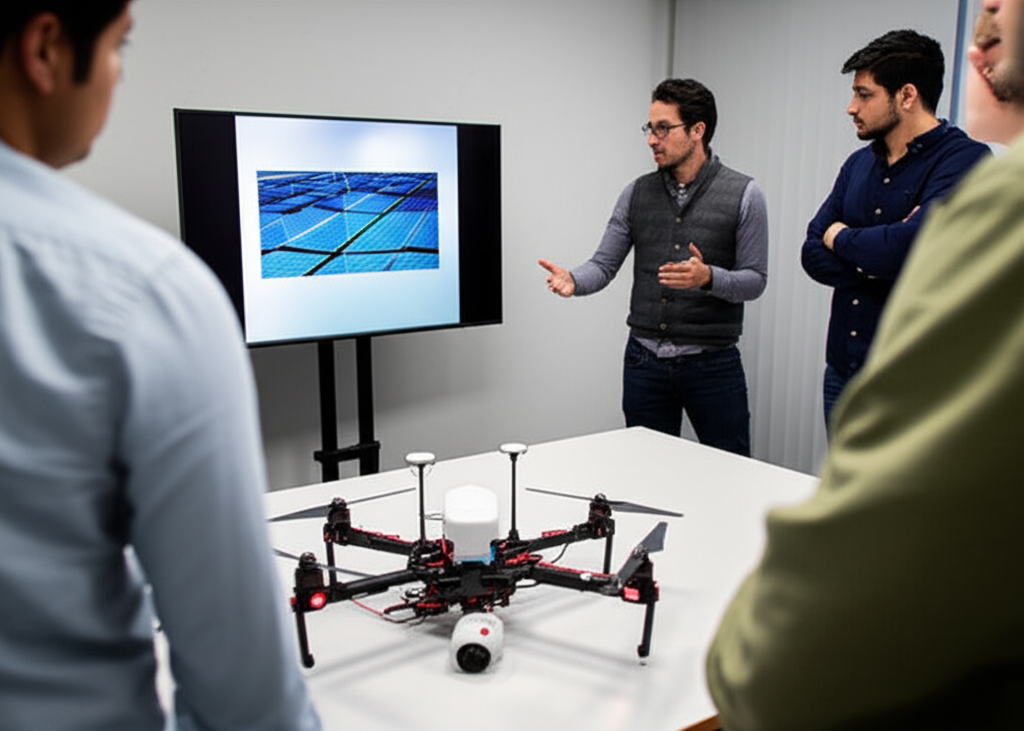
Solar park inspection course with UAV
- Format: Hybrid
- Duration: 3 months
- Hours: 300 H
- Language: English / Spanish
- Registration date: 23-10-2026
- Start date: 12-12-2026
- Available places: 2
550 $
Competencies and results
What you will learn
1. Inspection, Analysis and Predictive Maintenance of Solar Parks with Drones
Here is the requested content:
-
Identify and evaluate inspection and analysis techniques applied to solar farms using drones, including data collection and processing.
-
Understand the principles of predictive maintenance in solar farms, including identifying potential failures and scheduling interventions.
-
Learn to use drones equipped with different sensors (thermal, RGB, multispectral) for inspecting solar panels, inverters, and other farm components.
-
Analyze the data collected by the drones, identifying anomalies, failures, and trends that indicate the need for maintenance.
-
Master the use of specialized software for image and thermal data analysis, report generation, and solar farm information management.
-
Apply predictive maintenance techniques, such as vibration analysis and oil analysis, to monitor the condition of solar park equipment.
-
Learn to develop a predictive maintenance plan for a solar park, including scheduling inspections, identifying necessary resources, and managing costs.
-
Understand the relevant regulations and standards for solar park inspection and maintenance, as well as best safety practices.
-
Gain knowledge of emerging technologies in solar park inspection and maintenance, such as artificial intelligence and machine learning.
1. Aerial Analysis of Solar Installations: Fault Detection and Performance Optimization with UAVs
-
Identify and analyze faults in solar panels using high-resolution aerial images captured by drones (UAVs).
-
Learn to optimize the efficiency of solar plants by accurately identifying underperforming areas and implementing improvement strategies.
-
Become familiar with the safe handling and operation of UAVs, including flight planning, data acquisition, and compliance with applicable regulations.
-
Use specialized software for processing and analyzing aerial data, generating detailed reports on the condition of solar installations.
-
Understand the principles of solar energy and how it works, as well as the factors that influence the performance of solar panels.
Master thermography and spectral analysis techniques to detect hot spots, faulty connections, and other problems that affect the performance of solar installations.
Develop skills in data interpretation and decision-making based on information obtained through aerial analysis.
Learn best practices for the maintenance and repair of solar installations, using information provided by UAVs.
Explore the latest trends and technologies in the field of aerial analysis of solar installations, including the use of artificial intelligence and machine learning.
Acquire knowledge of the legislation and regulations relevant to the use of drones in the energy sector and the inspection of solar installations.
3. Comprehensive user-oriented design and validation (from modeling to manufacturing)
You will learn to integrate the entire product development process, from initial model conception to final validation, applying user-centered methodologies. You will develop skills in parametric design, ergonomics, simulation, sustainable materials, 3D visualization, and manufacturing management, ensuring efficient, safe solutions that meet current industry standards.
4. Defect Detection in Solar Panels: Drone Inspection to Optimize Energy Production
4. Solar Panel Defect Detection: Drone Inspection to Optimize Energy Production
Understand the operation and key technologies of solar panels.
Identify common types of defects in solar panels, such as broken cells, hot spots, LID/PID degradation, and faulty connections.
Master drone inspection techniques, including flight planning, thermal and visual image capture, and data processing.
Analyze the collected images and data to accurately detect and locate defects.
Use specialized software for thermal image analysis and report generation.
Evaluate the severity of defects and their impact on energy production.
Learn how to optimize drone configuration and flight parameters for maximum inspection efficiency.
Understand the Regulations and standards applicable to the inspection of solar panels with drones.
Develop strategies for the repair and maintenance of damaged solar panels.
Optimize solar energy production through early detection and prevention of failures.
5. Performance Evaluation and Fault Detection in Solar Parks Using Aerial Inspection with UAVs
## What Will You Learn?
1. Identify and analyze critical components of solar farms susceptible to failure, using UAV aerial inspection technology.
2. Master the techniques for planning and executing UAV flights for solar farm inspection, including defining flight paths, selecting sensors, and calibrating equipment.
3. Interpret data collected by UAVs, such as thermal images, visual data, and other sensor data, to detect anomalies and failures in solar components.
4. Apply solar farm performance evaluation methods based on data obtained through aerial inspection, identifying areas of low efficiency and energy losses.
5. Understand the fundamentals of thermography and other fault detection techniques using UAVs, and apply them to identify problems in solar panels, electrical connections, and other components.
6. Analyze the root causes of failures detected in solar farms, including factors such as material aging, wear, and environmental conditions.
7. Develop predictive and corrective maintenance strategies based on information obtained through UAV aerial inspections, optimizing the efficiency and lifespan of solar farms.
8. Become familiar with the regulations and standards applicable to UAV operation in the context of solar farm inspections, ensuring legal compliance and safety.
9. Use specialized software for UAV data analysis, report generation, and visualization of inspection results.
10. Implement an asset management system for the solar farm, based on the findings of UAV aerial inspections, to improve decision-making and optimize performance.
6. Inspection and Data Analysis of Solar Parks: Use of Drones for Evaluation and Maintenance
6. Solar Park Inspection and Data Analysis: Using Drones for Evaluation and Maintenance
Fundamentals of drone technology and its application in solar park inspection.
Planning and execution of drone flights for data acquisition: routes, altitudes, and image overlay.
Types of sensors used in drones for solar inspection: RGB, thermal, and multispectral cameras.
Image processing and analysis: orthomosaics, digital surface models (DSMs), and digital terrain models (DTMs).
Detection of anomalies and failures in solar panels: identification of hot spots, shadows, dirt, and physical damage.
Estimation of solar panel efficiency and performance using drone data.
Predictive maintenance techniques based on drone data.
Software and data analysis tools for solar farm inspection.
Interpreting reports and generating recommendations for performance optimization and maintenance cost reduction.
Safety and regulatory considerations for drone operation in solar farms.
Who this program is for:
Solar park inspection course with UAV
- Engineers with degrees in Aerospace, Mechanical, Industrial, Electrical, or related fields.
- Technicians and professionals from companies dedicated to solar energy, interested in drone inspection.
- Drone (UAV) operators who wish to expand their knowledge and specialize in solar inspection.
- Professionals from inspection companies, energy consulting, or solar park maintenance.
Recommended requirements: Basic drone flight experience and knowledge of solar energy.
- Standards-driven curriculum: you will work with CS-27/CS-29, DO-160, DO-178C/DO-254, ARP4754A/ARP4761, ADS-33E-PRF from the first module.
- Accreditable laboratories (EN ISO/IEC 17025) with rotor bench, EMC/Lightning pre-compliance, HIL/SIL, vibrations/acoustics.
- Evidence-oriented TFM: safety case, test plan, compliance dossierand operational limits.
- Mentored by industry: teachers with experience in rotorcraft, tiltrotor, eVTOL/UAM and flight test.
- Flexible modality (hybrid/online), international cohorts and support from SEIUM Career Services.
- Ethics and security: safety-by-design approach, cyber-OT, DIH and compliance as pillars.
Module 1 — Introduction to Drones and Regulations for Solar Inspection
1.1 Introduction to drones and their application in solar energy
1.2 Types of drones and their sensors: thermal, RGB, and multispectral cameras
1.3 Legislation and regulations for drone flights in solar inspections
1.4 Safety in drone operations and risk management
1.5 Flight planning: routes, areas of interest, and parameters
1.6 Flight planning and drone control software
1.7 Getting started with image capture: configuration and calibration
1.8 Introduction to data analysis: thermography, anomaly identification
1.9 Practical case studies and success stories
1.10 Final considerations and next steps in the course
2.2 Selecting Drones and Sensors for Solar Inspection
2.2 Configuring and Calibrating Drones for Inspection Flights
2.3 Planning Autonomous Flights for Solar Farms
2.4 Flight Techniques for Efficient Data Capture
2.5 Safety in Drone Operations in Solar Environments
2.6 Legislation and Regulations on the Use of Drones in Solar Inspection
2.7 Types of Data Collected: RGB, Thermography, Multispectral
2.8 Flight Control and Data Processing Software
2.9 Getting Started with Data Capture and Review
2.20 Best Practices and Tips for Drone Inspection
3.3 Legal Framework and Regulations for Drones: Flight regulations, licenses, and permits.
3.2 Drone Components and Operation: Structure, flight systems, and types of drones.
3.3 Safety in Drone Operations: Protocols, safety zones, and risk prevention.
3.4 Meteorology for Drone Pilots: Interpreting forecasts and weather effects.
3.5 Navigation and Flight Planning: Route design, points of interest, and planning software.
3.6 First Aid and Safety: Basic knowledge and emergency management.
3.7 Photogrammetry and Sensors: Principles, cameras, and sensors for solar inspection.
3.8 Data Acquisition and Processing: Image capture and basic processing.
3.9 Basic Drone Maintenance: Equipment inspection, repair, and care. 3.30 Ethics and Responsibility: Proper use of drones and compliance with regulations.
4.4 Introduction to Drone Inspection: Fundamentals of thermography and photogrammetry applied to solar panels.
4.2 Types of Drones and Sensors: Selecting the appropriate equipment for solar inspection (thermal, RGB, and multispectral cameras).
4.3 Flight Planning for Solar Inspection: Route design, safety considerations, and regulatory compliance.
4.4 Data Capture and Processing: Obtaining thermal and visual images, processing techniques, and calibration.
4.5 Detection of Common Defects: Identifying hot spots, microcracks, faulty connections, and other problems.
4.6 Thermal Data Analysis: Interpreting thermal anomalies, evaluating the severity of defects, and assessing their impact on production.
4.7 Analysis and Reporting Software: Using tools for data analysis, report generation, and documentation. 4.8 Predictive and Preventive Maintenance: Strategies for optimizing the performance and lifespan of solar panels.
4.9 Case Studies: Analysis of real-world examples of drone inspections and their results.
4.40 Legislation and Regulations: Legal and regulatory aspects related to the use of drones in solar inspection.
5.5 Introduction to Aerial Inspection of Solar Plants with Drones
5.5 Fundamentals of Infrared Thermography for Fault Detection
5.3 Safe Operation and Flight of Drones in Solar Environments
5.4 Data Capture and Processing: Thermographic Images and Data
5.5 Data Analysis: Identifying Anomalies and Faults in Solar Panels
5.6 Optimizing Solar Performance: Improvement Strategies
5.7 Predictive Maintenance: Scheduling and Planning Inspections
5.8 Analysis and Reporting Software: Generating Detailed Reports
5.9 Standards and Regulations: Legal Compliance in Solar Inspection with Drones
5.50 Case Studies: Practical Applications and Results Obtained
6.6 Aerial Data Collection: Sensors and UAV Platforms
6.2 Image Processing Software: From Image to Analysis
6.3 Thermal Data Analysis: Anomaly Identification
6.4 Visual Data Analysis: Detailed Panel Inspection
6.5 Data Integration: Combining Information for Comprehensive Analysis
6.6 Reporting and Documentation: Creating Accurate Technical Reports
6.7 Predictive Maintenance: Data-Driven Strategies
6.8 Performance Optimization: Improving Plant Efficiency
6.9 Legislation and Regulations: Regulatory Compliance in Inspections
6.60 Case Studies: Analysis of Real-World Case Studies
- Hands-on methodology: test-before-you-trust, design reviews, failure analysis, compliance evidence.
- Software (depending on licenses/partners): MATLAB/Simulink, Python (NumPy/SciPy), OpenVSP, SU2/OpenFOAM, Nastran/Abaqus, AMESim/Modelica, acoustics tools, planning toolchains DO-178C.
- SEIUM Laboratories: scale rotor bench, vibrations/acoustics, EMC/Lightning pre-compliance, HIL/SIL for AFCS, data acquisition with strain gauging.
- Standards and compliance: EN 9100, 17025, ISO 27001, GDPR.
Capstone-type projects
- Fault Detection: Thermography, data analysis; performance optimization.
- UAV Inspection: Flight planning, image capture, data analysis.
- Predictive Maintenance: Anomaly identification, asset management.
- Energy Optimization: Efficiency assessment, improvement proposals.
- Drone Inspection: Acquisition of thermographic and visual data in solar parks.
- Data Analysis: Detection of anomalies and failures in solar panels.
- Predictive Maintenance: Generation of reports and optimization strategies.
- Performance Optimization: Improvement of energy production and reduction of costs.
- Solar Inspection with Drones: Thermal mapping, fault detection (hotspots, degradation).
- Data Analysis: Processing software, performance reports, optimization.
- Predictive Maintenance: Planning, cost reduction, increased efficiency.
- Plant Evaluation: Diagnostics, anomaly analysis, lifespan.
- Solar Inspection with Drones: Thermography, data analysis, fault detection, and performance optimization.
Admissions, fees, and scholarships
- Profile: Background in Computer Engineering, Mathematics, Statistics, or related fields; practical experience in NLP and valued information retrieval systems.
- Documentation: Updated CV, academic transcript, SOP/statement of purpose, project examples or code (optional).
- Process: Application → Technical evaluation of profile and experience → Technical interview → Review of case studies → Final decision → Enrollment.
- Fees:
- Single payment: 10% discount.
- Payment in 3 installments: No fees; 30% upon registration + 2 equal monthly payments of the remaining 35%.
Monthly payment: available with a 7% commission on the total; annual review.
Scholarships: based on academic merit, financial need, and promoting inclusion; agreements with companies in the sector for partial or full scholarships.
See “Calendar & Calls for Applications,” “Scholarships & Grants,” and “Fees & Financing” in the SEIUM mega-menu.
Do you have any questions?
Our team is ready to help you. Contact us, and we will respond as soon as possible.
F. A. Q
Frequently asked questions
Yes, we have international certification
Yes: experimental models, real data, applied simulations, professional environments, real case studies.
It is not mandatory. We offer leveling tracks and tutoring.
Completely. It covers e-propulsion, integration, and emerging regulations (SC-VTOL).
Recommended. There are also internal challenges and consortiums.
Yes. Online/hybrid modality with planned labs and visa support (see “Visa & Residence”).