

PX4 and Ardupilot Autopilot Course
About our
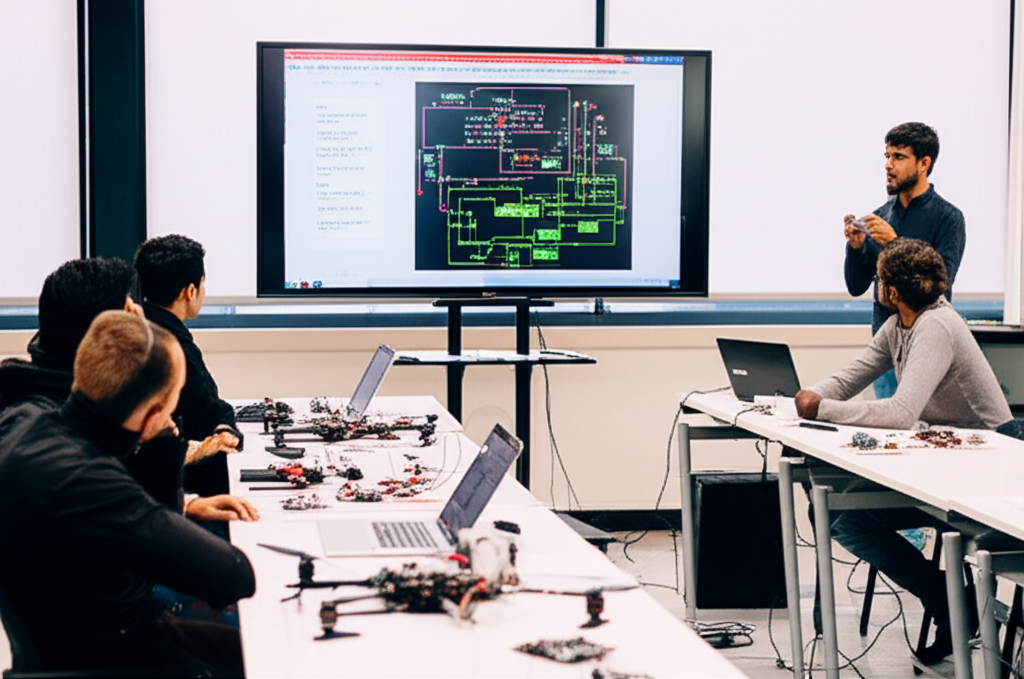
The PX4 and ArduPilot Autopilot Course offers comprehensive training in the development, configuration, and operation of open-source software-based flight control systems. It focuses on hands-on learning of PX4 and ArduPilot, including sensor configuration, component calibration, and autonomous mission programming. The course covers key aspects such as flight control, kinematics, dynamics, and GPS navigation systems, equipping participants to use drones and unmanned aerial vehicles (UAVs) in various applications.
Hardware and software integration, as well as flight simulation, are explored. Students will learn to customize and optimize autopilot systems for different types of aircraft. The course offers a solid foundation for those interested in the research, development, and application of autonomous systems in the drone and aerial robotics industry, preparing them for professional roles such as flight engineers, UAV specialists, and flight control software developers.
PX4 and Ardupilot Autopilot Course
- Format: Hybrid
- Duration: 3 months
- Hours: 300 H
- Language: English / Spanish
- Registration date: 23-10-2026
- Start date: 12-12-2026
- Available places: 3
550 $
Competencies and results
What you will learn
1. In-Depth Mastery of PX4 and ArduPilot Autopilot Systems: Design, Configuration, and Expert Autonomous Flight
Here is the requested content:
1. In-Depth Mastery of PX4 and ArduPilot Autopilot Systems: Design, Configuration, and Expert Autonomous Flight
Fundamentals of PX4 and ArduPilot autopilot systems: architecture, components, and data flows.
Advanced hardware and software configuration: sensor selection and calibration (IMU, GPS, barometer, etc.).
Control system design: PID tuning, filters, and attitude and navigation control algorithms.
Complex mission planning: waypoints, geofences, events, and Lua scripting.
Firmware integration and customization: modification and extension of the PX4 and ArduPilot source code.
Advanced autonomous flight: automatic takeoff and landing techniques, obstacle avoidance, and object tracking.
Simulation and testing in virtual environments: use of Gazebo and SITL/HITL for development and validation.
Troubleshooting and system diagnostics: log analysis, error identification, and correction.
Implementation of safety systems: failsafes, redundancy, and fault protection.
Development of specific applications: adaptation of systems to particular platforms and payloads.
Translated with DeepL.com (free version)
2. Comprehensive Exploration of PX4 and ArduPilot Autopilots: From Fundamental Concepts to Advanced Implementation and Autonomous Flight
Here is the requested content:
2. Comprehensive Exploration of PX4 and ArduPilot Autopilots: From Fundamental Concepts to Advanced Implementation and Autonomous Flight
Understand the architecture of the PX4 and ArduPilot autopilot systems, including their hardware and software components.
Configure and calibrate key sensors (IMU, GPS, barometer, etc.) for optimal data acquisition.
Delve into the different available flight modes (stabilized, altitude, position, autonomous, etc.) and their applications.
Master the programming and configuration of autonomous flight missions using GCS (Ground Control Station) software such as QGroundControl and Mission Planner.
Learn about the most common communication protocols (MAVLink) and their implementation for telemetry and control.
Customize and extend the functionality of autopilots by modifying the source code (C++).
Implement PID control systems and optimize their parameters to achieve stable and precise flight performance.
Explore flight simulation techniques (Gazebo, SITL) to test and develop new features.
Analyze and troubleshoot common issues related to drone flight and autopilot configuration.
Study navigation and control strategies for complex flight scenarios, including obstacle avoidance and target tracking.
3. Comprehensive user-centered design and validation (from modeling to manufacturing)
You will learn to integrate the entire product development process—from model conception to final validation—using user-centered methodologies. You will develop skills in parametric design, ergonomics, simulation, sustainable materials, 3D visualization, and manufacturing management, ensuring efficient and safe solutions that are aligned with current industry standards.
4. Developing Expertise in PX4 and ArduPilot Autopilots: Design, Calibration, Programming, and Flying Advanced Drones
4. Developing Expertise in PX4 and ArduPilot Autopilots: Design, Calibration, Programming, and Flying Advanced Drones
Autopilot Fundamentals: Understanding the architecture of PX4 and ArduPilot, including sensors, actuators, and control logic.
Hardware Design and Selection: Choosing the right components (flight controllers, motors, ESCs, propellers, batteries) for different types of drones and specific applications.
Advanced Calibration: Mastering the precise calibration of sensors (IMU, gyroscopes, accelerometers, magnetometers, barometers, GPS) to ensure accurate data and optimal performance.
Parameter Configuration: Adjusting flight parameters (PID, gains, filters) to optimize stability, response, and flight behavior under various conditions.
Programming and Customization: Modify and extend the PX4 and ArduPilot firmware to create custom features, including programming flight modes, control algorithms, and behavior logic.
Autonomous Flight: Configure and program autonomous flight missions using waypoints, predefined routes, and advanced navigation functions.
Flight Control Systems: Delve into control algorithms, including attitude control, position control, and trajectory control.
Sensor and Peripheral Integration: Connect and integrate additional sensors (cameras, LiDAR, optical flow sensors, etc.) to expand the drone’s capabilities.
Simulation and Testing: Use flight simulators (Gazebo, SITL) to safely and efficiently test and optimize configurations, algorithms, and flight missions.
Troubleshooting and Diagnostics: Identify and resolve common flight issues, including sensor failures, control errors, and communication problems.
Aviation Safety: Apply safety best practices, including compliance with local regulations, risk management, and safe flight planning.
Advanced Applications: Explore advanced drone applications, such as photogrammetry, inspection, precision agriculture, and 3D mapping.
Software Development: Develop skills in using development tools (QGroundControl, Mission Planner, etc.) and programming in languages such as C++ and Python.
5. Mastering PX4 and ArduPilot Autopilots: Configuration, Programming, and Optimization for Professional Autonomous Flight
Here’s what you’ll learn:
Fundamentals of Aircraft Control Systems: An in-depth look at control theory, including an understanding of flight models, aircraft dynamics, and stability.
Introduction to PX4 and ArduPilot: A detailed exploration of the PX4 and ArduPilot software architectures, their differences, advantages, and disadvantages.
Advanced Hardware Configuration: Selection and configuration of critical hardware components (sensors, IMUs, GPS, radios) to optimize autonomous flight performance.
Autonomous Flight Programming with PX4 and ArduPilot: Development of programming skills in environments specific to both systems, including the use of scripting and the development of complex missions.
Firmware Customization and Adaptation: Modification and adaptation of PX4 and ArduPilot firmware to meet specific project and platform requirements.
Performance Optimization: Advanced techniques to optimize control response, GPS accuracy, and energy efficiency to maximize flight endurance and performance.
Simulation and Testing: Use of flight simulators (such as Gazebo and AirSim) to test and validate configurations, algorithms, and missions in a controlled environment prior to real-world deployment.
Sensor and Peripheral Integration: Integration of specialized sensors (cameras, LiDAR, etc.) and peripherals to expand the capabilities of drones and autonomous systems.
Analysis and Troubleshooting: Tools and methodologies for analyzing flight logs, identifying issues, and troubleshooting faults in autonomous systems.
Safety and Best Practices: Implementation of safety protocols, risk management, and regulatory compliance to ensure safe and compliant autonomous flight operations.
6. Expert Drone Optimization with PX4 and ArduPilot: Advanced Configuration, Autonomous Flight, and Professional-Grade Performance
6. **Expert Drone Optimization with PX4 and ArduPilot: Advanced Configuration, Autonomous Flight, and Professional Performance**
* In-depth mastery of the PX4 and ArduPilot software architectures: You’ll understand their modular structure, task management, and data flow.
* Expert configuration of sensors and peripherals: You’ll master the precise calibration of IMUs, GPS, barometers, and other sensors critical for stable and accurate flight.
* Advanced implementation of autonomous flight modes: You’ll learn to configure complex missions with waypoints, geofences, RTL (Return to Launch), and automated landing modes.
* Flight Performance Optimization: You’ll adjust PID parameters to achieve optimal flight control response, minimizing vibrations and improving stability.
* Development of custom control algorithms: You will explore modifying and adapting existing control algorithms, or creating new algorithms for specific applications.
* Integration of vision and perception systems: You will learn to integrate cameras, LiDAR sensors, and other perception systems to enable vision-based navigation and obstacle avoidance.
* Flight data analysis and debugging: You’ll master the analysis of flight logs to identify performance issues, diagnose failures, and optimize settings.
* Implementation of safety and redundancy systems: You’ll understand the importance of safety in drone flight and learn how to implement redundancy systems to ensure reliability.
* Configuration and tuning of telemetry and communication systems: You’ll learn how to configure telemetry systems to monitor the drone’s status in real time and establish secure and reliable communications.
* Optimization of power consumption and flight endurance: You’ll learn how to optimize power consumption to maximize flight endurance.
Who this program is for:
PX4 and Ardupilot Autopilot Course
Engineers with degrees in aerospace, mechanical, industrial, automation, or related fields.
Experts in rotorcraft/eVTOL OEMs, MRO, technical consulting, or employees of research centers.
Specialists in flight testing, aviation certification, avionics systems, flight control, and aircraft dynamics.
Professionals from regulatory bodies, aviation authorities, and those involved in UAM/eVTOL development who are interested in regulatory compliance.
Recommended requirements: Solid knowledge of aerodynamics, control theory, and aircraft structures. Proficiency in Spanish or English at the B2+/C1 level. Bridging tracks are provided to address any potential knowledge gaps.
- Standards-driven curriculum: You will work with CS-27/CS-29, DO-160, DO-178C/DO-254, ARP4754A/ARP4761, and ADS-33E-PRF starting in the first module.
- Accredited laboratories (EN ISO/IEC 17025) featuring a rotor test stand, EMC/Lightning pre-compliance testing, HIL/SIL, and vibration/acoustics testing.
- Evidence-based Master’s thesis: safety case, test plan, compliance dossier, and operational limits.
- Industry-led mentorship: faculty with experience in rotorcraft, tiltrotor, eVTOL/UAM, and flight testing.
- Flexible format (hybrid/online), international cohorts, and support from SEIUM Career Services.
- Ethics and safety: a “safety-by-design” approach, cyber-OT, DIH, and compliance as cornerstones.
1.1. The Concept of Autopilot and Differences Between Manual, Stabilized, Assisted, Autonomous, and Programmed-Mission Control
1.2. Types of compatible vehicles: multirotors, fixed-wing aircraft, VTOLs, rovers, unmanned vessels, and experimental platforms
1.3. General architecture of an unmanned system: flight controller, sensors, actuators, power, radio, telemetry, and ground station
1.4. Differences between PX4 and ArduPilot in terms of design philosophy, ecosystem, configuration, compatibility, and common applications
1.5. Flight modes, basic safety, failsafes, geofences, automatic return, and mission control
1.6. A systems-based approach to the autopilot as an integration of hardware, firmware, sensors, communications, control, and safe operation
2.1. Flight controllers, GPS, compass, IMU, barometer, RC receivers, telemetry modules, and power systems
2.2. Physical installation, controller orientation, vibration isolation, wiring, connectors, and secure mounting
2.3. Initial configuration in Mission Planner, QGroundControl, or other compatible ground stations
2.4. Calibration of accelerometers, compass, radio, ESCs, speed sensors, leveling, and basic parameters
2.5. Configuration of motors, servos, PWM outputs, digital protocols, and actuator testing
2.6. Building a reliable system that minimizes sensor errors, control failures, and safety issues
3.1. Fundamentals of parameterization and differences between critical parameters, adjustment parameters, safety parameters, and mission parameters
3.2. Flight modes for multirotors, fixed-wing aircraft, VTOLs, rovers, and unmanned maritime vehicles
3.3. Mission planning using waypoints, speeds, altitudes, actions, conditions, and special commands
3.4. Configuring failsafes for battery, radio, GPS, geofence, telemetry loss, and navigation errors
3.5. Autonomous navigation, return-to-home, automatic landing, loitering, route tracking, and mission control
3.6. Designing safe, verifiable missions tailored to the vehicle, environment, and operational objective
4.1. Fundamentals of flight control and the relationship between stability, attitude, speed, position, and vehicle response
4.2. Basic tuning of PID, filters, vibrations, motor response, and dynamic system behavior
4.3. Real-time telemetry, data links, radios, Wi-Fi, LTE, MAVLink, and ground station monitoring
4.4. Log analysis to identify vibrations, GPS errors, power failures, control saturation, and sensor issues
4.5. Diagnosis of abnormal behaviors: oscillations, drift, altitude loss, poor return, and erratic response
4.6. Development of tuning criteria and analysis methods to improve stability, safety, and operational performance
5.1. Integration of cameras, gimbals, LiDAR sensors, sonar, RTK, environmental sensors, and specialized payloads
5.2. Use of companion computers, MAVLink, ROS, scripts, APIs, and communication with external systems
5.3. Applications in photogrammetry, inspection, agriculture, surveillance, rescue, maritime operations, research, and mobile robotics
5.4. Advanced automation through smart missions, triggers, events, payload control, and synchronized data capture
5.5. Integration safety: power consumption, interference, weight, balance, wiring, compatibility, and preliminary testing
5.6. Building expandable autonomous platforms using sensors, external software, and mission-oriented payloads
6.1. Case Definition: Multirotor drone, fixed-wing aircraft, rover, USV, VTOL, or experimental autonomous platform
6.2. Selection of hardware, sensors, firmware, ground station, communications, and vehicle architecture
6.3. Initial configuration, calibration, operating modes, failsafes, geofence, and key parameters
6.4. Autonomous mission design with waypoints, actions, safety criteria, telemetry, and contingency plan
6.5. Log analysis, behavior diagnostics, basic adjustments, and validation of system performance
6.6. Final project presentation including technical, operational, and safety justification for the configured platform
- Hands-on methodology: test-before-you-trust, design reviews, failure analysis, compliance evidence.
- Software (depending on licenses/partners): MATLAB/Simulink, Python (NumPy/SciPy), OpenVSP, SU2/OpenFOAM, Nastran/Abaqus, AMESim/Modelica, acoustics tools, DO-178C planning toolchains.
- SEIUM Laboratories: full-scale rotor test stand, vibrations/acoustics, EMC/lightning pre-compliance, HIL/SIL for AFCS, data acquisition using strain gauges.
- Standards and compliance: EN 9100, 17025, ISO 27001, GDPR.
Capstone-type projects
“`html
Professional Autonomous Flight: Design, calibration, and route optimization with PX4/ArduPilot.
HIL/SIL Simulation: Comprehensive testing of autonomous flight systems.
Advanced Navigation: Implementation of algorithms and sensors for complex environments.
Performance Analysis: Optimization of flight endurance and efficiency.
“`
“`html
Professional Autonomous Flight: Design, calibration, and route optimization with PX4/ArduPilot.
HIL/SIL Simulation: Comprehensive testing of autonomous flight systems.
Advanced Navigation: Implementation of algorithms and sensors for complex environments.
Performance Analysis: Optimization of flight endurance and efficiency.
“`
- Advanced Autonomous Mission Design: Planning, simulation, and execution of complex missions with PX4 and ArduPilot.
- Sensor and Peripheral Integration: Development of custom interfaces for specific sensors.
- Flight Performance Analysis and Optimization: Adjustments to improve efficiency and autonomy.
- Safety System Implementation: Integration of advanced obstacle detection and avoidance features.
Project 1: Advanced Drone Design and Autonomous Flight with PX4/ArduPilot: Route development, complex mission planning, and performance optimization.
“`
- Autopilot Integration: PX4/ArduPilot configuration, sensors, calibration, autonomous flight testing.
- Design and Simulation: 3D modeling, structural analysis, advanced flight simulations.
- Software Development: Programming of custom functions, scripting, development of complex missions.
- Testing and Validation: SIL/HIL, flight data analysis, performance optimization.
“`
Admissions, fees, and scholarships
- Profile: Degree in Computer Engineering, Mathematics, Statistics, or related fields; practical experience in NLP and information retrieval systems is a plus.
- Documents: Updated resume, academic transcript, statement of purpose (SOP), examples of projects or code (optional).
- Process: Application → Technical evaluation of profile and experience → Technical interview → Review of case studies → Final decision → Enrollment.
- Fees:
Lump-sum payment: 10% discount.
Payment in 3 installments: no fees; 30% upon enrollment + 2 equal monthly payments of the remaining 35%.
Monthly payment: available with a 7% fee on the total; subject to annual review. - Scholarships: based on academic merit, financial need, and promoting inclusion; agreements with companies in the sector for partial or full scholarships.
See “Calendar & Application Deadlines,” “Scholarships & Financial Aid,” and “Tuition & Financing” in the SEIUM mega-menu
Do you have any questions?
Our team is ready to help you. Contact us, and we will respond as soon as possible.
F. A. Q
Frequently asked questions
Yes, we have international certification.
Yes: experimental models, real-world data, applied simulations, professional settings, real-world case studies.
It is not required. We offer remedial courses and tutoring.
Absolutely. It covers electric propulsion, integration, and emerging regulations (SC-VTOL).
Recommended. There are also internal challenges and consortia.
Yes. Online/hybrid modality with planned labs and visa support (see “Visa & Residence”).