

Renewable energy course at UAM hubs
About our
The Renewable Energy in Hubs UAM Course explores the design, implementation, and management of photovoltaic solar energy systems, wind power, and other renewable energy sources, focusing on their application in urban environments and communities (hubs). Topics covered include energy efficiency, energy storage, and smart grid management, with an emphasis on sustainability and environmental impact. It includes case studies, economic feasibility analysis, and regulatory aspects, preparing participants to lead the transition to a cleaner energy future. The course offers a combination of theory, hands-on experience, and technical visits to renewable energy facilities, enabling students to acquire solid knowledge in system design, installation, maintenance, and energy resource optimization. It addresses the integration of renewable energy into existing infrastructure, considering the specific characteristics of each location and local energy policies. Graduates will be trained to contribute to the development of sustainable projects in the energy sector.
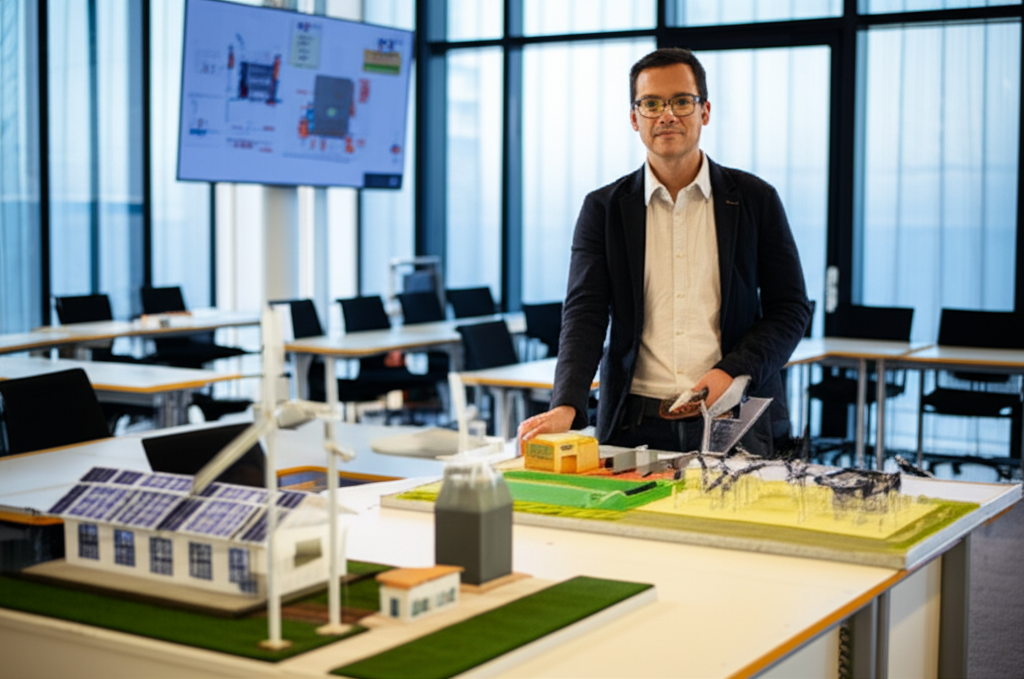
Renewable energy course at UAM hubs
- Format: Hybrid
- Duration: 3 months
- Hours: 300 H
- Language: English / Spanish
- Registration date: 23-10-2026
- Start date: 12-12-2026
- Available places: 2
620 $
Competencies and results
What you will learn
1. SEO Optimization and Positioning Strategies for Renewable Energy Projects
- Identify and apply key techniques for researching relevant keywords in the renewable energy sector.
- Understand and optimize website structure to maximize visibility in search engines.
- Develop and execute effective on-page SEO strategies, including content and tag optimization.
- Implement off-page SEO tactics, such as link building and online reputation management.
- Analyze and evaluate SEO performance using web analytics tools and key metrics.
- Learn about the specifics of SEO for renewable energy, including local search optimization and adapting to market trends.
- Design and execute content strategies focused on attracting and retaining the target audience in the renewable energy sector.
- Apply SEO techniques to improve the ranking of videos and other multimedia content.
- Understand and use advanced SEO tools for competitor research and opportunity identification.
- Stay up-to-date on the latest search engine algorithm updates and adapt strategies accordingly.
2. Analysis and Optimization of Renewable Energy Projects in UAM Hub Environments
2. **Analysis and Optimization of Renewable Energy Projects in UAM Hub Environments: What Will You Learn?**
- Evaluate the technical and economic feasibility of renewable energy projects in urban environments.
- Identify and analyze the key factors that influence the design and implementation of energy projects in urban hubs.
- Understand the specific regulations and standards of the energy sector in the urban context.
- Use simulation and modeling tools to optimize the performance of renewable energy systems.
- Apply project management strategies to ensure the efficiency and sustainability of energy initiatives.
- Analyze the environmental and social impact of renewable energy projects in urban environments.
- Develop skills for informed decision-making and problem-solving in the field of renewable energy.
- Explore the latest trends and technologies in The field of renewable energy, including energy storage and smart grids.
Become familiar with life cycle assessment (LCA) and its application in the evaluation of energy projects.
Understand the concepts of energy efficiency and their integration into project design.
3. Comprehensive user-oriented design and validation (from modeling to manufacturing)
You will learn to integrate the entire product development process, from initial model conception to final validation, applying user-centered methodologies. You will develop skills in parametric design, ergonomics, simulation, sustainable materials, 3D visualization, and manufacturing management, ensuring efficient, safe solutions that meet current industry standards.
4. Evaluation and Improvement of Wind Turbine Performance at the UAM
4. **Evaluation and Improvement of Wind Turbine Performance at the UAM**
Analyze flap-lag-torsion, whirl flutter, and fatigue couplings.
Sizing laminates in composites, joints, and bonded joints with FE.
Implement damage tolerance and NDT (UT/RT/thermography).
5. Performance Analysis and Optimization of Wind Turbine Blades
- Analyze flap–lag–torsion couplings, whirl flutter and fatigue.
- Size laminates in composites, unions and bonded joints with FE.
- Implement damage tolerance and NDT (UT/RT/thermography).
6. Design and Evaluation of Wind Turbines in the UAM Hub Environment
- Understand the design and operating principles of wind turbines.
- Study the UAM Hub environment and its relevance to wind turbine design.
- Analyze flap-lag-torsion, whirl flutter, and fatigue couplings.
- Dimension laminates in composites, joints, and bonded joints with FE.
- Apply wind turbine modeling and simulation techniques.
- Implement damage tolerance and NDT (UT/RT/thermography).
- Evaluate the performance and efficiency of wind turbines.
- Gain in-depth knowledge of the regulations and standards of the wind energy sector.
- Understand the strategies of Maintenance and repair of wind turbines.
Learn about integrating wind turbines into the electrical grid.
Who this program is for:
Renewable energy course at UAM hubs
- Engineers with degrees in Aerospace, Mechanical, Industrial, Electrical, Energy Engineering, or related fields.
- Professionals from renewable energy companies, energy project development, energy consulting, and research centers.
- Experts in energy efficiency, energy management, sustainability, and sustainable urban development.
- Public officials and public administration managers interested in renewable energy and energy transition policies.
Recommended requirements: basic knowledge of physics, mathematics, and programming; ES/EN B2+/C1.
- Standards-driven curriculum: you will work with CS-27/CS-29, DO-160, DO-178C/DO-254, ARP4754A/ARP4761, ADS-33E-PRF from the first module.
- Accreditable laboratories (EN ISO/IEC 17025) with rotor bench, EMC/Lightning pre-compliance, HIL/SIL, vibrations/acoustics.
- Evidence-oriented TFM: safety case, test plan, compliance dossierand operational limits.
- Mentored by industry: teachers with experience in rotorcraft, tiltrotor, eVTOL/UAM and flight test.
- Flexible modality (hybrid/online), international cohorts and support from SEIUM Career Services.
- Ethics and security: safety-by-design approach, cyber-OT, DIH and compliance as pillars.
1.1 SEO Fundamentals for Renewable Energy
1.2 Keyword Research in the Energy Sector
1.3 On-Page SEO: Content Optimization and Website Structure
1.4 Off-Page SEO: Link Building Strategies and Public Relations
1.5 Technical SEO: Site Speed Optimization and Mobile-First Orientation
1.6 Competitive Analysis and SEO Benchmarking
1.7 Content Strategies for Generating Traffic and Leads
1.8 Local SEO: Optimization for Geographic Results
1.9 Measuring and Analyzing Results with Google Analytics and Search Console
1.10 Future Trends in SEO and Their Application in Renewable Energy
2.2 Keyword Research and Competitive Analysis in the Renewable Energy Sector
2.2 On-Page Optimization: Website Structure, Content, and UX for SEO
2.3 Off-Page Optimization: Link Building and Digital Marketing Strategies
2.4 Technical SEO: Website Speed, Indexing, and Website Architecture
2.5 Local SEO: Optimization for Geographic Searches and Maps
2.6 Content Strategies for Renewable Energy: Blogs, Videos, and Infographics
2.7 Monitoring and Analysis of Results: Tools and KPIs
2.8 SEO for Specific Platforms: YouTube, Social Media, and Directories
2.9 Long-Term Positioning Strategies and Adaptation to Algorithm Changes
2.20 Case Studies and Success Stories in the Renewable Energy Sector
3.3 Introduction to Wind Turbine System Simulation
3.2 Fundamentals of Wind Turbine Blade Aerodynamics
3.3 Modeling Wind Turbine Performance
3.4 Wind Turbine Simulation Software: Tools and Applications
3.5 Data Analysis and Simulation Results
3.6 Influence of the Environment on Wind Turbine Performance
3.7 Optimizing Wind Turbine Design Through Simulation
3.8 Validation and Verification of Simulation Models
3.9 Case Studies: Wind Farm Performance Analysis
3.30 Strategies for Continuous Improvement of Wind Turbine Performance
4.4 Introduction to Wind Turbine Evaluation: Key Concepts
4.2 Performance Data Analysis: Collection and Processing
4.3 Identifying Areas for Improvement: Failure and Efficiency Analysis
4.4 Optimization Techniques: Design and Operation
4.5 Performance Evaluation: Key Indicators
4.6 Wind Turbine Modeling and Simulation
4.7 Predictive and Preventive Maintenance
4.8 Improvement Technologies: Blades, Control Systems
4.9 Case Studies: Optimization in Practice
4.40 Environmental and Economic Impact: Life Cycle Assessment
5.5 Keyword research and competitor analysis in the renewable energy sector.
5.5 On-page optimization: website structure, relevant content, and tag optimization.
5.3 Off-page optimization: link building, public relations strategies, and domain authority.
5.4 Technical SEO: website speed, mobile optimization, and indexing.
5.5 Data analysis and results tracking: key tools and metrics.
5.6 Content strategies: creating and promoting engaging and relevant content.
5.7 Local SEO: optimization for geographic searches and local businesses.
5.8 SEO trends and updates for renewable energy.
5.9 Positioning strategies for different types of renewable energy projects.
5.50 Adapting to search algorithms and updates.
5.5 Introduction to UAM Hub environments and their importance in renewable energy.
5.5 Data analysis and key metrics for energy projects. 5.3 Optimization of the location and design of renewable energy projects.
5.4 Evaluation of energy efficiency and system performance.
5.5 Cost-benefit analysis of different options.
5.6 Tools and techniques for project optimization.
5.7 Case studies of renewable energy projects in UAM Hub environments.
5.8 Identification and mitigation of risks in energy projects.
5.9 Regulatory and legal aspects of project optimization.
5.50 Sustainability and corporate social responsibility in renewable energy.
3.5 Introduction to wind turbine system simulation and its importance.
3.5 Modeling of wind turbine components: blades, towers, and control systems.
3.3 Simulation software and analysis tools.
3.4 Key parameters in wind turbine system simulation.
3.5 Analysis of the performance and efficiency of wind turbine systems. 3.6 Validation and calibration of simulation models.
3.7 Design of experiments and sensitivity analysis.
3.8 Case studies of wind turbine system simulation at the UAM.
3.9 Applications of simulation in wind turbine system optimization.
3.50 Trends and advances in wind turbine system simulation.
4.5 Introduction to wind turbine performance evaluation.
4.5 Methods for evaluating and analyzing wind turbine data.
4.3 Key performance parameters: power, efficiency, and availability.
4.4 Performance improvement techniques: optimization of operation and maintenance.
4.5 Failure analysis and problem diagnosis in wind turbines.
4.6 Performance improvement strategies: repowering and modernization.
4.7 Case studies of wind turbine evaluation and improvement at the UAM.
4.8 Safety and regulatory considerations in wind turbine evaluation.
4.9 Analysis of the useful life and life cycle of wind turbines.
4.50 Environmental impact of wind turbines and mitigation strategies.
5.5 Introduction to the analysis and optimization of wind turbine blades.
5.5 Aerodynamic design of wind turbine blades and its impact on performance.
5.3 Materials and manufacturing of wind turbine blades.
5.4 Structural analysis of blades and fatigue assessment.
5.5 Blade design optimization techniques.
5.6 Modeling and simulation of blade behavior.
5.7 Case studies of wind turbine blade analysis and optimization.
5.8 Control and monitoring of wind turbine blades.
5.9 Aspects of blade maintenance and repair.
5.50 Trends and advances in wind turbine blade design.
6.5 Introduction to wind turbine design. 6.5 Design Principles and Component Selection
6.3 Design of Control and Operation Systems
6.4 Design of Towers and Foundations
6.5 Integration of Wind Turbines into the Environment
6.6 Design Tools and Software
6.7 Design for Performance Optimization and Cost Reduction
6.8 Safety and Regulatory Aspects in Wind Turbine Design
6.9 Case Studies of Wind Turbine Design in the UAM Hub Environment
6.50 Environmental Impact Assessment and Sustainable Design Strategies
7.5 Introduction to the Design and Evaluation of Wind Turbine Components
7.5 Design and Selection of Generators and Transmission Systems
7.3 Evaluation and Design of Braking and Safety Systems
7.4 Design of Control and Electronic Systems
7.5 Evaluation and Selection of Materials for Wind Turbine Components 7.6 Nacelle and Hub Design and Optimization
7.7 Integration of Components and Systems in the UAM Hub Environment
7.8 Testing and Trials of Wind Turbine Components
7.9 Case Studies of Wind Turbine Component Design and Evaluation
7.5 Trends and Advances in Wind Turbine Component Design
8.5 Introduction to Wind Turbine Modeling
8.5 Aerodynamic Modeling and Computational Aerodynamics
8.3 Structural Modeling and Finite Element Analysis
8.4 Modeling of Control and Operation Systems
8.5 Modeling of Wind Turbine-Grid Interaction
8.6 Modeling and Simulation Software and Tools
8.7 Performance Analysis and Results Evaluation
8.8 Case Studies of Wind Turbine Modeling at the UAM Hub
8.9 Model Validation and Calibration 8.50 Applications of modeling in the optimization of wind turbines.
6.6 Keyword Research for Renewable Energy
6.2 On-Page SEO: Content Optimization and Website Structure
6.3 Off-Page SEO: Link Building Strategies and Online Reputation Management
6.4 Competitive Analysis in the Renewable Energy Sector
6.5 Content Strategies: Creating Relevant and Valuable Content
6.6 Optimization for Local Search and Google Maps
6.7 Technical SEO: Website Speed and Mobile Optimization
6.8 Results Analysis and ROI Measurement
6.9 SEO Trends in the Renewable Energy Sector
6.60 Essential SEO Tools for Ranking
2.6 Introduction to Renewable Energy Project Analysis
2.2 Technical and Economic Analysis of Photovoltaic Projects
2.3 Technical and Economic Analysis of Wind Energy Projects
2.4 Feasibility Assessment of Solar Thermal Energy Projects
2.5 Profitability Analysis of Biomass Projects
2.6 Environmental and Social Impact Assessment of Energy Projects
2.7 Risk Analysis in Renewable Energy Projects
2.8 Modeling and Simulation of Energy Projects
2.9 Legislation and Regulations Applicable to Renewable Projects
2.60 Case Study: Complete Analysis of a UAM Energy Project
3.6 Fundamentals of Wind Turbine System Simulation
3.2 Aerodynamic Modeling of Wind Turbine Blades
3.3 Wind Turbine Performance Simulation
3.4 Wind Turbine System Simulation Software
3.5 Wind-Turbine Interaction Analysis
3.6 Energy Production Simulation
3.7 Study of the Influence of the Environment on Wind Turbine Performance
3.8 Optimization of Wind Turbine System Design through Simulation
3.9 Validation of Simulation Models
3.60 Applications of Simulation in the Design and Operation of Wind Farms
4.6 Introduction to Wind Turbine Evaluation
4.2 Methods for Measuring and Analyzing Wind Turbine Performance
4.3 Performance Evaluation of Key Components: Rotor, nacelle, tower
4.4 Operation and Maintenance Data Analysis
4.5 Identification and Analysis of Wind Turbine Faults
4.6 Performance Optimization through Data Analysis
4.7 Wind Turbine Inspection and Diagnostic Techniques
4.8 Study of Wind Turbine Lifespan and Aging
4.9 Economic Evaluation of Performance and Availability
4.60 Case Studies: Performance Evaluation and Improvement in UAM Wind Farms
5.6 Fundamentals of Wind Turbine Blade Aerodynamics
5.2 Aerodynamic Blade Design: Airfoil, Chord, Angle of Attack
5.3 Analysis of Load Distribution on Blades
5.4 Optimization of Blade Shape and Design
5.5 Wind Turbine Blade Materials and Manufacturing
5.6 Modeling and Simulation of Blade Performance
5.7 Analysis of Blade Fatigue and Durability
5.8 Blade Inspection and Evaluation Techniques
5.9 Strategies for Optimizing Blade Performance
5.60 Practical Cases of Wind Turbine Blade Optimization
6.6 Introduction to Wind Turbine Design
6.2 Rotor Design: Number of Blades, Diameter, Rotational Speed
6.3 Nacelle Design: Structure, Control System, Generator
6.4 Tower Design: Height, Materials, Structural Strength
6.5 Selection and Sizing of Component Components: Gearbox, Brake, etc.
6.6 Wind Turbine Energy Performance Evaluation
6.7 Structural and Fatigue Analysis of Wind Turbines
6.8 Wind Turbine Design for Different Wind Conditions
6.9 Wind Turbine Design Software and Tools
6.60 Design and Evaluation of a Wind Turbine in the UAM Hub Environment
7.6 Wind Turbine Component Performance Evaluation: Blades, Generator, Gearbox
7.2 Design and Selection of Components for Different Types of Wind Turbines
7.3 Component Efficiency and Reliability Analysis
7.4 Component Integration Study in the Wind Turbine System
7.5 Component Design Optimization to Maximize Performance
7.6 Component Behavior Modeling and Simulation
7.7 Component Lifespan and Maintenance Analysis
7.8 Economic Evaluation of Components
7.9 Case Studies: Component Evaluation and Design in UAM Hubs
7.60 Trends in Wind Turbine Component Design
8.6 Fundamentals Wind Turbine Modeling
8.2 Aerodynamic and Aerodynamic-Elastic Modeling
8.3 Wind Turbine Control System Modeling
8.4 Turbulence Modeling and its Impact on Performance
8.5 Software and Tools for Wind Turbine Modeling
8.6 Simulation of Wind Turbine Performance under Different Conditions
8.7 Analysis of Energy Production and the Power Curve
8.8 Validation of Simulation Models with Real Data
8.9 Optimization of Wind Turbine Design and Operation through Modeling
8.60 Modeling and Analysis of Wind Turbine Performance at the UAM Hub
- Hands-on methodology: test-before-you-trust, design reviews, failure analysis, compliance evidence.
- Software (depending on licenses/partners): MATLAB/Simulink, Python (NumPy/SciPy), OpenVSP, SU2/OpenFOAM, Nastran/Abaqus, AMESim/Modelica, acoustics tools, planning toolchains DO-178C.
- SEIUM Laboratories: scale rotor bench, vibrations/acoustics, EMC/Lightning pre-compliance, HIL/SIL for AFCS, data acquisition with strain gauging.
- Standards and compliance: EN 9100, 17025, ISO 27001, GDPR.
Capstone-type projects
- Renewable Energy SEO: Keyword analysis, on-page/off-page optimization, link building.
- UAM Hub: Wind project studies, performance data analysis, improvement proposals.
- Wind Turbine Simulation: CFD modeling, aerodynamic analysis, design optimization.
- Wind Turbines: Performance evaluation, failure analysis, efficiency improvement proposals.
- Wind Turbine Blades: Design, structural analysis, aerodynamic optimization, wind tunnel testing.
- Wind Turbine Design: Complete design, cost analysis, environmental impact assessment.
- Wind Turbine Components: Design, simulation, performance analysis, optimization.
- Wind Turbine Modeling: Model development, simulation, sensitivity analysis.
- SEO & Positioning: Keyword analysis, on-page/off-page optimization, link building, valuable content.
UAM Hub: Performance data analysis, optimization, proposed improvements, environmental impact.
Wind Turbine Simulation: Modeling, analysis, performance evaluation, identification of areas for improvement.
Wind Turbines: Evaluation, proposed improvements, variable impact analysis, optimization.
Wind Turbine Blades: Design, CFD analysis, optimization, performance evaluation, impact.
UAM Design: Design, modeling, analysis, evaluation, optimization, technical feasibility.
UAM Components: Evaluation, design, optimization, simulation, performance.
UAM Modeling: Modeling, simulation, performance analysis, optimization.
- SEO for Renewables: Keyword analysis, link building, on-page/off-page optimization.
- UAM Hub: Analysis of energy projects, local SEO optimization, Google My Business.
- UAM Wind Turbines: CFD modeling, performance analysis, web positioning strategies.
- UAM Wind Turbines: SEO audits, content improvements, competitor analysis.
- Wind Turbine Blades: Keyword research, technical optimization, relevant content.
- UAM Wind Turbine Design: SEO strategies, SERP analysis, link building.
- UAM Wind Turbine Components: On-site SEO, image optimization, data analysis.
- UAM Modeling: Web structure design, SEO audit, performance analysis.
- SEO & Renewable Energies: Keyword analysis, on-page optimization, link building, CTR improvement.
- UAM Hub: Data analysis, performance optimization, scenario simulation, efficiency improvement.
- UAM Wind Turbines: Design, simulation, evaluation, failure analysis, performance improvement.
- Wind Blades: Design, optimization, CFD/FEA analysis, simulation, aerodynamic improvement.
Admissions, fees, and scholarships
- Profile: Background in Computer Engineering, Mathematics, Statistics, or related fields; practical experience in NLP and valued information retrieval systems.
- Documentation: Updated CV, academic transcript, SOP/statement of purpose, project examples or code (optional).
- Process: Application → Technical evaluation of profile and experience → Technical interview → Review of case studies → Final decision → Enrollment.
- Fees:
- Single payment: 10% discount.
- Payment in 3 installments: No fees; 30% upon registration + 2 equal monthly payments of the remaining 35%.
Monthly payment: available with a 7% commission on the total; annual review.
Scholarships: based on academic merit, financial need, and promoting inclusion; agreements with companies in the sector for partial or full scholarships.
See “Calendar & Calls for Applications,” “Scholarships & Grants,” and “Fees & Financing” in the SEIUM mega-menu.
Do you have any questions?
Our team is ready to help you. Contact us, and we will respond as soon as possible.
F. A. Q
Frequently asked questions
Yes, we have international certification
Yes: experimental models, real data, applied simulations, professional environments, real case studies.
It is not mandatory. We offer leveling tracks and tutoring.
Completely. It covers e-propulsion, integration, and emerging regulations (SC-VTOL).
Recommended. There are also internal challenges and consortiums.
Yes. Online/hybrid modality with planned labs and visa support (see “Visa & Residence”).