

Human-machine handover course in eVTOL
About our
The Human-Machine Handover in eVTOL course explores the safe and efficient transfer of control between the pilot and the automated control system in eVTOL vehicles. It focuses on the design of intuitive interfaces and the implementation of handover protocols that minimize risks and ensure operational continuity, covering areas such as flight safety, system reliability, and user experience (UX). It integrates knowledge of artificial intelligence (AI) and automation to optimize control transitions, considering emergency scenarios and system failures.
The course provides practical skills in the design and evaluation of handover systems, using simulations and real-world case studies. It includes human factors analysis, user interface validation, and compliance with air safety regulations. Participants will acquire skills in risk management and in implementing strategies to ensure a smooth and safe transition between the pilot and the automatic control system, contributing to the development of safer and more efficient urban air mobility.
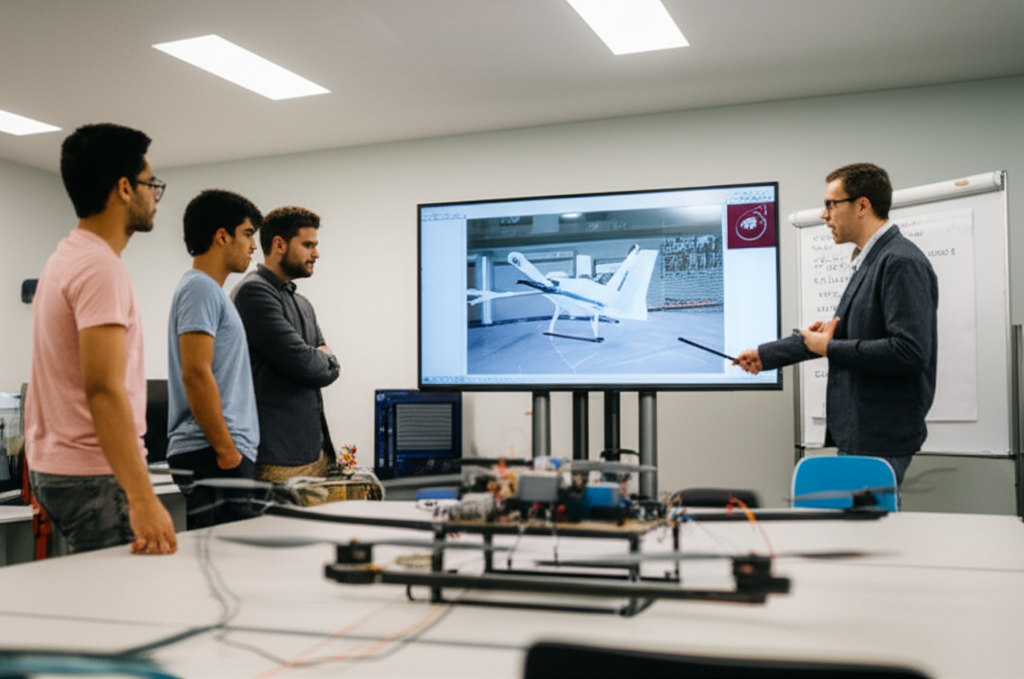
Human-machine handover course in eVTOL
- Format: Hybrid
- Duration: 3 months
- Hours: 300 H
- Language: English / Spanish
- Registration date: 23-10-2026
- Start date: 12-12-2026
- Available places: 3
320 $
Competencies and results
What you will learn
1. Comprehensive Mastery of Human-Machine Handover in eVTOL: Fundamentals and Applications
-
Understand human-machine interaction (HMI) in the context of eVTOLs, including the control interface, information presentation, and workload management.
-
Identify the specific challenges of eVTOL operation in urban environments, such as airspace management, noise mitigation, and integration with other modes of transportation.
-
Analyze safety aspects of eVTOLs, including redundant system design, certification, and applicable regulations.
-
Explore current and future applications of eVTOLs, such as passenger transport, logistics, and surveillance.
-
Apply simulation and modeling tools to analyze the behavior of eVTOLs and optimize their design and operation.
-
Study propulsion technologies and power systems in eVTOLs, including batteries, electric motors, and power management systems.
-
Understand the current regulatory framework and certification standards for eVTOLs.
-
Develop skills in planning and executing eVTOL missions, including navigation, route management, and communication.
Evaluate the fundamental principles of eVTOL flight dynamics, including flight control, stability, and performance in different phases of flight.
Master handover techniques, both in hardware design and software programming, for flight control and emergency management.
2. In-depth Analysis of Human-Machine Handover in eVTOL: Design and Optimized Operation
## What Will You Learn?
1. Mastery of Human-Machine Interaction (HMI) Fundamentals:
* Exploration of ergonomic and usability principles applied to eVTOL cockpit design.
* Understanding the cognitive and performance needs of pilots during eVTOL operation.
* Analysis of critical human factors in the design of flight control systems and user interfaces.
2. Design and Optimization of Control and Avionics Systems:
* Evaluation of fly-by-wire flight control systems and their adaptation to the unique characteristics of eVTOLs.
* Design of intuitive and efficient human-machine interfaces (HMIs) for flight management and navigation.
* Implementation of redundancy and safety systems to ensure the reliability of critical systems.
3. eVTOL Performance Simulation and Analysis:
* Simulation of the aerodynamic and dynamic behavior of eVTOLs under different flight conditions.
* Optimization of flight control algorithms to improve stability, maneuverability, and energy efficiency.
* Analysis of the influence of environmental conditions (wind, turbulence) on performance and safety.
4. eVTOL Regulation and Certification:
* Knowledge of the regulations and certification standards applicable to eVTOLs globally.
* Analysis of the safety and performance requirements established by civil aviation authorities.
* Strategies to meet certification requirements and obtain approval for eVTOL operation.
5. Structural Design and Advanced Materials:
* Exploration of the structural architecture of eVTOLs, including fuselage, wings, and rotors.
* Selection of advanced composite materials (carbon fiber, etc.) to optimize the strength-to-weight ratio. * Analysis of the structural integrity and durability of components under different loads and conditions.
6. Optimized Operations and Maintenance:
* Design of standard operating procedures (SOPs) to ensure the safety and efficiency of eVTOL operations.
* Implementation of preventive and predictive maintenance programs to minimize downtime and operating costs.
* Analysis of flight data to identify areas for improvement and optimize the performance of the eVTOL fleet.
7. Systems Integration and Cybersecurity:
* Design of secure communication and navigation systems for data transmission between the eVTOL and ground stations.
* Implementation of cybersecurity measures to protect flight control systems and sensitive information.
* Analysis of cybersecurity vulnerabilities and risks associated with eVTOL operations and development of mitigation strategies.
8. Failure Analysis and Risk Management:
* Identification and analysis of potential failure modes in eVTOL systems.
* Assessment of the severity and probability of failures, as well as their impact on safety.
* Implementation of risk mitigation measures and contingency plans for emergency situations.
3. Comprehensive user-oriented design and validation (from modeling to manufacturing)
You will learn to integrate the entire product development process, from initial model conception to final validation, applying user-centered methodologies. You will develop skills in parametric design, ergonomics, simulation, sustainable materials, 3D visualization, and manufacturing management, ensuring efficient, safe solutions that meet current industry standards.
4. Human-Machine Integration in eVTOL: Perspectives and Handover Strategies
- Understand the fundamentals of human-machine interaction (HMI) in the specific context of eVTOL (electric vertical takeoff and landing) vehicles.
- Explore different perspectives on HMI in eVTOLs, including the pilot’s view, automated flight control, and system management.
- Identify and analyze handover strategies between the pilot and automated systems in eVTOLs.
- Study the challenges and key considerations in designing safe and efficient handover systems.
- Examine user interfaces (UI) and user interfaces (UX) for interacting with eVTOLs, including information display and controls.
- Evaluate the impact of automation on pilot workload and decision-making in critical situations.
- Analyze the role of simulation and training in preparing pilots for Interact with handover systems.
Explore regulations and standards related to HMI and handover in eVTOL.
Investigate future trends in HMI and handover, including the use of artificial intelligence (AI) and machine learning.
Develop practical skills to design and evaluate HMI systems and handover strategies in eVTOL.
5. Human-Machine Handover in eVTOL: Design, Implementation and Optimization of the Workflow
5. Human-Machine Handover in eVTOL: Design, Implementation, and Workflow Optimization
- Understand the fundamentals of eVTOL system design, including aerodynamics, propulsion, and flight control.
- Evaluate the needs and capabilities of the human operator in interacting with autonomous systems.
- Design intuitive and effective human-machine interfaces (HMIs) for eVTOL control and monitoring.
- Implement seamless handover strategies between the pilot and the autonomous system, considering failure and emergency scenarios.
- Optimize the workflow for eVTOL operation, including flight planning, air traffic management, and payload management.
- Analyze safety, reliability, and acceptability factors in eVTOL design and operation.
- Apply tools for Simulation and modeling to evaluate and validate handover systems and HMIs.
Integrate technologies such as artificial intelligence (AI) and machine learning (ML) to improve system autonomy and efficiency.
Study and apply relevant regulations and standards for eVTOL certification and operation.
Evaluate the impact of eVTOLs on urban mobility and the environment.
6. Human-Machine Handover in eVTOL: Essential Principles and Systems Evaluation
6. **Human-Machine Handover in eVTOLs: Essential Principles and Systems Evaluation**
In this course, you will delve into the key aspects of human-machine interaction in the context of eVTOL vehicles, covering both theoretical foundations and practical applications. You will learn to:
Understand the fundamental principles of human-machine interface (HMI) design for eVTOLs, including pilot perception, cognition, and decision-making.
Identify and analyze critical human factors in eVTOL operations, such as workload, situational awareness, and error management.
Evaluate different control and automation systems for eVTOLs, including handover between the pilot and the automatic control system (autonomy).
Apply methodologies for evaluating the safety and usability of eVTOL HMI systems, including simulator and flight testing.
Explore design considerations for the eVTOL cockpit, including ergonomics, information display, and the control interface.
Analyze aspects related to communication and coordination between the pilot and the control system, as well as between the pilot and ground crew.
Understand the regulations and standards relevant to eVTOL operation in relation to human-machine interaction.
Study HMI case studies in eVTOL and analyze the challenges and best practices.
Apply tools and techniques for the design and evaluation of HMIs for eVTOL, including task analysis, user modeling, and usability testing.
Explore future trends in HMI research and development for eVTOL, including artificial intelligence, augmented reality, and cognitive computing.
Who this program is for:
Human-machine handover course in eVTOL
- Engineers with degrees in:
- Aerospace Engineering
- Mechanical Engineering
- Industrial Engineering
- Automation Engineering
- Engineering-related fields
- Professionals in the eVTOL and aeronautical sectors:
- OEM (Original Equipment Manufacturer) personnel of rotorcraft/eVTOL aircraft.
- MRO (Maintenance, Repair, and Overhaul) personnel.
- Consultants specializing in the aerospace sector.
- Personnel from technology centers focused on aeronautical innovation.
- Specialists in specific eVTOL areas:
- Flight Test Professionals
- Aircraft and Systems Certification Experts
- Avionics, Control Systems, and Flight Dynamics Engineers
- Regulatory Personnel and UAM/eVTOL Profiles:
- Aeronautical Regulators and Authorities
- Professionals involved in the development and operation of UAM/eVTOLs
- Individuals interested in acquiring compliance skills
Recommended Requirements: Basic knowledge of aerodynamics, control, and structures. Language level Spanish/English B2+ or C1. bridging tracks (leveling courses) are offered to cover possible deficiencies.
- Standards-driven curriculum: you will work with CS-27/CS-29, DO-160, DO-178C/DO-254, ARP4754A/ARP4761, ADS-33E-PRF from the first module.
- Accreditable laboratories (EN ISO/IEC 17025) with rotor bench, EMC/Lightning pre-compliance, HIL/SIL, vibrations/acoustics.
- Evidence-oriented TFM: safety case, test plan, compliance dossierand operational limits.
- Mentored by industry: teachers with experience in rotorcraft, tiltrotor, eVTOL/UAM and flight test.
- Flexible modality (hybrid/online), international cohorts and support from SEIUM Career Services.
- Ethics and security: safety-by-design approach, cyber-OT, DIH and compliance as pillars.
1.1 Introduction to eVTOLs and Urban Air Mobility (UAM)
1.2 Fundamental Principles of Human-Machine Handover (HHM)
1.3 Architecture and Components of eVTOL Systems
1.4 Human-Machine Interface (HMI) in eVTOLs
1.5 The Pilot’s Role in eVTOL Operations
1.6 Types of Handover: Control Transfer and Task Management
1.7 Human-Centered Design for eVTOLs
1.8 Human Factors and Performance in the Context of eVTOLs
1.9 Introduction to EHM Simulation and Testing
1.10 Ethics and Safety in eVTOL Design and Operation
2.2 Fundamentals of Human-Machine Handover in eVTOL: Conceptual Design
2.2 eVTOL System Architecture: Key Components and Subsystems
2.3 Human-Machine Interface (HMI): Design Principles and Ergonomics
2.4 User-Centered Design: Methodologies and Tools
2.5 Task and Workflow Analysis for Handover
2.6 Control Transfer Optimization: Protocols and Procedures
2.7 Flight Control System Design: Key Aspects
2.8 Handover Simulation: Modeling and Evaluation
2.9 Testing and Validation: Performance and Safety Metrics
2.20 Case Study: Design and Optimization of an eVTOL Handover System
3.3 Modeling and Simulation of eVTOL Systems
3.2 Handover Simulation Design
3.3 Simulation-Based Handover Strategies
3.4 Performance Analysis and Strategy Validation
3.5 Advanced Simulation Environments
3.6 Simulation of Different Operational Scenarios
3.7 Handover Validation Under Critical Conditions
3.8 Simulation Tools for Optimization
3.9 Data Analysis and Simulation Results
3.30 Integrating Simulation into Design and Development
4.4 Human-Machine Transition in eVTOL: Introduction to Strategies
4.2 Integration Framework: Workflow Design and Optimization
4.3 Human Factors: Key Considerations in Handover
4.4 User-Centered Design: Fundamental Principles
4.5 Simulation and Analysis: Tools for Handover Evaluation
4.6 Control Systems and Handover: Integration and Performance
4.7 Handover Strategies: Design, Implementation, and Optimization
4.8 Handover in Complex Scenarios: Analysis and Solutions
4.9 Evaluation of Handover Systems: Metrics and Criteria
4.40 Future Perspectives: Trends and Advances in Human-Machine Integration
5.5 Introduction to eVTOLs: Types and Key Components
5.5 The Human-Machine Handover (HHM) Concept: Definition and Relevance
5.3 HHM Interface Principles: Design and Usability
5.4 Human Factors in eVTOL Aviation: Cognition and Perception
5.5 Control and Automation Systems in eVTOLs
5.6 HHM Use Cases in eVTOL Operations
5.7 Emerging Technologies for HHM
5.8 Challenges and Opportunities in HHM Design
5.9 HHM-Related Standards and Regulations
5.50 Case Studies: Practical Examples of HHM in eVTOLs
5.5 HHM Interface Design: Display and Control Design
5.5 Flight Management Systems (FMS) and Their Interaction with the Pilot
5.3 Cockpit Design and Ergonomics for the Pilot
5.4 Handover Procedures: Standard and Emergency Procedures
5.5 Automation and Levels of Autonomy in eVTOLs
5.6 Integration of Sensors and Data in the HHM Interface
5.7 Optimizing Pilot Workload
5.8 Evaluating the Safety and Reliability of the HHM
5.9 Risk Analysis and Mitigation in HHM Design
5.50 Case Studies: Analysis of Existing HHM Designs
3.5 Introduction to Simulation Tools for eVTOLs and HHMs
3.5 Modeling eVTOL Systems: Flight Physics and Dynamics
3.3 Simulating Human Behavior: Pilot Models
3.4 Simulation Scenarios for HHMs: Transitions and Failures
3.5 Simulation Data Analysis: Metrics and Evaluation
3.6 Simulating Different Levels of Autonomy
3.7 Validating and Verifying the HHM Design Through Simulation
3.8 Implementing Virtual and Augmented Reality in HHM Simulation
3.9 Sensitivity Analysis and Optimization of the HHM Design
3.50 Case Studies: Application of Simulations in HHM Development
4.5 Handoff Strategies: Manual, Automated, and Hybrid Handover
4.5 HHM System Integration: Communication and Coordination
4.3 Design of Communication Protocols Between Pilot and System
4.4 Managing the Human-Machine Control Transition
4.5 Implementing Alerts and Notifications in the HHM
4.6 Design of Decision Support Systems
4.7 Optimizing the User Experience in the HHM
4.8 Legal and Liability Aspects in the HHM
4.9 Cybersecurity in eVTOL HHM Systems
4.50 Case Studies: Handoff Strategies in Different Flight Scenarios
5.5 Workflow Analysis in eVTOL Operations
5.5 Process Mapping and Critical Point Identification
5.3 Designing Pilot Tasks and Responsibilities
5.4 Designing Efficient and User-Friendly User Interfaces
5.5 Optimizing Pilot Workload and Fatigue
5.6 Task Automation and Error Reduction
5.7 Designing Manuals and Operating Procedures
5.8 Implementing Quality Management Systems
5.9 Change Management and Continuous Improvement
5.50 Case Study: Workflow Optimization in eVTOL Companies
6.5 HHM Interface Design Principles: Guidelines and Standards
6.5 HHM System Evaluation Methods: Usability Testing
6.3 Performance Metrics: Response Time, Accuracy, and Errors
6.4 Safety Assessment: Risk Analysis and Mitigation
6.5 Human Factors and Their Impact on System Performance
6.6 Validating HHM Design: Simulator and Flight Testing
6.7 Error Management and Anomaly Handling Systems
6.8 Implementing Feedback and Machine Learning
6.9 Compliance with Aviation Regulations and Standards
6.50 Study of Case Studies: Real-World HHM System Evaluations
7.5 Human-Centered Design: Principles and Methodologies
7.5 User Interface (UI) and User Experience (UX) Design
7.3 Cockpit Design: Ergonomics and Comfort
7.4 Adapting the HHM to Human Capabilities and Limitations
7.5 Considering the Needs of Different Users
7.6 Inclusive Design and Accessibility
7.7 Prototyping and User Testing
7.8 Design Iteration and Continuous Improvement
7.9 Ethical Considerations in HHM System Design
7.50 Case Studies: Human-Centered Design in the eVTOL Industry
8.5 Modeling and Simulation of Control Systems for eVTOLs
8.5 Flight Control System (FCS) Design
8.3 Implementing Control Algorithms
8.4 System Stability and Performance Analysis
8.5 Integrating the HHM into the System Control
8.6 Design of redundant and fault-tolerant control systems
8.7 Simulation of fault and emergency scenarios
8.8 System performance optimization
8.9 Validation of the control system and HHM
8.50 Case study: Design and analysis of control systems in eVTOL
6.6 Fundamentals of eVTOL and Human-Machine Handover
6.2 eVTOL System Architecture and its Interaction with the Operator
6.3 Human-Machine Interface (HMI) Design Principles
6.4 Human Factors and Ergonomics in eVTOL Operation
6.5 Introduction to Automation and the Pilot’s Role in eVTOL
6.6 Regulatory and Safety Aspects of Control Transition
6.7 Case Study: Analysis of Existing eVTOL Systems
6.8 Risk Assessment and Mitigation in Control Transfer
2.6 Task and Workload Analysis in Handover
2.2 Design of Intuitive and Efficient User Interfaces
2.3 Pilot-System Communication Strategies
2.4 Design of Standard Operating Procedures (SOPs)
2.5 Optimization of Response and Control Times
2.6 Validation and Verification of Handover Designs
2.7 Design Considerations for Different Handover Scenarios Flight
2.8 Error Analysis and Crisis Management in Handover
3.6 Modeling and Simulation of Human-Machine Handover
3.2 Simulation of Complex and Emergency Scenarios
3.3 Adaptive and Predictive Handover Strategies
3.4 Artificial Intelligence and Machine Learning in Handover
3.5 Decision Support Systems (DSS)
3.6 Evaluation of the Effectiveness of Handover Strategies
3.7 Design of Simulation Tests and Experiments
3.8 Validation of Handover Strategies in Simulated Environments
4.6 Integration of Handover into the Overall eVTOL Design
4.2 Safety Considerations in Handover Integration
4.3 Design of Alert and Warning Systems for Control Transfer
4.4 Integration of Real-Time Information Systems
4.5 Design of Emergency and Recovery Procedures
4.6 Interfacing with Air Traffic Control (ATC) in Handover Management
4.7 Considerations On Interoperability and System Compatibility
4.8 Strategies for Managing Pilot Fatigue and Stress
5.6 Handover Workflow Analysis
5.2 Optimizing Information and Communication Flow
5.3 Designing Efficient Operating Procedures
5.4 Workflow Automation and Error Reduction
5.5 Integrating Management and Monitoring Tools
5.6 Evaluating the Impact of Workflow Changes
5.7 Designing Training and Simulation Systems
5.8 Continuous Workflow Improvement and Adaptation to New Technologies
6.6 Design Principles for Robust Handover Systems
6.2 Evaluating Reliability, Availability, and Maintainability (RAM)
6.3 Risk and Safety Analysis Methods (HAZOP, FMEA)
6.4 Designing Verification and Validation Tests
6.5 Evaluating Usability and User Experience
6.6 Analyzing System Efficiency and Performance
6.7 Cybersecurity Considerations in Handover
6.8 Compliance with industry regulations and standards
7.6 User-centered design and needs
7.2 Research and analysis of pilot needs
7.3 Design of intuitive and user-friendly interfaces
7.4 Evaluation of workload and fatigue
7.5 Ergonomics and cockpit design
7.6 Design of effective training and simulation systems
7.7 Design iteration and continuous improvement
7.8 Usability testing and user feedback
8.6 Modeling of control systems for eVTOLs
8.2 Simulation of control systems and handover
8.3 Design of advanced control algorithms
8.4 Integration of control systems and HMIs
8.5 Analysis of system stability and performance
8.6 Optimization of control parameters
8.7 Design of control system tests and evaluation
8.8 Implementation and validation of control systems in simulators and platforms flight
- Hands-on methodology: test-before-you-trust, design reviews, failure analysis, compliance evidence.
- Software (depending on licenses/partners): MATLAB/Simulink, Python (NumPy/SciPy), OpenVSP, SU2/OpenFOAM, Nastran/Abaqus, AMESim/Modelica, acoustics tools, planning toolchains DO-178C.
- SEIUM Laboratories: scale rotor bench, vibrations/acoustics, EMC/Lightning pre-compliance, HIL/SIL for AFCS, data acquisition with strain gauging.
- Standards and compliance: EN 9100, 17025, ISO 27001, GDPR.
Capstone-type projects
- eVTOL HMI Design: Task analysis, UX/UI design, handover simulation.
- Safe Handover: Protocols, scenarios, performance evaluation.
- HMI Control System: Implementation, SIL/HIL simulation, optimization.
- Human Factor: Error investigation, user-centered design, evaluation.
- HMI Integration: Workflows, testing, validation, continuous improvement.
“`
- eVTOL UI/UX HMI Design: Usability studies, prototyping, testing.
- eVTOL Handover Protocols: Design, implementation, and validation.
- eVTOL Handover Simulation: Modeling, simulation, and scenario analysis.
- Handover Evaluation: Performance metrics, error analysis, optimization.
“
“`
- eVTOL HMI Design and Simulation: UI/UX design; handover protocols; simulation in realistic environments.
- HMI System Evaluation: Performance and ergonomics analysis; user testing; workflow optimization.
- HMI Development and Validation: Prototype implementation; testing on real hardware; DO-178C validation.
“
- eVTOL Handoff: Design an intuitive pilot interface.
- HMI Simulation: Model and optimize control transfers.
- Flow Analysis: Evaluate critical response times.
- Advanced Strategies: Implement backup systems.
- Validation: Extensive flight simulator testing.
Admissions, fees, and scholarships
- Profile: Background in Computer Engineering, Mathematics, Statistics, or related fields; practical experience in NLP and valued information retrieval systems.
- Documentation: Updated CV, academic transcript, SOP/statement of purpose, project examples or code (optional).
- Process: Application → Technical evaluation of profile and experience → Technical interview → Review of case studies → Final decision → Enrollment.
- Fees:
- Single payment: 10% discount.
- Payment in 3 installments: No fees; 30% upon registration + 2 equal monthly payments of the remaining 35%.
Monthly payment: available with a 7% commission on the total; annual review.
Scholarships: based on academic merit, financial need, and promoting inclusion; agreements with companies in the sector for partial or full scholarships.
See “Calendar & Calls for Applications,” “Scholarships & Grants,” and “Fees & Financing” in the SEIUM mega-menu.
Do you have any questions?
Our team is ready to help you. Contact us, and we will respond as soon as possible.
F. A. Q
Frequently asked questions
Yes, we have international certification
Yes: experimental models, real data, applied simulations, professional environments, real case studies.
It is not mandatory. We offer leveling tracks and tutoring.
Completely. It covers e-propulsion, integration, and emerging regulations (SC-VTOL).
Recommended. There are also internal challenges and consortiums.
Yes. Online/hybrid modality with planned labs and visa support (see “Visa & Residence”).