

PEM fuel cell course in automotive
About our
PEM Fuel Cell Course in Automotive
Explore the technology of proton exchange membrane (PEM) fuel cells applied in the automotive sector. It focuses on the design, operation, and optimization of these systems, including hydrogen storage, energy management, and their integration into vehicles. The course covers both theoretical and practical aspects, with an emphasis on safety and future prospects for hydrogen-powered mobility.
The program includes knowledge of electrochemistry, materials, and key components of PEM fuel cells, as well as control strategies and simulation. Experience is provided in performance analysis and fault identification. The training prepares students for professional roles such as fuel cell systems engineers, hydrogen vehicle development specialists, and energy performance analysts, driving innovation in the sustainable automotive industry.
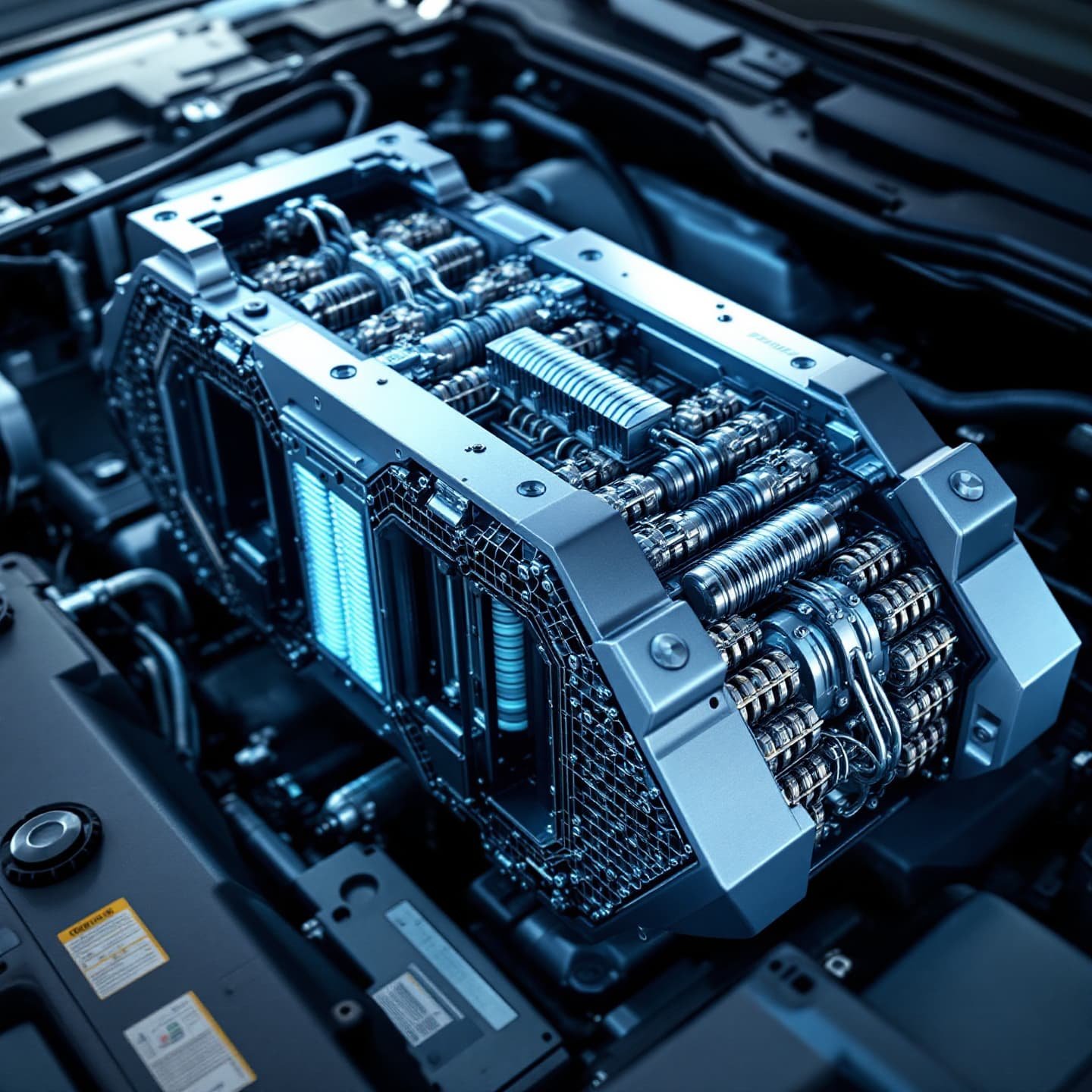
PEM fuel cell course in automotive
- Format: Hybrid
- Duration: 3 months
- Hours: 300 H
- Language: English / Spanish
- Registration date: 23-10-2026
- Start date: 12-12-2026
- Available places: 2
699 $
Competencies and results
What you will learn
1. Comprehensive Mastery of PEM Fuel Cells for Automotive Applications: Design, Operation and Optimization
- Fundamentals and Principles of PEM Fuel Cells: You will understand the electrochemistry, thermodynamics, and kinetics of reactions in the fuel cell, as well as the key materials and components (membrane, electrodes, catalysts).
- Design and Simulation of PEM Fuel Cells: You will acquire skills to model and simulate the performance of PEM fuel cells using specialized software, including aspects such as mass, heat, and current transfer, and optimization of flow channel design.
- Operation and Control of PEM Fuel Cell Systems for Automotive Applications: You will learn about the auxiliary systems (hydrogen supply, water management, thermal control) required for the operation of the fuel cell in a vehicle, as well as energy management and control strategies.
- Optimizing Performance and Durability: You will master techniques to improve the efficiency, power, and lifespan of fuel cells, including strategies for managing humidity,
- Temperature optimization and deterioration mitigation.
- Fuel Cell Integration in Vehicles: You will understand the challenges and solutions for integrating fuel cells into vehicles, including safety, space management, interaction with other vehicle systems, and automotive industry standards.
- Failure Analysis and Diagnostics: You will learn to identify and diagnose PEM fuel cell failures using analytical tools and testing techniques, as well as how to implement corrective measures.
- Fuel Cell Technology Trends and Advances: You will stay up-to-date with the latest advances in fuel cell materials, design, and technologies, as well as automotive industry trends related to electromobility and hydrogen.
2. In-depth Analysis of PEM Fuel Cells in Automotive: Operation, Integration and Applications
Here is the requested content:
- Understand the fundamental principles of PEM (Proton Exchange Membrane) fuel cells and their relevance to the automotive industry.
- Study the detailed operation of PEM fuel cells, including electrochemical processes, power generation, and reactant management.
- Explore the different components of a PEM fuel cell, such as the membrane, electrodes, separators, and thermal management system.
- Analyze the advantages and disadvantages of PEM fuel cells compared to other vehicle propulsion technologies.
- Investigate the integration of PEM fuel cells into vehicles, including hydrogen storage systems, energy management, and power electronics.
- Evaluate current and future applications of PEM fuel cells in the automotive industry, such as cars, buses, trucks, and other commercial vehicles.
- Examine the technical challenges and
- Learn about the barriers to the widespread adoption of PEM fuel cells in the automotive sector.
- Learn about strategies to improve the efficiency, durability, and cost-effectiveness of PEM fuel cells.
- Become familiar with the regulations, standards, and standards related to PEM fuel cells in the automotive industry.
- Learn about the latest trends and advances in PEM fuel cell research and development for automotive applications.
3. Comprehensive user-oriented design and validation (from modeling to manufacturing)
You will learn to integrate the entire product development process, from initial model conception to final validation, applying user-centered methodologies. You will develop skills in parametric design, ergonomics, simulation, sustainable materials, 3D visualization, and manufacturing management, ensuring efficient, safe solutions that meet current industry standards.
4. Unraveling PEM Fuel Cells in Automotive: Fundamentals, Implementation and Performance
4. Unraveling PEM Fuel Cells in Automotive Applications: Fundamentals, Implementation, and Performance
Understand the fundamental principles of PEM (Proton Exchange Membrane) fuel cells and their operation in the automotive context.
Explore the thermodynamics and electrochemistry that govern the reactions within a PEM fuel cell.
Identify and analyze the key components of a PEM fuel cell, including membranes, electrodes, and flow plates.
Study the materials used in the construction of PEM fuel cells and their relevant properties.
Learn about energy management systems and the optimization of fuel cell performance in vehicles.
Evaluate the energy efficiency and performance metrics of PEM fuel cells.
Analyze the factors that affect the durability and lifespan of PEM fuel cells.
5. Complete Mastery of PEM Fuel Cells in Automotive: Study, Application and Improvement
5. Comprehensive Mastery of PEM Fuel Cells in Automotive Applications: Study, Application, and Improvement
Theoretical and practical foundations of PEM (Proton Exchange Membrane) fuel cells in the automotive context.
Comprehensive analysis of the structure and operation of PEM fuel cells, including key components such as membranes, electrodes, and catalysts.
Detailed study of the electrochemical processes that take place within the fuel cell, with special attention to reaction kinetics and factors affecting performance.
Exploration of different types of PEM fuel cells, their advantages, disadvantages, and specific applications in the automotive industry.
Design and optimization of PEM fuel cell systems for vehicles, including energy management, thermal control, and hydrogen delivery.
Analysis of the challenges related to integrating PEM fuel cells into vehicles, such as… Durability, cost, and refueling infrastructure.
Evaluation of the performance and efficiency of PEM fuel cells under real-world operating conditions, using simulation tools and data analysis.
Research into emerging technologies in the field of PEM fuel cells, including new materials, designs, and improvement strategies.
Practical application of acquired knowledge through projects and case studies, enabling participants to develop innovative solutions for sustainable mobility.
Continuous improvement of PEM fuel cells through failure analysis, component optimization, and the implementation of predictive maintenance strategies.
6. Master's Degree in PEM Fuel Cells for Automotive: Fundamentals, Technology and Development
6. **Master’s Degree in PEM Fuel Cells for Automotive: Fundamentals, Technology, and Development**
- Fundamentals of PEM Fuel Cells: Electrochemical principles, thermodynamics, and reaction kinetics.
- Structure and Components of PEM Fuel Cells: Proton exchange membranes (PEMs), electrodes, catalysts, separators, and water management systems.
- PEM Fuel Cell Technology for Automotive: Design, optimization, and manufacturing of cells and stacks.
- Modeling and Simulation of PEM Fuel Cells: Electrochemical, thermal, and hydraulic models for performance analysis.
- Thermal and Water Management in PEM Fuel Cells: Cooling systems, humidity control, and water management strategies.
- Materials and Nanotechnology in PEM Fuel Cells: Development of new materials to improve efficiency and durability.
Hydrogen Storage and Delivery Systems: Hydrogen storage techniques and delivery systems for vehicles.
Integration of PEM Fuel Cells in Vehicles: Design and integration of fuel cell systems in cars, buses, and other vehicles.
Testing and Validation of PEM Fuel Cells: Testing methods, characterization, and analysis of performance and durability.
Economics and Life Cycle of PEM Fuel Cells: Analysis of costs, environmental impact, and life cycle assessment of the technology.
Legislation and Regulations on Fuel Cells: Standards and regulations relevant to the automotive and energy industries.
Future Trends in PEM Fuel Cells: Development of new Technologies, research, and future perspectives of sustainable mobility.
Who this program is for:
PEM fuel cell course in automotive
- Graduates in Aerospace Engineering, Mechanical Engineering, Industrial Engineering, Automation Engineering, or related fields, interested in the cutting edge of sustainable mobility.
- OEM (Original Equipment Manufacturer) professionals in sectors such as rotorcraft/eVTOL, maintenance, repair, and overhaul (MRO), automotive consulting, and technology centers focused on innovation and the development of clean technologies.
- Experts in areas such as Flight Testing, aeronautical certification, avionics, control systems, and flight dynamics who wish to deepen their knowledge of PEM fuel cell-based propulsion systems.
- Aviation regulators/authorities and professionals involved in urban air mobility (UAM) and electric vertical takeoff and landing (eVTOL) vehicles projects who need to acquire skills in compliance and regulations related to fuel cells.
Recommended requirements: Basic knowledge of aerodynamics, control systems, and structures is advised. Proficiency in Spanish (ES) or English (EN) at level B2+ or C1 is essential for optimal learning of the course. We offer bridging tracks or leveling courses for those who need them, facilitating the understanding of key concepts.
- Standards-driven curriculum: you will work with CS-27/CS-29, DO-160, DO-178C/DO-254, ARP4754A/ARP4761, ADS-33E-PRF from the first module.
- Accreditable laboratories (EN ISO/IEC 17025) with rotor bench, EMC/Lightning pre-compliance, HIL/SIL, vibrations/acoustics.
- Evidence-oriented TFM: safety case, test plan, compliance dossierand operational limits.
- Mentored by industry: teachers with experience in rotorcraft, tiltrotor, eVTOL/UAM and flight test.
- Flexible modality (hybrid/online), international cohorts and support from SEIUM Career Services.
- Ethics and security: safety-by-design approach, cyber-OT, DIH and compliance as pillars.
1. Introduction to PEM Fuel Cells: Basic Concepts and Fundamental Principles
2. Key Components of PEM Fuel Cells: Structure and Function
3. Operating Principles of PEM Fuel Cells: Electrochemical Reactions
4. Thermodynamics of PEM Fuel Cells: Efficiency and Performance
5. Performance Parameters of PEM Fuel Cells: Polarization Curves
6. Types of PEM Fuel Cells: Design and Materials
7. Advantages and Disadvantages of PEM Fuel Cells: Comparison with Other Technologies
8. Automotive Applications of PEM Fuel Cells: Overview
9. The Future of PEM Fuel Cells: Trends and Developments
10. Fuel Cell Safety and Handling Essentials PEM
2.2 Operating Principles of PEM Fuel Cells
2.2 Key Components of an Automotive PEM Fuel Cell
2.3 Electrochemical Reactions in the Fuel Cell
2.4 Polarization Curves and Fuel Cell Performance
2.5 Fuel Cell Integration in the Vehicle
2.6 Automotive Applications of PEM Fuel Cells
2.7 Energy Management and Control Systems in PEM Vehicles
2.8 Optimizing PEM System Performance and Efficiency
2.9 Fuel Cell Failure Analysis and Maintenance
2.20 Future Perspectives and Trends in Automotive PEM Technology
3.3 Fundamentals of PEM Fuel Cells: Chemical and Electrochemical Principles.
3.2 Key Components of PEM Fuel Cells: Cells, Membranes, and Electrodes.
3.3 Detailed Operation: Redox Reactions and Ion Transfer.
3.4 Performance Parameters: Efficiency, Power Density, and Durability.
3.5 Voltage-Current Curves: Analysis and Performance Evaluation.
3.6 Factors Affecting Performance: Temperature, Pressure, and Humidity.
3.7 Strategies for Optimizing Performance: Design and Materials.
3.8 Thermal and Water Management Systems: Importance and Design.
3.9 Current and Future Applications in the Automotive Sector.
3.30 Comparison with Other Propulsion Technologies: Advantages and Challenges.
4.4 Fundamentals of PEM Fuel Cells: Basic Principles
4.2 Key Components of PEM Fuel Cells in Automotive Applications
4.3 Detailed Operation of a PEM Fuel Cell: Electrochemical Process
4.4 Types of PEM Fuel Cells and Their Applications in Vehicles
4.5 Integration of PEM Fuel Cells into Automotive Systems
4.6 Advantages and Challenges of PEM Technology in Automotive Applications
4.7 Performance and Efficiency of PEM Fuel Cells
4.8 Specific Applications of PEM Fuel Cells in Different Types of Vehicles
4.9 Cost-Benefit Analysis of PEM Fuel Cells
4.40 The Future of PEM Fuel Cells in the Automotive Industry
5.5 Operating Principles of PEM Fuel Cells
5.5 Components and Design of Automotive PEM Systems
5.3 Integration of Fuel Cells in Electric Vehicles
5.4 Performance and Efficiency Analysis in PEM Systems
5.5 Optimization Strategies for PEM Performance
5.6 Specific Applications of PEM in the Automotive Industry
5.7 Cost and Life Cycle Assessment of Fuel Cells
5.8 Thermal Control and Management in PEM Systems
5.9 Design for PEM Reliability and Durability
5.50 Future Trends and Technological Advancements in PEM Fuel Cells
6.6 Introduction to PEM Fuel Cells: Key Concepts
6.2 Operating Principles of PEM Fuel Cells
6.3 Essential Components of a PEM Fuel Cell
6.4 Materials Technologies in PEM Fuel Cells
6.5 Design and Configuration of PEM Fuel Cell Systems
6.6 The Electrolysis and Redox Reaction Process in PEM Fuel Cells
6.7 Performance Characteristics: Efficiency, Power, and Durability
6.8 Thermal Management Systems in PEM Fuel Cells
6.9 Current and Future Applications of PEM Fuel Cells
6.60 Trends and Advances in PEM Fuel Cell Research
- Hands-on methodology: test-before-you-trust, design reviews, failure analysis, compliance evidence.
- Software (depending on licenses/partners): MATLAB/Simulink, Python (NumPy/SciPy), OpenVSP, SU2/OpenFOAM, Nastran/Abaqus, AMESim/Modelica, acoustics tools, planning toolchains DO-178C.
- SEIUM Laboratories: scale rotor bench, vibrations/acoustics, EMC/Lightning pre-compliance, HIL/SIL for AFCS, data acquisition with strain gauging.
- Standards and compliance: EN 9100, 17025, ISO 27001, GDPR.
Capstone-type projects
- PEM Stack Design and Simulation: 3D modeling, CFD, performance analysis, flow optimization.
- Thermal and Water Management: System design, control, and efficiency evaluation.
- Materials Analysis and Durability: Degradation testing, selection, and simulation.
- System Integration and Control: Electronic design, software, and load control.
- PEM Automotive Power System: Modeling, simulation, and optimization of energy performance.
- Fuel Cell Stack Analysis: Evaluation of design, efficiency, and durability; experimental validation.
- System Integration: Design and implementation of management systems, including control and safety.
- Performance Evaluation: Analysis of performance under different operating conditions; improvement strategies.
- PEM Design and Optimization: 3D modeling, simulation, efficiency and durability analysis.
- Implementation and Control: Management system design, control strategy, and performance testing.
- Cost and Feasibility Analysis: Market research, life cycle analysis, and economic evaluation.
- Vehicle Integration: System architecture design, simulation, and integration testing.
- PEM Pile Analysis: Advanced modeling and simulation (PEMFC, balance of plant).
- Integrated Design: Building Management Systems (BMS), control and optimization strategies.
- Testing and Validation: Characterization, performance and durability evaluation.
- Economic Study: Feasibility, production costs, and market analysis.
Admissions, fees, and scholarships
- Profile: Background in Computer Engineering, Mathematics, Statistics, or related fields; practical experience in NLP and valued information retrieval systems.
- Documentation: Updated CV, academic transcript, SOP/statement of purpose, project examples or code (optional).
- Process: Application → Technical evaluation of profile and experience → Technical interview → Review of case studies → Final decision → Enrollment.
- Fees:
- Single payment: 10% discount.
- Payment in 3 installments: No fees; 30% upon registration + 2 equal monthly payments of the remaining 35%.
Monthly payment: available with a 7% commission on the total; annual review.
Scholarships: based on academic merit, financial need, and promoting inclusion; agreements with companies in the sector for partial or full scholarships.
See “Calendar & Calls for Applications,” “Scholarships & Grants,” and “Fees & Financing” in the SEIUM mega-menu.
Do you have any questions?
Our team is ready to help you. Contact us, and we will respond as soon as possible.
F. A. Q
Frequently asked questions
Yes, we have international certification
Yes: experimental models, real data, applied simulations, professional environments, real case studies.
It is not mandatory. We offer leveling tracks and tutoring.
Completely. It covers e-propulsion, integration, and emerging regulations (SC-VTOL).
Recommended. There are also internal challenges and consortiums.
Yes. Online/hybrid modality with planned labs and visa support (see “Visa & Residence”).