

Course on managing workshops specializing in motorcycles
About our
The Motorcycle Workshop Management Course provides comprehensive training in the administration and optimization of motorcycle workshops. It includes modules on inventory management, quality control, customer service, and digital marketing for workshops. It focuses on learning advanced diagnostic and repair techniques, spare parts management, and compliance with safety and environmental regulations. The course prepares participants to improve the profitability and operational efficiency of the workshop, covering everything from strategic planning to the implementation of management tools.
Participants will acquire skills in human resource management, process optimization, and supplier management. The course delves into the application of workshop management software and the interpretation of key performance indicators (KPIs). It focuses on creating a superior customer experience and adapting to motorcycle market trends, including electric mobility. It offers opportunities to improve the competitiveness and long-term success of the workshop.
workshop management, motorcycle repair, quality control, inventory management, customer service, digital marketing, spare parts management, management software, profitability, operational efficiency.
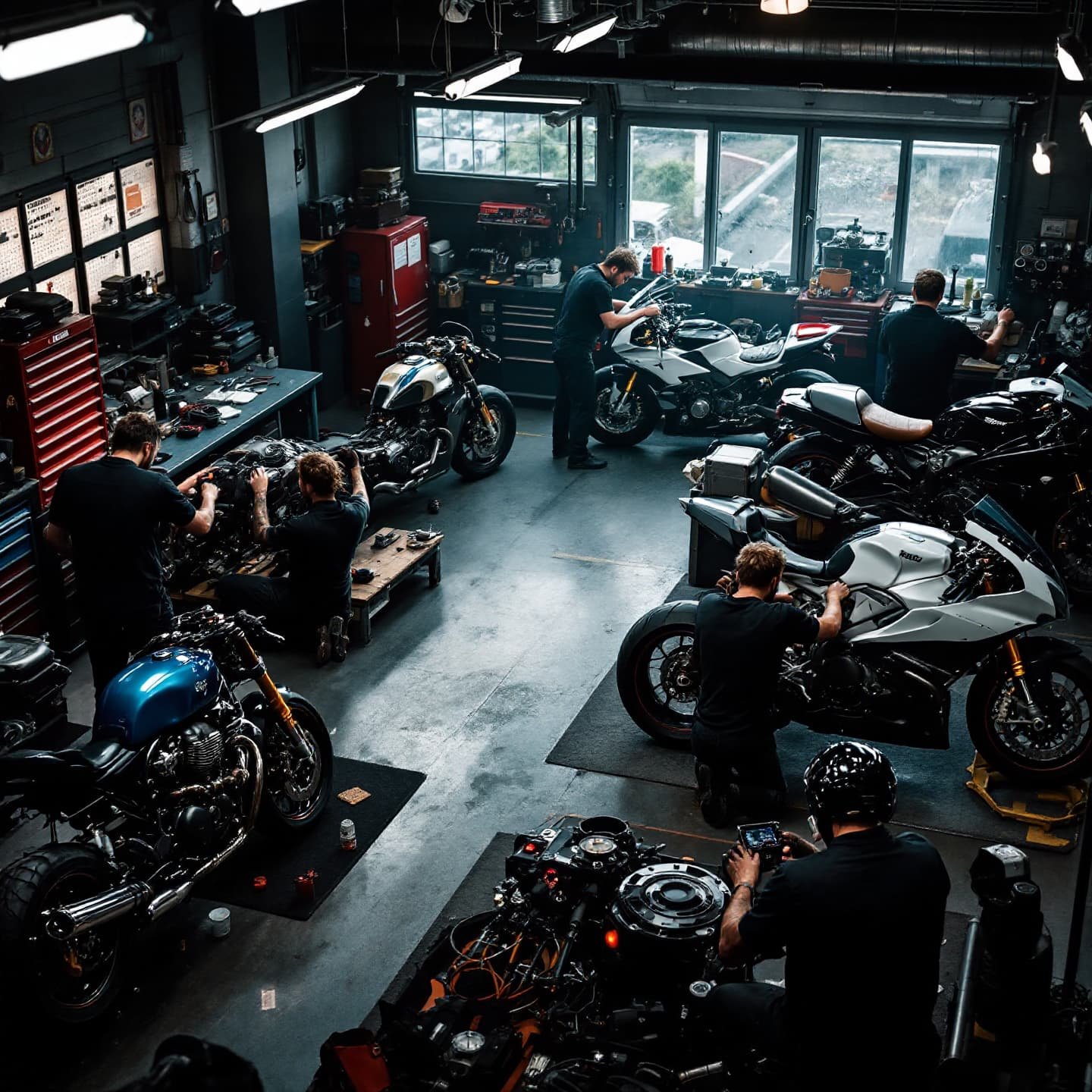
Course on managing workshops specializing in motorcycles
- Format: Hybrid
- Duration: 3 months
- Hours: 300 H
- Language: English / Spanish
- Registration date: 23-10-2026
- Start date: 12-12-2026
- Available places: 2
575 $
Competencies and results
What you will learn
1. Expert and Profitable Management of Motorcycle Workshops
- Efficient management of spare parts and tool inventory.
- Advanced diagnostic and repair techniques for the latest generation of motorcycle engines.
- Strategies for optimizing customer service and loyalty.
- Implementation of quality management systems in the workshop.
- Development of accurate and profitable budgets.
- Digital marketing and promotional strategies for motorcycle workshops.
- Analysis of workshop costs and profitability.
- Personnel management and effective leadership in the workshop environment.
- Knowledge of legal regulations and occupational safety applicable to motorcycle workshops.
- Application of digital technologies and tools for workshop management.
2. Comprehensive Mastery of Motorcycle Workshop Management
2. Comprehensive Mastery of Motorcycle Workshop Management
- Fundamental Principles of Motorcycle Mechanics: You will understand the basic structure of motorcycles, including the engine, transmission, chassis, and auxiliary systems.
- Advanced Fault Diagnosis: You will learn to use sophisticated diagnostic tools, from OBD-II scanners to gas analyzers, to identify complex problems in motorcycle electrical, electronic, and mechanical systems.
- Efficient Workshop Management: You will master workshop organization and optimization techniques, including spare parts inventory management, appointment scheduling, and cost and profitability control.
- Specialized Repair and Maintenance: You will acquire practical skills in repairing specific components such as engines (including fuel injection and carburetion systems), suspensions, ABS brakes, and transmission systems (chains, belts, clutches).
- Motorcycle Electronics and Electrical Systems: You will You will become familiar with modern electrical and electronic systems, including the operation of sensors, actuators, electronic control units (ECUs), and lighting systems, as well as troubleshooting complex electrical problems.
Personnel Management and Customer Service: You will develop skills to lead work teams, manage customer service, and build strong relationships with workshop suppliers and customers.
Workshop Safety: You will learn to implement safety practices in the workshop, including the correct use of tools, the handling of chemicals and waste, and the prevention of workplace accidents.
Workshop Marketing and Promotion: You will discover strategies to promote your workshop, including the use of social media, online and offline advertising, and customer loyalty.
Legislation and Regulations: You will become familiar with the legal regulations related to motorcycle repair, including work warranties, data protection, and environmental regulations.
Trends and Technologies Emerging Trends: You’ll stay up-to-date on the latest trends and technologies in the motorcycle world, including electric vehicles, Advanced Driver Assistance Systems (ADAS), and connectivity.
3. Comprehensive user-oriented design and validation (from modeling to manufacturing)
You will learn to integrate the entire product development process, from initial model conception to final validation, applying user-centered methodologies. You will develop skills in parametric design, ergonomics, simulation, sustainable materials, 3D visualization, and manufacturing management, ensuring efficient, safe solutions that meet current industry standards.
4. Management Strategies for Successful Motorcycle Workshops
4. Management Strategies for Successful Motorcycle Repair Shops
Strategic Planning and Organization of the Workshop: Defining mission, vision, and values. SWOT analysis (Strengths, Weaknesses, Opportunities, Threats) applied to the business.
Financial and Budgetary Management: Budgeting, cost control, and profitability. Break-even point analysis and competitive pricing strategies.
Inventory and Supply Management: Stock control, purchasing optimization, and supplier negotiation. Implementation of inventory management systems (e.g., Kanban).
Marketing and Sales: Online and offline promotion and advertising strategies. Social media management and online reputation management. Customer loyalty and cross-selling techniques.
Human Resources Management: Recruitment, selection, and training of personnel. Performance management and team motivation. Compliance with current labor regulations.
Quality Management and Customer Service: Establishment of quality standards and work procedures. Exceptional customer service and management of complaints and claims.
Workshop Management and Workflow: Organization of the physical space and optimization of workflow. Implementation of workshop management software (e.g., TallerMecánico).
Legal and Regulatory Aspects: Compliance with safety and environmental regulations. Licenses, insurance, and workshop responsibilities.
Data Analysis and KPIs: Measurement and monitoring of key performance indicators (KPIs). Data-driven decision-making and continuous improvement.
Adaptation to New Technologies and Market Trends: Electronic diagnostics, electric vehicles, and other innovations. Ongoing training and knowledge updates.
5. Master's Degree in Management and Profitability for Specialized Motorcycle Workshops
- Fundamentals of Business Management: Master the key principles for the efficient management of a motorcycle repair shop, including strategic planning, organization, and control.
- Financial Analysis and Accounting: Interpret financial statements, analyze costs, budgets, and profitability specific to the motorcycle repair industry.
- Specialized Marketing and Sales: Develop digital and traditional marketing strategies focused on the target audience of motorcycle repair shops, including branding, positioning, and customer loyalty.
- Operations and Process Management: Optimize workflows, spare parts inventory management, and appointment scheduling, seeking efficiency and reduced operating costs.
- Profitability and Strategic Pricing: Implement competitive and profitable pricing strategies, considering costs, profit margins, and the perceived value of the product or service. customer.
- Human Resources Management: Lead and manage work teams, including the recruitment, training, motivation, and evaluation of technical and administrative staff.
- Technology and Digitalization: Integrate digital tools, workshop management software, diagnostic systems, and online platforms to optimize operations and improve the customer experience.
- Legislation and Regulations: Understand and comply with the specific legal and regulatory requirements for motorcycle workshops, including licenses, insurance, and workplace safety.
- Market and Competitive Analysis: Conduct market research, competitive analysis, and identify opportunities for growth and differentiation in the sector.
- Innovation and New Trends: Stay abreast of the latest trends in the motorcycle market, including electric models, cutting-edge technologies, and new business opportunities.
6. Excellence in Motorcycle Workshop Management: A Comprehensive Course
6.
Financial management of the workshop: Cost control, profitability analysis, and budgeting.
Financial management of the workshop: Cost control, profitability analysis, and budgeting.
Who this program is for:
Course on managing workshops specializing in motorcycles
- Motorcycle workshop owners and managers.
- Motorcycle technicians and mechanics who wish to improve their management skills.
- Entrepreneurs interested in opening or expanding a motorcycle workshop.
- Motorcycle workshop supervisors and coordinators.
- Standards-driven curriculum: you will work with CS-27/CS-29, DO-160, DO-178C/DO-254, ARP4754A/ARP4761, ADS-33E-PRF from the first module.
- Accreditable laboratories (EN ISO/IEC 17025) with rotor bench, EMC/Lightning pre-compliance, HIL/SIL, vibrations/acoustics.
- Evidence-oriented TFM: safety case, test plan, compliance dossierand operational limits.
- Mentored by industry: teachers with experience in rotorcraft, tiltrotor, eVTOL/UAM and flight test.
- Flexible modality (hybrid/online), international cohorts and support from SEIUM Career Services.
- Ethics and security: safety-by-design approach, cyber-OT, DIH and compliance as pillars.
1.1 Importance of Management in Motorcycle Workshops
1.2 Workshop Structure and Organization
1.3 Applicable Legislation and Regulations
1.4 Types of Workshops and Specializations
1.5 The Customer: Needs and Expectations
1.6 Introduction to Basic Administration
1.7 Workshop Safety Principles
1.8 Essential Tools and Equipment
1.9 Suppliers and Spare Parts Selection
1.10 Basic Marketing for Motorcycle Workshops
2. Initial Workshop Diagnosis and Evaluation
3. Layout Design and Space Distribution
4. Capacity and Resource Planning
5. Inventory Management and Stock Control
6. Workflow and Process Organization
7. Establishing Standards and Operating Procedures
8. Implementing Management Tools and Software
9. Creating a Preventive Maintenance Schedule
20. Defining Staff Roles and Responsibilities
22. Developing a Quality Control System
3.3 Legal Framework and Naval Regulations
3.2 Maritime Safety: Fundamental Principles
3.3 Legislation on Ships and Vessels
3.4 Responsibilities and Obligations of Naval Personnel
3.5 Accident Prevention and Environmental Protection
3.6 Onboard Safety Regulations
3.7 International Maritime Law
3.8 Investigation of Maritime Incidents
3.9 First Aid and Rescue at Sea
3.30 Protection of the Marine Environment
4.4 Essential Accounting and Financial Statements
4.2 Budgets and Financial Projections
4.3 Cost Analysis and Pricing
4.4 Cash Flow Management
4.5 Financial Key Performance Indicators (KPIs)
4.6 Inventory Control and Purchasing Management
4.7 Profitability Analysis and Profit Margin
4.8 Financing and Investment Options
4.9 Financial Management Tools and Software
4.40 Strategies for Continuous Improvement and Profitability
5.5 Cost Analysis and Budgeting in Motorcycle Repair Shops
5.5 Pricing Strategies to Maximize Profitability
5.3 Key Performance Indicators (KPIs) for Financial Monitoring
5.4 Financial Planning and Cash Flow Management
5.5 Digital Marketing and Promotion to Increase the Customer Base
5.6 Customer Loyalty and Rewards Programs
5.7 Business Expansion: Opportunities and Challenges
5.8 Inventory Management and Merchandise Cost Control
5.9 Competitive Analysis and Market Positioning
5.50 Sustainable Growth and Scalability Strategies
6.6 Fundamentals of Motorcycle Workshop Management
6.2 Workshop Structure and Organization: Design and Layout
6.3 Inventory Management: Stock and Supply Control
6.4 Financial Management: Budgeting and Cost Control
6.5 Marketing and Sales: Strategies for Attracting Customers
6.6 Human Resources Management: Staffing and Training
6.7 Customer Service: Loyalty and Experience
6.8 Quality Control: Ensuring Satisfaction
6.9 Regulations and Legislation: Legal Compliance
6.60 Profitability Analysis: Key Indicators and Continuous Improvement
- Hands-on methodology: test-before-you-trust, design reviews, failure analysis, compliance evidence.
- Software (depending on licenses/partners): MATLAB/Simulink, Python (NumPy/SciPy), OpenVSP, SU2/OpenFOAM, Nastran/Abaqus, AMESim/Modelica, acoustics tools, planning toolchains DO-178C.
- SEIUM Laboratories: scale rotor bench, vibrations/acoustics, EMC/Lightning pre-compliance, HIL/SIL for AFCS, data acquisition with strain gauging.
- Standards and compliance: EN 9100, 17025, ISO 27001, GDPR.
Capstone-type projects
- Workshop Profitability: Financial analysis and pricing strategies to maximize profits.
- Inventory Management: Implementation of efficient systems to optimize stock and reduce costs.
- Digital Marketing: SEO and social media strategies to attract customers and increase online visibility.
- Customer Experience: Design of exceptional service to build customer loyalty and generate referrals.
- Workshop Profitability: Cost analysis, pricing, digital marketing strategies, and customer loyalty.
- Operations Management: Inventory optimization, quality control, appointment management, and efficient workflow.
- Financial Analysis: Budgeting, key performance indicators (KPIs), and profit maximization.
- Leadership Strategies: Personnel management, motivation, and skills development for the team.
- Business Plan: Market analysis, cost structure, financial projections.
- Operational Management: Workflow optimization, inventory control, supplier management.
- Digital Marketing: SEO, social media, online advertising for customer acquisition.
- Customer Management: CRM, customer loyalty, customer experience, and after-sales service.
- Business Plan: SWOT Analysis, Market Research, Digital Marketing Strategies, Financial Plan, and Profitability Projections.
- Operational Management: Process Optimization, Inventory Control, Supplier Management, Implementation of Management Software, and KPIs.
- Customer Experience: Customer Experience Design, Customer Loyalty, and Management of Complaints and Online Reviews.
- Human Resources: Selection and Training of Technical Staff, Leadership, Motivation, and Team Management.
Admissions, fees, and scholarships
- Profile: Background in Computer Engineering, Mathematics, Statistics, or related fields; practical experience in NLP and valued information retrieval systems.
- Documentation: Updated CV, academic transcript, SOP/statement of purpose, project examples or code (optional).
- Process: Application → Technical evaluation of profile and experience → Technical interview → Review of case studies → Final decision → Enrollment.
- Fees:
- Single payment: 10% discount.
- Payment in 3 installments: No fees; 30% upon registration + 2 equal monthly payments of the remaining 35%.
Monthly payment: available with a 7% commission on the total; annual review.
Scholarships: based on academic merit, financial need, and promoting inclusion; agreements with companies in the sector for partial or full scholarships.
See “Calendar & Calls for Applications,” “Scholarships & Grants,” and “Fees & Financing” in the SEIUM mega-menu.
Do you have any questions?
Our team is ready to help you. Contact us, and we will respond as soon as possible.
F. A. Q
Frequently asked questions
Yes, we have international certification
Yes: experimental models, real data, applied simulations, professional environments, real case studies.
It is not mandatory. We offer leveling tracks and tutoring.
Completely. It covers e-propulsion, integration, and emerging regulations (SC-VTOL).
Recommended. There are also internal challenges and consortiums.
Yes. Online/hybrid modality with planned labs and visa support (see “Visa & Residence”).