

Electrical diagnostics course using a multimeter for motorcycles
About our
Motorcycle Electrical Diagnostics with Multimeter
This course equips you with the essential skills to diagnose electrical problems in motorcycles. It focuses on the practical use of the multimeter for voltage, current, and resistance measurements, as well as interpreting diagrams and troubleshooting systems such as ignition, charging, and lighting. The course covers electrical safety and the methodology for identifying and correcting common problems, improving your ability to perform preventive maintenance and repair motorcycles.
Through practical exercises, you will learn to identify short circuits, open circuits, and faulty components, optimizing motorcycle performance and reliability. The course also covers components such as sensors, actuators, and the battery, enabling you to perform a complete diagnostic. This training is ideal for mechanics, motorcycle enthusiasts, and anyone interested in developing a solid foundation in automotive electronics.
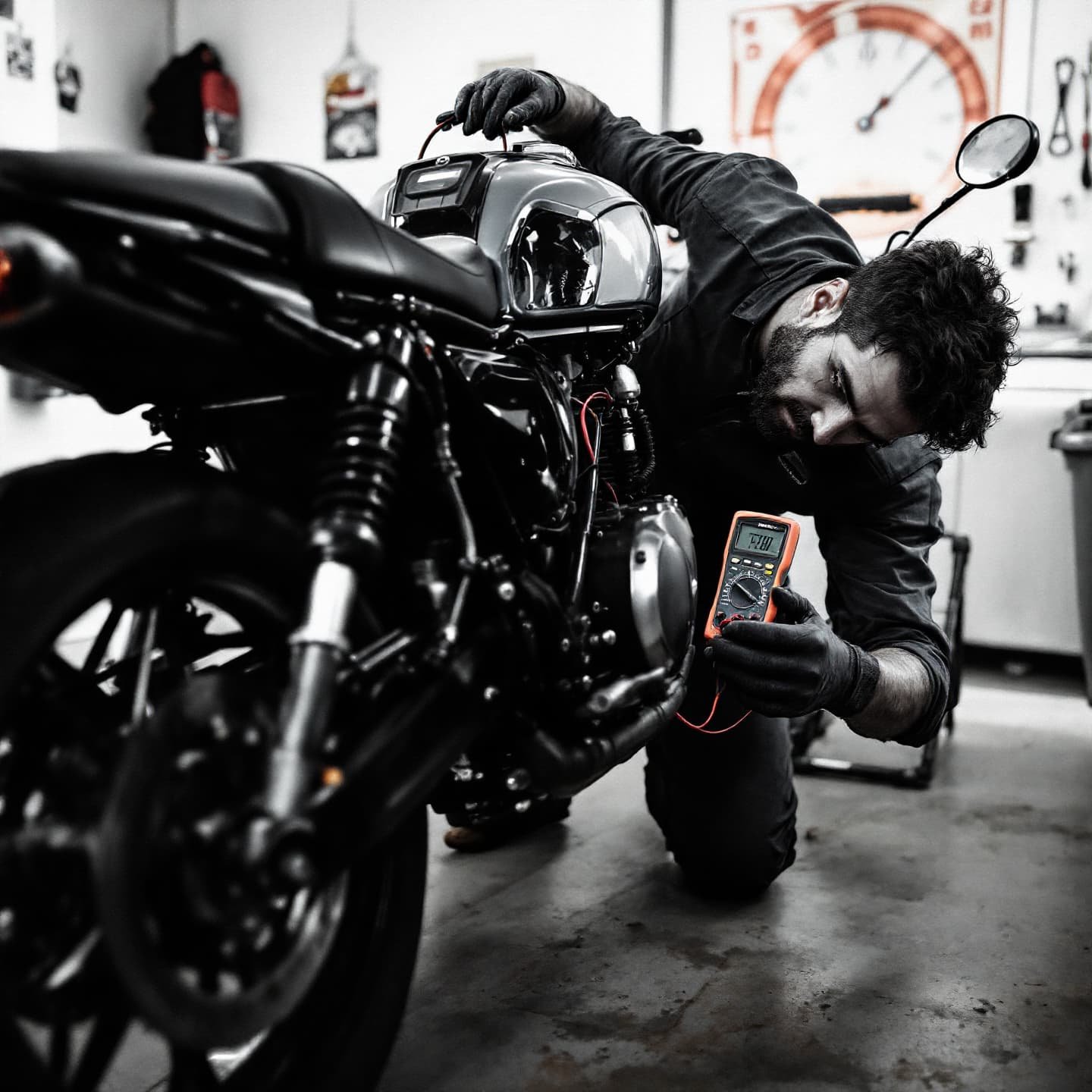
Electrical diagnostics course using a multimeter for motorcycles
- Format: Hybrid
- Duration: 3 months
- Hours: 300 H
- Language: English / Spanish
- Registration date: 23-10-2026
- Start date: 12-12-2026
- Available places: 3
550 $
Competencies and results
What you will learn
1. Motorcycle Electrical Diagnostics: Mastering the Multimeter to Troubleshoot
- Understand the operation of a motorcycle’s electrical system.
- Use a multimeter to measure voltage, current, and resistance.
- Identify the key electrical components of a motorcycle and their functions.
- Diagnosticate faults in the charging, ignition, lighting, and starting systems.
- Interpret electrical diagrams and wiring schematics.
- Perform continuity, short-circuit, and current leakage tests.
- Troubleshoot sensors, actuators, and electronic control modules.
- Apply step-by-step diagnostic techniques to resolve common faults.
- Use specialized diagnostic tools and equipment.
- Learn to repair and replace faulty electrical components.
2. Rotor Optimization: Analysis and Superior Performance
- Identify and analyze rotor dynamics, including the study of flap-lag-torsion couplings.
- Evaluate the structural stability and performance of rotors, addressing phenomena such as whirl flutter.
- Understand and evaluate material fatigue in rotors, implementing analysis and mitigation techniques.
- Design and dimension rotor components using advanced composite materials.
- Apply finite element analysis (FE) methods to optimize the design of laminates in composites, joints, and bonded joints.
- Evaluate the structural integrity and behavior of joints using FEA.
- Implement damage tolerance strategies to ensure the safety and reliability of the rotors.
- Use non-destructive testing (NDT) techniques such as UT (ultrasound), RT (radiography), and thermography for rotor inspection.
- Interpret the NDT test results to assess the condition of components and detect potential defects.
3. Comprehensive user-oriented design and validation (from modeling to manufacturing)
You will learn to integrate the entire product development process, from initial model conception to final validation, applying user-centered methodologies. You will develop skills in parametric design, ergonomics, simulation, sustainable materials, 3D visualization, and manufacturing management, ensuring efficient, safe solutions that meet current industry standards.
4. Motorcycle Course: Advanced Electrical Diagnostics with Multimeter
- Identify complex electrical faults in motorcycles using a multimeter.
- Interpret advanced electrical diagrams and apply them to diagnostics.
- Measure voltage, current, and resistance in critical electrical circuits of the motorcycle.
- Accurately detect short circuits, open circuits, and current leaks.
- Diagnosticate problems in ignition, charging, and starting systems.
- Analyze the operation of sensors and actuators with a multimeter.
- Use the multimeter to check the condition of the battery and alternator.
- Interpret and apply measurement results to troubleshoot problems.
- Learn advanced electrical measurement and diagnostic techniques.
- Troubleshoot efficiently and safely.
5. Multimeter in Motorcycles: Accurate and Effective Electrical Diagnosis
5. **Multimeter on Motorcycles: Accurate and Effective Electrical Diagnostics**
- Identify and understand the essential electrical components of a motorcycle.
- Master the use of a multimeter to measure voltage, current, resistance, and continuity in motorcycle circuits.
- Diagnosticate common electrical faults, such as battery, ignition system, and lighting problems.
- Interpret motorcycle electrical diagrams to trace and troubleshoot problems.
- Perform tests and measurements on sensors, actuators, and electronic control units (ECUs).
- Use the multimeter to check the condition of fuses, relays, and wiring.
- Troubleshoot battery charging and general charging system issues.
- Apply advanced diagnostic techniques to identify intermittent faults and connection problems.
- Learn to use the multimeter safely and efficient, avoiding damage to components and the equipment itself.
Develop electrical troubleshooting skills for motorcycles to perform accurate and effective repairs.
6. Motorcycle Electrical Diagnostics: Multimeter, Your Key Tool for Repair
6. Motorcycle Electrical Diagnostics: Multimeter, Your Key Tool for Repair
- Identify and understand the essential electrical components of a motorcycle: battery, alternator, ignition system, lights, sensors, and actuators.
- Master the use of a multimeter to measure voltage, current, resistance, and continuity in the motorcycle’s electrical circuits.
- Perform diagnostic tests on the battery to determine its condition and detect potential faults.
- Verify the operation of the alternator and voltage regulator to ensure proper battery charging.
- Diagnosticate problems in the ignition system, including spark plugs, coils, and wiring, using a multimeter.
- Identify and troubleshoot faults in the motorcycle’s lighting system (headlights, taillights, turn signals).
- Interpret motorcycle electrical diagrams to facilitate troubleshooting and component repair.
- Use a multimeter to diagnose and troubleshoot engine sensors and actuators (crankshaft position sensor, temperature sensor, etc.).
- Apply diagnostic techniques to identify short circuits, loose connections, and other common electrical system faults.
- Learn to perform basic repairs on the motorcycle’s electrical system, such as replacing fuses, repairing wires, and connecting new components.
Who this program is for:
Electrical diagnostics course using a multimeter for motorcycles
- Motorcycle mechanics and repair technicians who wish to expand their knowledge of electrical systems.
- Motorcycle workshop owners looking to improve the quality and efficiency of their diagnostics.
- Motorcycle mechanics enthusiasts who wish to learn how to diagnose and troubleshoot electrical problems.
- Students of technical programs related to automotive or motorcycle mechanics.
- Standards-driven curriculum: you will work with CS-27/CS-29, DO-160, DO-178C/DO-254, ARP4754A/ARP4761, ADS-33E-PRF from the first module.
- Accreditable laboratories (EN ISO/IEC 17025) with rotor bench, EMC/Lightning pre-compliance, HIL/SIL, vibrations/acoustics.
- Evidence-oriented TFM: safety case, test plan, compliance dossierand operational limits.
- Mentored by industry: teachers with experience in rotorcraft, tiltrotor, eVTOL/UAM and flight test.
- Flexible modality (hybrid/online), international cohorts and support from SEIUM Career Services.
- Ethics and security: safety-by-design approach, cyber-OT, DIH and compliance as pillars.
Module 1 — Introduction to the Multimeter and Electrical Safety
1.1 Motorcycle Electrical Fundamentals: Current, Voltage, and Resistance
1.2 Common Electrical Components in Motorcycles: Battery, Alternator, Ignition Coils
1.3 The Multimeter: Introduction and Basic Functions (Voltage, Current, Resistance)
1.4 Selecting the Right Multimeter for Motorcycles: Types and Characteristics
1.5 Electrical Safety: Risk Prevention and Use of Personal Protective Equipment
1.6 Safety Standards in the Motorcycle Workshop
1.7 Multimeter Settings: Ranges and Scales
1.8 Initial Measurements: Battery Voltage and Continuity Tests
1.9 Interpreting Readings and Basic Tips
1.10 Practice: Simple Exercises with the Multimeter and Basic Components
2.2 Rotor Operating Principles: Components and Structure
2.2 Analysis of Common Rotor Failures: Identification and Causes
2.3 Rotor Measurements and Tests with a Multimeter: Resistance, Continuity, and Voltage
2.4 Rotor Winding Diagnosis: Detection of Short Circuits and Open Circuits
2.5 Verification of Rotor Magnets: Force and Magnetism Tests
2.6 Rotor Performance Optimization: Adjustments and Calibration
2.7 Rotor Temperature Considerations: Overloading and Overheating
2.8 Rotor Preventive Maintenance: Inspection and Cleaning
2.9 Troubleshooting Specific Rotor Problems: Common Failures and Remedies
2.20 Rotor Replacement and Repair: Procedures and Tools
3.3 Motorcycle Electrical Fundamentals: Basic electrical circuits and key components.
3.2 Introduction to the multimeter: Use, functions, and diagnostic settings.
3.3 Identifying common electrical faults: Wires, sensors, coils, and more.
3.4 Continuity and resistance testing: Detecting short circuits and damaged components.
3.5 Voltage and current measurement: Analyzing power supply and energy consumption.
3.6 Charging system diagnostics: Battery, alternator, and regulator/rectifier.
3.7 Ignition system diagnostics: Coils, spark plugs, and position sensors.
3.8 Troubleshooting lighting and signaling systems.
3.9 Practical application: Real-world diagnostic and repair scenarios using a multimeter.
3.30 Preventive maintenance and tips for avoiding electrical faults.
4.4 Multimeter Fundamentals: Key Concepts for Electrical Measurement
4.2 Motorcycle Electrical Components: Identification and Operation
4.3 Basic Measurements: Voltage, Current, and Resistance in Motorcycle Circuits
4.4 Battery Diagnostics: Tests and Solutions
4.5 Charging System: Alternator and Regulator Evaluation
4.6 Ignition System: Coil, Spark Plug, and Sensor Diagnostics
4.7 Motorcycle Sensors: Testing and Troubleshooting
4.8 Lighting Circuits: Lights and Signal Diagnostics
4.9 Starting System: Starter Motor and Relay Evaluation
4.40 Practical Cases: Troubleshooting Common Problems with a Multimeter
5.5 Multimeter Fundamentals: Key Components and Functions
5.5 Voltage Measurements: Circuit and Battery Diagnostics
5.3 Current Measurements: Short Circuit Detection and Current Draw
5.4 Resistance Measurement: Sensor and Cable Analysis
5.5 Continuity Testing: Identifying Broken Wires and Connections
5.6 Ignition System Troubleshooting
5.7 Sensor Verification: TPS, MAP, and Other Sensors
5.8 Charging System Analysis: Alternator and Regulator
5.9 Troubleshooting: Advanced Diagnostic Techniques
5.50 Preventive Maintenance: Using the Multimeter for Prevention
6.6 Introduction to the Multimeter: Basic Concepts and Operation
6.2 Multimeter Selection: Types and Features for Motorcycles
6.3 Voltage Measurements: Battery and Circuit Diagnosis
6.4 Current Measurements: Evaluating Current Consumption and Component Failures
6.5 Resistance Measurements: Identifying Short Circuits and Damaged Components
6.6 Continuity Testing: Checking Cables and Connections
6.7 Sensor Diagnosis: Using the Multimeter on Common Sensors
6.8 Troubleshooting: Practical Application in Motorcycle Electrical Systems
6.9 Preventive Maintenance: Using the Multimeter to Detect Problems
6.60 Safety Tips: Safe Multimeter Operation and Precautions
- Hands-on methodology: test-before-you-trust, design reviews, failure analysis, compliance evidence.
- Software (depending on licenses/partners): MATLAB/Simulink, Python (NumPy/SciPy), OpenVSP, SU2/OpenFOAM, Nastran/Abaqus, AMESim/Modelica, acoustics tools, planning toolchains DO-178C.
- SEIUM Laboratories: scale rotor bench, vibrations/acoustics, EMC/Lightning pre-compliance, HIL/SIL for AFCS, data acquisition with strain gauging.
- Standards and compliance: EN 9100, 17025, ISO 27001, GDPR.
Capstone-type projects
- Motorcycle Electrical System Diagnosis and Repair: Circuit analysis, advanced multimeter use, troubleshooting.
- Motorcycle Electrical Diagnostics: System analysis, multimeter use, troubleshooting.
- Motorcycle Electronics: Problem identification, accurate measurements, effective repair.
- Multimeter on Motorcycles: Component verification, reading interpretation, preventative maintenance.
- Advanced Diagnostics: Multimeter and Electrical Troubleshooting.
- Analysis and Repair: Using the Multimeter on Complex Electrical Systems.
- Circuit Optimization: Accurately Identifying and Solving Problems.
- Key Techniques: Efficient Electrical Measurement, Analysis, and Repair.
- Advanced Electrical Diagnostics: Using a multimeter to detect faults.
- Effective Repair: Identifying and resolving electrical problems.
- Key Tools: Mastering the multimeter for repairs.
Admissions, fees, and scholarships
- Profile: Background in Computer Engineering, Mathematics, Statistics, or related fields; practical experience in NLP and valued information retrieval systems.
- Documentation: Updated CV, academic transcript, SOP/statement of purpose, project examples or code (optional).
- Process: Application → Technical evaluation of profile and experience → Technical interview → Review of case studies → Final decision → Enrollment.
- Fees:
- Single payment: 10% discount.
- Payment in 3 installments: No fees; 30% upon registration + 2 equal monthly payments of the remaining 35%.
Monthly payment: available with a 7% commission on the total; annual review.
Scholarships: based on academic merit, financial need, and promoting inclusion; agreements with companies in the sector for partial or full scholarships.
See “Calendar & Calls for Applications,” “Scholarships & Grants,” and “Fees & Financing” in the SEIUM mega-menu.
Do you have any questions?
Our team is ready to help you. Contact us, and we will respond as soon as possible.
F. A. Q
Frequently asked questions
Yes, we have international certification
Yes: experimental models, real data, applied simulations, professional environments, real case studies.
It is not mandatory. We offer leveling tracks and tutoring.
Completely. It covers e-propulsion, integration, and emerging regulations (SC-VTOL).
Recommended. There are also internal challenges and consortiums.
Yes. Online/hybrid modality with planned labs and visa support (see “Visa & Residence”).