

Basic preparation course for amateur rally cars
About our
Basic Preparation Course for Amateur Rally Cars
This course offers a practical introduction to the exciting world of rallying. It focuses on acquiring fundamental knowledge of basic automotive mechanics, rally safety, and driving techniques. Participants will learn about vehicle preparation, including suspension, brakes, and tires, as well as rally rules and first aid. The course combines theory and practice, culminating in simulations and track tests to reinforce learning.
The program focuses on developing the skills necessary to participate safely and effectively in amateur rally events. Basic tools are used, and participants learn how to perform preventative maintenance and how to react to critical situations on the track, all while adhering to safety regulations. This training prepares participants to work as amateur drivers, co-drivers, and team technicians, fostering a passion for motorsport.
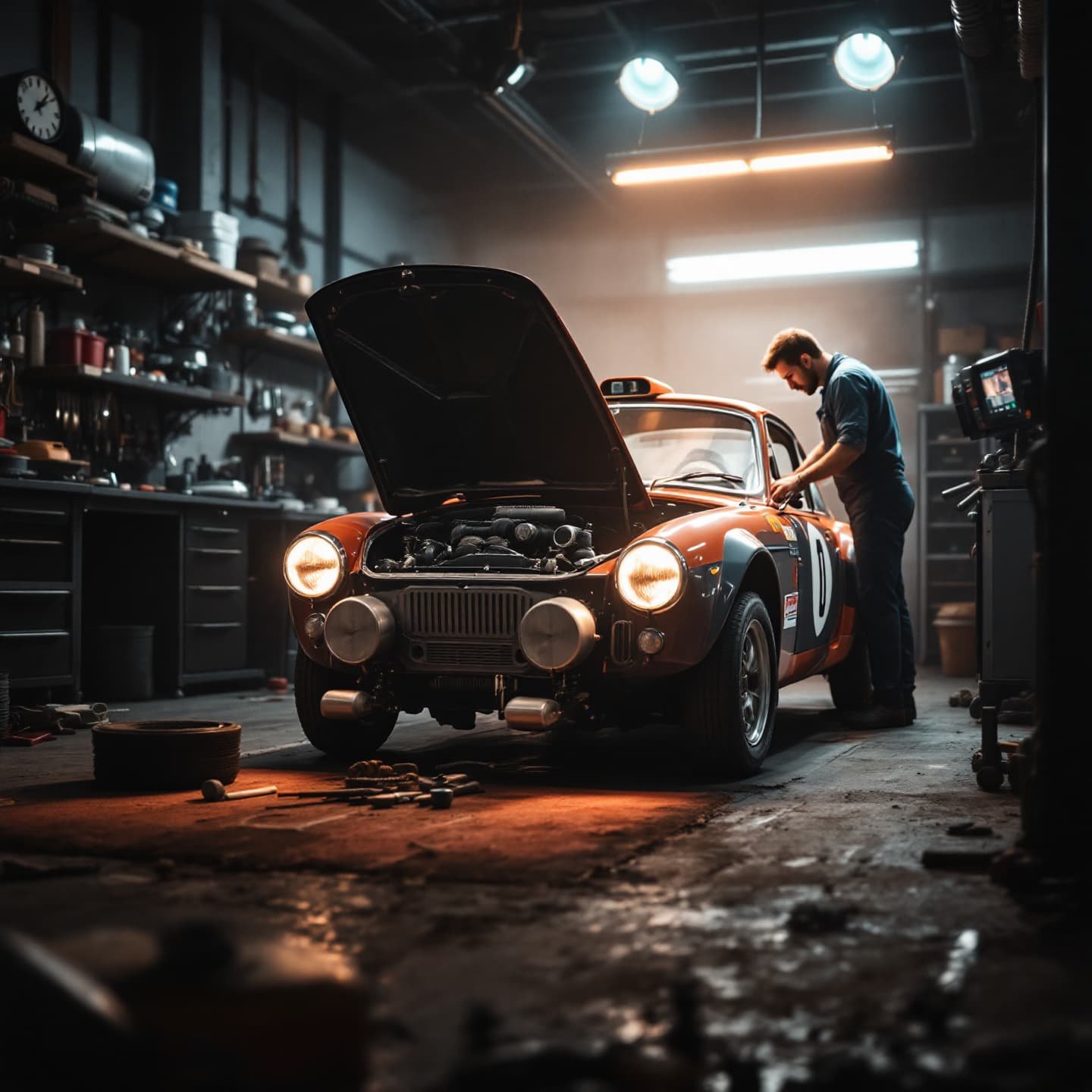
Basic preparation course for amateur rally cars
- Format: Hybrid
- Duration: 3 months
- Hours: 300 H
- Language: English / Spanish
- Registration date: 23-10-2026
- Start date: 12-12-2026
- Available places: 3
349 $
Competencies and results
What you will learn
1. Total Mastery: Preparation and Technique for Amateur Rally
- Develop navigation and route planning strategies for amateur rallies, including map interpretation and the use of basic navigation instruments.
- Understand the specific regulations and rules of amateur rallies, including safety requirements and penalties.
- Learn safe and efficient driving techniques for rallies, such as vehicle control on different terrains and in various weather conditions.
- Acquire knowledge of basic mechanics and preventive vehicle maintenance to ensure its proper functioning during the rally.
- Practice teamwork skills and effective communication with the co-driver to optimize performance in competition.
2. Unlock the Podium: Fundamentals and Strategies to Succeed in Amateur Rally
## What Will You Learn in “Unlock the Podium: Fundamentals and Strategies for Success in Amateur Rallying”?
1. **Fundamental Knowledge:**
* Master the rules and regulations of amateur rallying.
* Understand the importance of road and personal safety.
* Become familiar with rally-specific terminology.
2. **Driving and Navigation Techniques:**
* Refine vehicle control in different terrain and weather conditions.
* Learn defensive and offensive driving techniques.
* Develop navigation skills using maps, GPS, and other tools.
3. **Race Strategies:**
* Design an effective race plan, considering the route, time, and competitors.
* Manage race pace to optimize performance and endurance.
* Apply overtaking and positioning strategies.
4. **Vehicle Preparation:**
* Understand the basic mechanical aspects of the vehicle and how to prepare it for rallying.
* Learn about tires, suspension, and other key components.
* Perform preventative maintenance and troubleshoot common problems.
5. **Team and Resource Management:**
* Work as a team with your co-driver and other team members.
* Manage the budget and resources efficiently.
* Learn to cope with the pressure and stress of competition.
6. **Analysis and Continuous Improvement:**
* Evaluate your own and the team’s performance after each race.
* Identify areas for improvement and develop strategies to optimize performance.
* Stay up-to-date on the latest rally trends and technologies.
3. Comprehensive user-oriented design and validation (from modeling to manufacturing)
You will learn to integrate the entire product development process, from initial model conception to final validation, applying user-centered methodologies. You will develop skills in parametric design, ergonomics, simulation, sustainable materials, 3D visualization, and manufacturing management, ensuring efficient, safe solutions that meet current industry standards.
4. Amateur Rally: From Beginner to Driver, Master Preparation Guide
4. Amateur Rally: From Beginner to Pilot, Master Preparation Guide
- Master basic navigation: You will learn to read nautical charts, use a compass and GPS, and understand the fundamental concepts of dead reckoning.
- Understand marine meteorology: You will learn about weather patterns, how to interpret forecasts, and how to make safe decisions based on the weather.
- Learn to maneuver a sailboat: You will practice essential maneuvers, such as tacking, changing course, and docking and undocking in different conditions.
- Master safety at sea: You will become familiar with safety equipment, learn how to prevent accidents, and know how to act in emergency situations.
- Prepare the boat for the regatta: You will understand the importance of sail trim, system adjustments, and optimizing the boat’s performance.
- Develop regatta strategies: You will learn to Read the racecourse, make tactical decisions, and compete effectively.
Refine your sailing skills: Through practical exercises and simulations, you will improve your ability to navigate in different situations and conditions.
Understand the regulations and racing rules: You will become familiar with the racing regulations and learn to compete according to the established rules.
Manage the logistics of a race: You will learn to plan trips, organize teams, and manage the practical aspects of participating in a race.
Become an amateur rally driver: You will integrate all the knowledge and skills acquired to become a safe, efficient, and competitive navigator.
5. Amateur Rally: Master the Preparation and Conquer the Track
## What Will You Learn?
5. Amateur Rally: Master Preparation and Conquer the Track
Strategic Route Planning: You will learn to design the ideal route, considering geography, terrain type, and weather conditions.
Navigation and Orientation: You will master the use of maps, compasses, GPS, and other navigation instruments to maintain your course and avoid mistakes.
Vehicle Preparation: You will gain in-depth knowledge of basic mechanics, learn to perform pre-ride inspections, and identify and troubleshoot common vehicle problems to ensure reliability.
Off-Road Driving Techniques: You will develop driving skills on different types of terrain (dirt, sand, mud, rocks), including vehicle control techniques, traction management, and obstacle overcoming.
First Aid and Safety: You will acquire basic first aid knowledge to treat injuries and emergency situations, along with the implementation of personal and vehicle safety measures. Team.
Equipment and Supply Management: You will learn to select and organize essential equipment, including tools, spare parts, food, water, and other supplies needed for the duration of the rally.
Competition Strategies: You will develop strategies to optimize your time, manage your energy, and make tactical decisions during the race to maximize your chances of success.
Rules and Regulations: You will learn the specific rules and regulations of the rally, ensuring compliance and avoiding penalties.
Teamwork and Communication: You will learn to work efficiently as a team with your co-driver, communicating effectively to coordinate navigation and actions during the rally.
Adaptation and Problem Solving: You will develop the ability to adapt to unforeseen situations, solve problems, and make decisions under pressure—crucial elements for completing the rally and conquering the course.
6. Amateur Rally: Optimization, Strategies and Preparation for Victory
6. Amateur Rally: Optimization, Strategies, and Preparation for Victory
Route Design and Planning: Map analysis, navigation systems, and route optimization considering terrain and weather conditions.
Race Strategies: Tire selection, fuel management, and driving techniques to maximize speed and minimize vehicle wear.
Vehicle Preparation: Essential modifications and adjustments to improve car performance and reliability, including suspension, brakes, and engine.
Advanced Driving Techniques: Vehicle control on various surfaces, handling emergency situations, and obstacle avoidance skills.
Data Analysis and Telemetry: Interpreting performance data to identify areas for improvement and adjust strategies in real time.
Regulations and Safety: Knowledge of rally regulations, safety measures, first aid, and emergency management.
Who this program is for:
Basic preparation course for amateur rally cars
- Passionate rally enthusiasts with prior driving and automotive mechanical experience.
- Amateur rally drivers looking to improve their skills and technical knowledge to compete more safely and efficiently.
- Automotive mechanics and rally car tuners who wish to expand their knowledge of preparing and tuning competition cars.
- Motorsport and rally fans who want to acquire a solid foundation of knowledge to better understand how rally cars and the sport in general work.
- Standards-driven curriculum: you will work with CS-27/CS-29, DO-160, DO-178C/DO-254, ARP4754A/ARP4761, ADS-33E-PRF from the first module.
- Accreditable laboratories (EN ISO/IEC 17025) with rotor bench, EMC/Lightning pre-compliance, HIL/SIL, vibrations/acoustics.
- Evidence-oriented TFM: safety case, test plan, compliance dossierand operational limits.
- Mentored by industry: teachers with experience in rotorcraft, tiltrotor, eVTOL/UAM and flight test.
- Flexible modality (hybrid/online), international cohorts and support from SEIUM Career Services.
- Ethics and security: safety-by-design approach, cyber-OT, DIH and compliance as pillars.
1.1 Introduction to Amateur Rallying: What is it and why is it so exciting?
1.2 History of Amateur Rallying: Evolution and key figures.
1.3 The Amateur Rallying Regulations: Structure and objectives.
1.4 Types of Amateur Rallying: Varieties and competition formats.
1.5 Vehicle Categories in Amateur Rallying: Classes and specifications.
1.6 Licenses and Permits Required to Compete.
1.7 Safety in Amateur Rallying: Rules and mandatory measures.
1.8 The Amateur Rallying Team: Roles and responsibilities.
1.9 Amateur Rallying Calendar and Events: Where and when to compete.
1.10 The Spirit of Amateur Rallying: Sportsmanship and community.
2.2 Vehicle Inspection and Preventive Maintenance
2.2 Introduction to Basic Mechanics: Engine, Transmission, and Suspension
2.3 Tires: Selection, Pressure, and Care
2.4 Braking Systems: Fundamentals and Inspection
2.5 Adjustments and Tuning: Essential Elements
2.6 Basic Tools and Equipment for Rallying
2.7 Cockpit Preparation: Safety and Ergonomics
2.8 Legal and Permissible Modifications in Amateur Rallying
2.9 Troubleshooting Common Mechanical Problems During a Race
2.20 On-Road Maintenance Practices and First Aid
3.3 History and Evolution of Amateur Rallying
3.2 Types of Rallies: Regularity, Speed, and Mixed
3.3 General Regulations: National and International Sporting Codes
3.4 Sporting Licenses and Procedures
3.5 Roles and Responsibilities: Driver, Co-driver, Technical Team
3.6 Signals and Flags: Interpretation and Meaning
3.7 Safety in Rallying: Mandatory Equipment and Recommendations
3.8 The Rally Vehicle: Categories and Homologations
3.9 Vehicle Documentation: Technical and Administrative Inspection
3.30 The Spirit of Amateur Rallying: Sportsmanship and Respect
4.4 Introduction to Amateur Rallying: History and Evolution
4.2 General Regulations: Structure and Key Rules
4.3 Types of Amateur Rallies: Formats and Disciplines
4.4 Licenses and Documentation: Requirements and Procedures
4.5 Rally Safety: Equipment and Protocols
4.6 Initial Planning: Objectives and Budget
4.7 Vehicle Selection: Criteria and Considerations
4.8 Track Reconnaissance: Maps and Routes
4.9 Communication: Signals and Codes
4.40 Getting Started: Registration and Participation
5.5 Introduction to Amateur Rallying: History and Evolution.
5.5 Types of Rallies: Regularity Rally, Speed Rally, Off-Road Rally.
5.3 Structure of a Rally: Timed Stages, Liaison Sections, Control Points.
5.4 Roles in Rallying: Driver, Co-driver, Support Team.
5.5 The Regulations: Basic Rules and Safety.
5.6 Mandatory and Recommended Equipment.
5.7 The Importance of Safety: Measures and Protocols.
5.8 Calendar and Events: How to Find and Choose Races.
5.9 Key Concepts: Times, Penalties, Classifications.
5.50 Getting Started: Registration, Licenses, and Initial Procedures.
6.6 Tire Selection and Optimal Pressures
6.2 Route Reconnaissance and Route Planning
6.3 Race Strategies: Pace and Distance Management
6.4 Reference Times and Data Analysis
6.5 Refueling Strategies and Race Logistics
6.6 Effective Communication with Co-driver and Team
6.7 Adapting to Changing Weather Conditions
6.8 Managing Breakdowns and Race Issues
6.9 Race Psychology and Stress Management
6.60 Post-Race Analysis and Continuous Improvement Plan
- Hands-on methodology: test-before-you-trust, design reviews, failure analysis, compliance evidence.
- Software (depending on licenses/partners): MATLAB/Simulink, Python (NumPy/SciPy), OpenVSP, SU2/OpenFOAM, Nastran/Abaqus, AMESim/Modelica, acoustics tools, planning toolchains DO-178C.
- SEIUM Laboratories: scale rotor bench, vibrations/acoustics, EMC/Lightning pre-compliance, HIL/SIL for AFCS, data acquisition with strain gauging.
- Standards and compliance: EN 9100, 17025, ISO 27001, GDPR.
Capstone-type projects
- Strategic Analysis: Route simulation, tire selection, and team management to maximize performance in every race.
- Advanced Mechanical Preparation: Engine, suspension, and brake diagnostics and optimization for optimal performance and reliability.
- Driving and Safety Techniques: Development of driving skills and safety protocols to minimize risks and maximize speed.
- Comprehensive Vehicle Analysis: Aerodynamic optimization, suspension, and braking.
- Race Strategies: Navigation, risk management, and pacing.
- Driver Preparation: Physical and mental training, nutrition, and safety.
- Simulation and Telemetry: Data analysis for continuous improvement.
“`html
- Rally Analysis and Optimization: Aerodynamic design, CFD simulation, correlation, and track testing.
- Race Strategies: Route planning, time management, data analysis, telemetry, and driving techniques.
- Vehicle Preparation: Modifications, suspension, brakes, safety, and tire selection.
- Simulation and Training: Virtual platforms, scenario simulation, and driver and co-driver training.
“`
“`html
- Rally Prep & Tech: Vehicle setup, safety, navigation & mechanical skills.
- Race Strategy: Course analysis, pacing, and competitor assessment.
- Performance Tuning: Suspension, engine optimization & data logging.
- Risk Management: Accident prevention, recovery & emergency response.
“`
Admissions, fees, and scholarships
- Profile: Background in Computer Engineering, Mathematics, Statistics, or related fields; practical experience in NLP and valued information retrieval systems.
- Documentation: Updated CV, academic transcript, SOP/statement of purpose, project examples or code (optional).
- Process: Application → Technical evaluation of profile and experience → Technical interview → Review of case studies → Final decision → Enrollment.
- Fees:
- Single payment: 10% discount.
- Payment in 3 installments: No fees; 30% upon registration + 2 equal monthly payments of the remaining 35%.
Monthly payment: available with a 7% commission on the total; annual review.
Scholarships: based on academic merit, financial need, and promoting inclusion; agreements with companies in the sector for partial or full scholarships.
See “Calendar & Calls for Applications,” “Scholarships & Grants,” and “Fees & Financing” in the SEIUM mega-menu.
Do you have any questions?
Our team is ready to help you. Contact us, and we will respond as soon as possible.
F. A. Q
Frequently asked questions
Yes, we have international certification
Yes: experimental models, real data, applied simulations, professional environments, real case studies.
It is not mandatory. We offer leveling tracks and tutoring.
Completely. It covers e-propulsion, integration, and emerging regulations (SC-VTOL).
Recommended. There are also internal challenges and consortiums.
Yes. Online/hybrid modality with planned labs and visa support (see “Visa & Residence”).