

Diploma in App↔Vehicle↔Charger: Usage Flow and Telemetry

About us Diploma in App↔Vehicle↔Charger: Usage Flow and Telemetry

The Diploma in App↔Vehicle↔Charger: Flow and Usage Telemetry explores the comprehensive architecture of charging systems for electric vehicles, encompassing the design and analysis of the interaction between mobile applications (apps), electric vehicles (EVs), and chargers. It focuses on the development of energy and data management systems, including the study of communication protocols, real-time telemetry, and the optimization of energy flow for an efficient and safe user experience. It includes the analysis of sensors, user interfaces, and data security. The diploma program provides practical knowledge of charging standards, communication protocols (such as OCPP), and emerging technologies such as V2G (Vehicle-to-Grid) and V2L (Vehicle-to-Load). It covers the implementation of intelligent charging management systems, the simulation of usage scenarios, and data analysis for decision-making. The training is geared towards engineers, developers, and professionals interested in electric mobility and the efficient management of energy resources. Target keywords (natural occurrences in the text): mobile applications, electric vehicles, chargers, telemetry, energy flow, communication protocols, V2G, V2L, charge management, electric mobility.
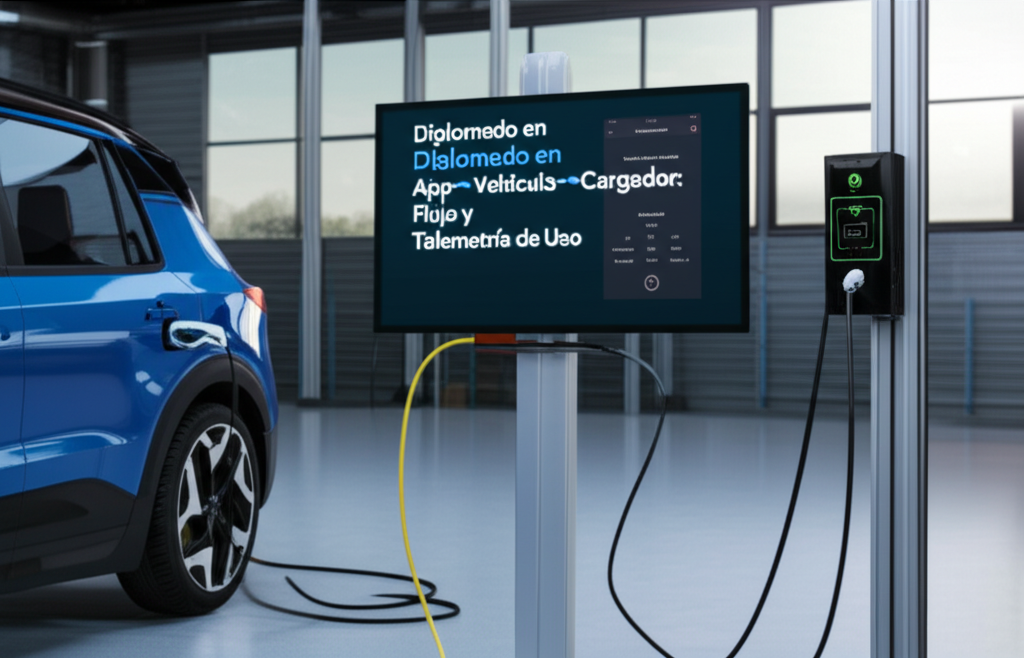
Diploma in App↔Vehicle↔Charger: Usage Flow and Telemetry

875 $

Competencias y resultados

Qué aprenderás

1. Mastering Flow and Telemetry in Apps, Vehicles, and Chargers: A Comprehensive Diploma Program [This section appears to be incomplete and possibly contains errors.]

  • Understand the architecture and design of data flow systems in applications, vehicles, and chargers.
  • Acquire knowledge of telemetry technologies and their implementation in data collection and transmission.
  • Learn to analyze and manage real-time information flow, identifying bottlenecks and optimizing performance.
  • Study the different data sources in applications, vehicles, and chargers, including sensors, control systems, and communication devices.
  • Develop skills in interpreting and visualizing telemetry data for informed decision-making.
  • Explore the security and privacy implications related to the collection and use of telemetry data.
  • Become familiar with the tools and platforms used for data analysis, such as visualization software, databases, and data management systems.
  • Understand the fundamentals of wireless communication and sensor networks used in the Telemetry data transmission.
  • Learn to apply data engineering and machine learning principles for predictive analytics and anomaly detection.

    Study real-world use cases in applications, vehicles, and chargers, and analyze how telemetry data is used to improve efficiency, safety, and user experience.

2. In-Depth Analysis of Data Flow and Telemetry in App-Vehicle-Charger Systems: An Advanced Study [The following appears to be unrelated and possibly machine-translated gibberish:] ...

  • Identify and understand the fundamentals of data flow and telemetry within the App-Vehicle-Charger ecosystem.

  • Evaluate the data architectures used in communication between mobile applications, electric vehicles, and charging stations.

  • Study the communication protocols (e.g., OCPP, MQTT) and data structures used for information exchange.

  • Analyze the critical data types: battery status, charging data, vehicle telemetry, and user data.

  • Develop skills for the efficient collection, processing, and storage of large volumes of telemetry data.

  • Apply advanced data analysis techniques to identify patterns, trends, and anomalies in the data flow.

  • Use data visualization tools to represent information clearly and effectively.

  • Implement security strategies to protect the integrity and confidentiality of transmitted data.

    Investigate the challenges related to latency, bandwidth, and reliability in data transmission.

    Learn about solutions for optimizing communication performance and real-time data management.

    Study the impact of data on load optimization, predictive maintenance, and improving the user experience.

    Explore the use of telemetry for developing predictive models and data-driven decision-making.

    Analyze case studies on the application of telemetry in different electric vehicle and charging contexts.

    Understand the relevant regulations and standards for data management and privacy in the electric vehicle sector.

3. Comprehensive user-oriented design and validation (from modeling to manufacturing)

You will learn to integrate the entire product development process, from initial model conception to final validation, applying user-centered methodologies. You will develop skills in parametric design, ergonomics, simulation, sustainable materials, 3D visualization, and manufacturing management, ensuring efficient, safe solutions that meet current industry standards.

4. Design and Optimization of Data Flow and Telemetry in App-Vehicle-Charger Ecosystems

  • Telemetry Architecture: You will understand the overall structure of telemetry systems, from sensors in the vehicle and charger to mobile applications and cloud servers.

  • Data Sources: You will learn to identify and categorize the different data sources generated by the vehicle (engine, battery, speed, location sensors, etc.) and the charger (charge status, voltage, current, etc.).

    Data Formats and Protocols: You will master the common data formats used in telemetry (JSON, Protocol Buffers, etc.) and communication protocols (MQTT, HTTP, etc.) for efficient data transmission.

    Data Flow Design: You will develop skills to design the data flow from its source to its destination, considering latency, bandwidth, and reliability.

  • Data Flow Optimization: You will acquire techniques to optimize data flow, including data compression, filtering, and aggregation to reduce resource consumption and improve performance.

  • Data Management: You will learn to efficiently manage and store telemetry data, using appropriate databases for analysis and querying.

  • Real-Time Data Analysis: You will become familiar with the tools and techniques for analyzing telemetry data in real time, detecting anomalies and relevant patterns.

  • Data Security: You will understand the importance of security in the transmission and storage of telemetry data and learn how to implement protective measures.

  • Mobile Application Integration: You will explore how to integrate telemetry data into a mobile application to provide valuable information to the user, such as vehicle status, charging history, and alerts.
  • Vehicle and Charger Integration: You will study how the telemetry system interacts with the vehicle and charger, including data acquisition, control, and feedback.

  • Scalability and Fault Tolerance: You will learn to design scalable and fault-tolerant telemetry systems to handle large volumes of data and ensure system availability.

    Case Study: You will analyze real-world case studies of telemetry systems in electric vehicles and charging systems, identifying best practices and common challenges.

5. Stream Decoding and Telemetry: Applications, Electric Vehicles, and Charging Stations

5. Data Stream Decoding and Telemetry: Applications, Electric Vehicles, and Charging Stations

  • Identify and analyze the fundamental principles of telemetry in electric vehicle (EV) systems and charging stations.

  • Describe the different telemetry data decoding techniques, including data formats, communication protocols, and transmission methods.

  • Evaluate the application of telemetry for monitoring and controlling electric vehicles, considering critical parameters such as battery status, motor efficiency, and thermal management.

  • Analyze the implementation of telemetry systems in charging stations, including power supply monitoring, load management, and vehicle communication.

  • Understand the challenges of telemetry in complex environments, such as electromagnetic interference, data security, and communication reliability.

  • Apply specialized tools and software for the decoding, analysis, and visualization of telemetry data in the context of EVs and charging stations.

  • Identify and evaluate relevant regulations and standards for telemetry in electric vehicles and charging stations, including aspects of safety, interoperability, and data privacy.

  • Explore future trends in telemetry for EVs and charging stations, such as integration with smart infrastructure, predictive analytics, and vehicle-to-everything (V2X) communication.

  • Analyze case studies of the application of telemetry in the design, development, and operation of electric vehicles and charging stations.

  • Develop practical skills in the configuration, testing, and troubleshooting of telemetry systems in simulated and real-world environments.

6. **Optimizing Data Flow and Telemetry in the App-Vehicle-Charger Ecosystem: Analysis and Application**

You will learn to integrate the entire product development process, from initial model conception to final validation, applying user-centered methodologies. You will develop skills in parametric design, ergonomics, simulation, sustainable materials, 3D visualization, and manufacturing management, ensuring efficient, safe solutions that meet current industry standards.

Para quien va dirigido nuestro:

Diploma in App↔Vehicle↔Charger: Usage Flow and Telemetry

  • Graduates in Aerospace Engineering, Mechanical Engineering, Industrial Engineering, Automation Engineering, or related fields.
  • Professionals in OEM rotorcraft/eVTOL, MRO, consulting, and technology centers.
  • Flight Testing, certification, avionics, control, and dynamics seeking specialization.
  • Regulators/authorities and UAM/eVTOL professionals requiring compliance skills.

Recommended qualifications: based in Aerodynamics, control, and structures; ES/EN B2+/C1. We offer bridging tracks if needed.

  • Standards-driven curriculum: you will work with CS-27/CS-29, DO-160, DO-178C/DO-254, ARP4754A/ARP4761, ADS-33E-PRF from the first module.
  • Accreditable laboratories (EN ISO/IEC 17025) with rotor bench, EMC/Lightning pre-compliance, HIL/SIL, vibrations/acoustics.
  • Evidence-oriented TFM: safety case, test plan, compliance dossierand operational limits.
  • Mentored by industry: teachers with experience in rotorcraft, tiltrotor, eVTOL/UAM and flight test.
  • Flexible modality (hybrid/online), international cohorts and support from SEIUM Career Services.
  • Ethics and security: safety-by-design approach, cyber-OT, DIH and compliance as pillars.

1.1 Definition of Data Flow and Telemetry
1.2 Importance of Data Flow and Telemetry in the App-Vehicle-Charger Ecosystem
1.3 Key Components of Data Flow: Source, Transport, Destination
1.4 Types of Telemetry Data: Sensors, Metrics, Events
1.5 Common Architectures for Data Flow
1.6 Communication Protocols: MQTT, HTTP, WebSocket
1.7 Introduction to Apps, Electric Vehicles, and Chargers
1.8 The Role of Telemetry in Monitoring and Control
1.9 Benefits of an Efficient Implementation of Data Flow and Telemetry
1.10 Common Challenges and Initial Considerations

2.2 Introduction to Telemetry: Key Concepts
2.2 App-Vehicle-Charger Ecosystem Architecture
2.3 Types of Telemetry Data: Collection and Uses
2.4 Communication Protocols: Fundamentals
2.5 Data Transmission Security: Encryption and Authentication
2.6 The Role of the App in Telemetry: Interface and Functionalities
2.7 The Role of the Vehicle in Telemetry: Sensors and Critical Data
2.8 The Role of the Charger in Telemetry: Monitoring and Control
2.9 Initial Data Analysis: Tools and Methods
2.20 Regulatory Framework and Industry Standards

3.3 Definition and Key Concepts of Data Flow and Telemetry
3.2 General System Architecture: App-Vehicle-Charger
3.3 Importance of Data Flow and Telemetry in the User Experience
3.4 Types of Telemetry Data: Metrics, Events, Logs
3.5 Relevant Communication Protocols and Standards
3.6 Tools and Technologies for Data Capture and Transmission
3.7 Introduction to Data Security and Privacy
3.8 Initial Use Cases and Practical Examples
3.9 Basic Legal and Regulatory Framework
3.30 Initial Considerations for System Design

4.4 Data Architecture: Flow Design in the App, Vehicle, and Charger
4.2 Communication Protocols: Analysis and Selection for Telemetry
4.3 Data Modeling: Efficient Structures for Information Flow
4.4 Transmission Optimization: Compression and Transfer Efficiency
4.5 Interface Design: Telemetry Visualization and Usability
4.6 Data Flow Security: Encryption and Threat Protection
4.7 Performance Analysis: Metrics and KPIs for Flow and Telemetry
4.8 Scalability: Design for Ecosystem Growth
4.9 Tools and Technologies: Platform and Software Selection
4.40 Case Studies: Flow Optimization in Real-World Scenarios

5.5 Fundamentals of Data Flow and Telemetry
5.5 App-Vehicle-Charger System Architecture
5.3 Communication Protocols and Standards
5.4 Data Capture and Collection
5.5 ​​Real-Time Data Analysis and Post-Processing
5.6 Data Visualization and Reporting
5.7 Data Security and Privacy
5.8 Bandwidth and Latency Optimization
5.9 Monitoring and Diagnostic Tools
5.50 Case Studies and Practical Applications

6.6 Introduction to Data Flow Analysis and Telemetry in the App-Vehicle-Charger Ecosystem
6.2 Architecture and Key Ecosystem Components: App, Vehicle, and Charger
6.3 Telemetry Data Types and Metrics: Identification and Classification
6.4 Communication Protocols and Standards: Implementation and Compatibility
6.5 Data Collection and Processing: Strategies and Tools
6.6 Data Storage and Management: Databases and Platforms
6.7 Data Analysis: Visualization Techniques and Methods
6.8 Practical Applications of Data Analysis: Optimization and Improvement
6.9 Case Studies: Real-World Analysis and Application Examples
6.60 Security and Privacy Considerations: Data Protection

7.7 Introduction to Data Flow: Components and Architecture
7.2 Telemetry Fundamentals: Principles and Protocols
7.3 Data Analysis in Applications: Collection and Processing
7.4 Vehicle Flow Decoding: CAN Bus and Protocols
7.7 Charging Stations: Identification and Analysis of Load Flow
7.6 Data Transmission Security: Encryption and Authentication
7.7 Analysis Tools: Software and Decoding Techniques
7.8 Case Studies: Flow Analysis in Real-World Environments
7.9 Flow Optimization: Strategies and Best Practices
7.70 Future Challenges: Trends in Flow and Telemetry

8.8 App ↔ Vehicle ↔ Charger Flow Architecture: Introduction and Components
8.8 User Interface (UI) and User Experience (UX) Design in the App
8.3 Communication Protocols and Standards for Telemetry
8.4 Security and Data Encryption in App-Vehicle-Charger Communication
8.5 Data Management and Storage in the Ecosystem
8.6 Data Analysis and Telemetry Visualization
8.7 Integration with Cargo and Vehicle Management Systems
8.8 Real-Time Monitoring and Remote Control
8.8 Scalability and Adaptability of the Architecture
8.80 Case Studies: Analysis of Successful Architectures

9.9 Fundamentals of Data Flow Architecture: Key Concepts
9.9 Data Structures and Formats in the App-Vehicle-Charger Ecosystem
9.3 Relevant Communication Protocols and Standards
9.4 User Interface (UI) and User Experience (UX) Design for Telemetry
9.5 Database Design and Telemetry Data Storage
9.6 Security and Privacy in Data Flow
9.7 Telemetry Data Analysis and Visualization
9.8 System Integration and APIs
9.9 Optimizing Data Flow Performance and Efficiency
9.90 Case Studies: Practical Examples and Best Practices

1.1 Introduction to Navigation and Control in Rotorcraft Systems
1.2 Principles of Aerodynamics and Stability in Rotorcraft
1.3 Navigation Systems and Sensors: GPS, IMU, Altimeters
1.4 Flight Control: Actuators, Servos, and Control Algorithms
1.5 Modeling and Simulation of Rotorcraft Systems
1.6 Design of Automatic Control Systems (Autopilot)
1.7 Communication Protocols and Data Transmission
1.8 Systems Integration and Flight Testing
1.9 Safety and Failure Analysis in Rotorcraft
1.10 Final Project: Development and Simulation of a Navigation and Control System

1.10

  • Hands-on methodology: test-before-you-trust, design reviews, failure analysis, compliance evidence.
  • Software (depending on licenses/partners): MATLAB/Simulink, Python (NumPy/SciPy), OpenVSP, SU2/OpenFOAM, Nastran/Abaqus, AMESim/Modelica, acoustics tools, planning toolchains DO-178C.
  • SEIUM Laboratories: scale rotor bench, vibrations/acoustics, EMC/Lightning pre-compliance, HIL/SIL for AFCS, data acquisition with strain gauging.
  • Standards and compliance: EN 9100, 17025, ISO 27001, GDPR.

Proyectos tipo capstones

Admisiones, tasas y becas

  • Profile: Background in Computer Engineering, Mathematics, Statistics, or related fields; practical experience in NLP and valued information retrieval systems.
  • Documentation: Updated CV, academic transcript, SOP/statement of purpose, project examples or code (optional).
  • Process: Application → Technical evaluation of profile and experience → Technical interview → Review of case studies → Final decision → Enrollment.
  • Fees:
    • Single payment: 10% discount.
    • Payment in 3 installments: No fees; 30% upon registration + 2 equal monthly payments of the remaining 35%.

      Monthly payment: available with a 7% commission on the total; annual review.

      Scholarships: based on academic merit, financial need, and promoting inclusion; agreements with companies in the sector for partial or full scholarships.

      See “Calendar & Calls for Applications,” “Scholarships & Grants,” and “Fees & Financing” in the SEIUM mega-menu.

¿Tienes dudas?

Nuestro equipo está listo para ayudarte. Contáctanos y te responderemos lo antes posible.

Please enable JavaScript in your browser to complete this form.
Scroll to Top