

Diploma in Applied Biomechanics and Exos Selection
About us Diploma in Applied Biomechanics and Exos Selection
The Diploma in Applied Biomechanics and Exoskeleton Selection delves into the study of human movement, muscle strength, and the body’s interaction with the environment, integrating knowledge of biomechanics, physiology, and engineering. It focuses on the application of biomechanical principles to the analysis and design of exoskeletons, evaluating their impact on rehabilitation, functional assistance, and athletic performance. It includes the analysis of the kinematics and dynamics of movement, the design and selection of exoskeletons, with special emphasis on ergonomics and the human-machine interface. The program provides knowledge of biomechanical measurement techniques, the use of simulation and analysis software, and the evaluation of the effectiveness and safety of exoskeletons. Participants will acquire skills to assess user needs, select the appropriate exoskeleton, and optimize its performance. They prepare for professional roles in areas such as rehabilitation, biomedical engineering, the sports industry, and research, contributing to the development of innovative solutions to improve quality of life and human performance. Target keywords (natural occurrences in the text): biomechanics, exoskeletons, human movement, rehabilitation, biomedical engineering, muscle strength, ergonomics, diploma in biomechanics.
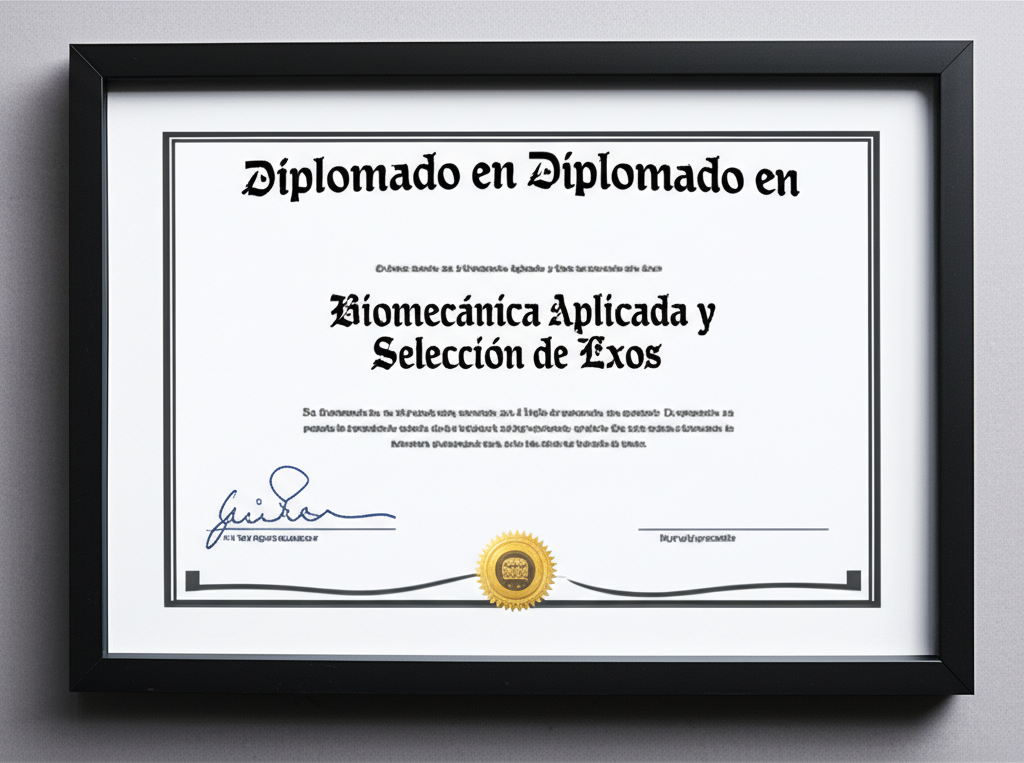
Diploma in Applied Biomechanics and Exos Selection
- Format:
- Duration:
- Hours: 900 H
- Language:
- Credits:
- Registration date: 08-10-2026
- Strat date: 18-11-2026
- Available places: 2
1,699 $
Competencies and results
What you will learn
Who this program is for:
Diploma in Applied Biomechanics and Exos Selection
9.9 Fundamentals of Biomechanics: Principles and applications in human movement.
9.9 Introduction to Exos: Types, functions, and classification.
9.3 Anatomy and Physiology of Movement: Foundations for biomechanical analysis.
9.4 Biomechanics of Movement: Kinematics and kinetics.
9.5 Principles of Exo Design: Ergonomic and safety considerations.
9.6 Materials and Technologies in Exos: Selection and applications.
9.7 Biomechanical Evaluation Methodologies: Instrumentation and analysis.
9.8 Introduction to Exo Selection: Criteria and considerations.
9.9 Ethics and Legal Considerations in the use of Exos.
9.90 Future Trends in Biomechanics and Exos.
Capstone-type projects
- Exos Selection: Biomechanics + Task Analysis; Ergonomic Design; Performance Optimization.
- Simulation and Validation: Biomechanical Modeling; Stress Testing; HIL Simulation.
- Specialized Applications: Skeletal Exos Design; Laboratory and Field Testing.
- Motion Optimization: Kinematic Analysis; Real-Time Feedback; Sensor Integration.
Admissions, fees and scholarships
Do you have any questions?
Our team is ready to help you. Contact us and we’ll get back to you as soon as possible.