Pilot Aero-Engineering and Equipment
About our Pilot Aero-Engineering and Equipment
Pilot and Equipment Aero Engineering
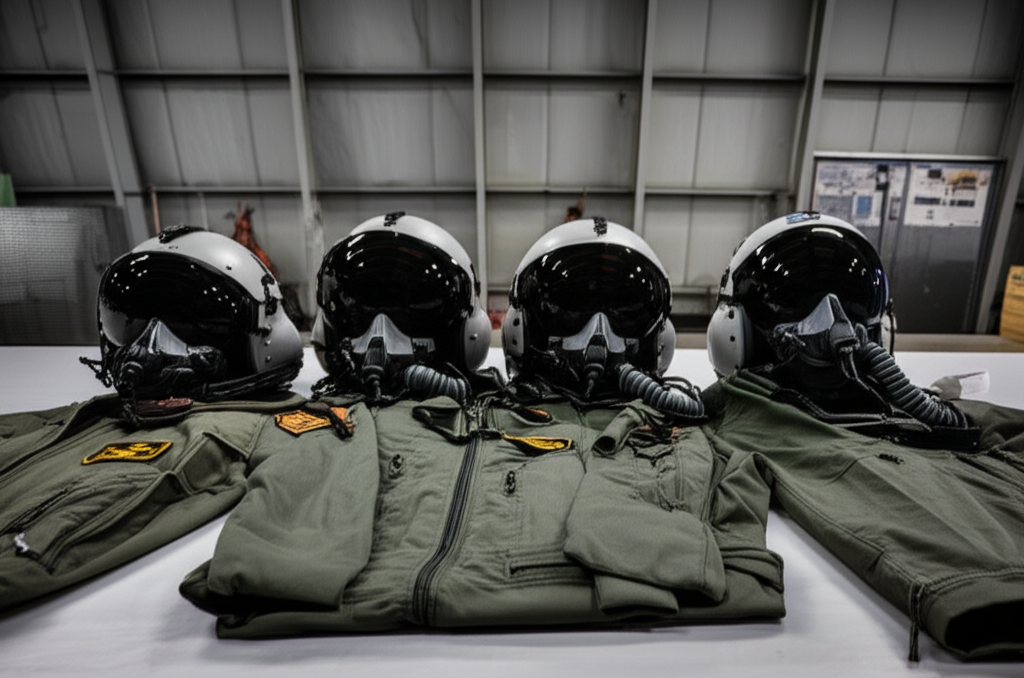
covers the comprehensive analysis of pilot position and flight environment ergonomics, incorporating advanced systems such as AFCS, FBW, and human-machine interface technologies to optimize safety and efficiency in fixed-wing and rotorcraft aircraft. CFD methods are used to simulate aerodynamic flow on helmets and garments designed to minimize drag and vibration effects, while the consideration of dynamics/control is key for the development of communication and vision devices integrated into the helmet. The integration of sensors in adaptive garments is also based on the study of aeroelasticity and cabin environment acoustics, crucial for eVTOL and UAM applications.
Experimental capabilities include HIL/SIL testing on test benches for biometric data acquisition systems, EMC evaluation, and certification testing under applicable international regulations, compatible with standards such as DO-160, ARP4754A, and EASA CS-27. Safety traceability is ensured through analysis in accordance with ARP4761, ensuring compliance with FAA Part 27 and DO-178C guidelines. This professional profile enables roles such as systems integration engineer, operational safety specialist, aeronautical ergonomics analyst, and aerospace systems designer.
Pilot Aero-Engineering and Equipment
- Format:
- Duration:
- Time: 1900 H
- Practices: Consult
- Language:
- Credits:
- Registration date: 08-10-2026
- Start date: 02-12-2026
- Available places: 2
4,600 $
Skills and results
What you will learn
- Analyze flap–lag–torsion couplings, whirl flutter, and fatigue.
- Size laminates in composites, joints, and bonded joints with FE.
- Implement damage tolerance and NDT (UT/RT/thermography).
2. Rotor Modeling and Performance: Advanced Analysis
- Analyze flap–lag–torsion couplings, whirl flutter, and fatigue in rotors and rotor systems.
- Size laminates in composites, joints, and bonded joints with FE for blades and articulations.
- Implement damage tolerance and NDT (UT/RT/thermography) for damage detection and rotor performance reliability.
3. Comprehensive user-oriented design and validation (from modeling to manufacturing)
You will learn to integrate the entire product development process, from model conception to final validation, applying user-centered methodologies. You will develop competencies in parametric design, ergonomics, simulation, sustainable materials, 3D visualization, and manufacturing management, ensuring efficient, safe solutions aligned with current industry standards.
4. Naval Aerospace Engineering: Piloting, Rotors, and Equipment
- Analyze flap–lag–torsion couplings, whirl flutter, and fatigue.
- Size laminates in composites, joints, and bonded joints with FE.
- Implement damage tolerance and NDT (UT/RT/thermography).
5. Ingeniería Naval Aeroespacial: Pilotaje, Posicionamiento, Equipamiento y Modelado de Rotores
- Analyze piloting, positioning, and equipment in naval aerospace systems, including trajectory control, GNSS/INS navigation, and human-machine interfaces.
- Size rotor modeling and aeroelastic simulation with vibration analysis and blade fatigue, using FE and optimization techniques.
- Implement positioning techniques and automatic piloting for naval rotor operations, integrating NDT (UT/RT/thermography) and damage tolerance to ensure safety and reliability.
6. Naval Aerospace Engineering: Piloting, Positioning, Equipment, and Rotor Modeling
- Master the fundamentals of piloting of aircraft and vessels, including maneuvers, navigation, and flight control.
- Apply positioning techniques using GPS, INS, and other advanced navigation systems.
- Study the essential equipment in naval aerospace engineering, such as instrumentation, communication, and control systems.
- Learn to model and simulate the behavior of helicopter rotors and propulsion systems using specialized software.
- Deepen the analysis of rotor aerodynamics, including lift, drag, and efficiency.
- Understand the rotor-wind interaction and its effects on aircraft performance and stability.
- Identify and analyze failure modes in rotors and associated systems, including vibrations and resonances.
- Design and optimize rotors for different applications, considering factors such as load, speed, and efficiency.
- Apply finite element analysis (FEA) techniques to simulate the structural behavior of rotors and components.
- Study the materials and manufacturing processes used in rotor construction, including metals, composites, and joining techniques.
Who this program is for:
Pilot Aero-Engineering and Equipment
- Aerospace Engineers
- Mechanical Engineers
- Industrial Engineers
- Automation Engineers
- Professionals from rotary-wing/eVTOL aircraft manufacturers (OEMs)
- Personnel from maintenance and repair organizations (MRO)
- Aeronautical consultants
- Researchers and technicians from technology centers
- Flight Test specialists
- Professionals involved in aeronautical certification processes
- Avionics experts
- Control and flight dynamics specialists
- Regulators and aeronautical authority personnel
- Professional profiles interested in the development of UAM/eVTOL
- Professionals seeking to acquire competencies in regulatory compliance
Recommended requirements: Basic knowledge of aerodynamics, control, and structures. Proficiency in Spanish/English at B2+/C1 level. We offer bridging tracks to cover any gaps in prior knowledge.
- Standards-driven curriculum: you will work with CS-27/CS-29, DO-160, DO-178C/DO-254, ARP4754A/ARP4761, ADS-33E-PRF from the very first module.
- Accreditable laboratories (EN ISO/IEC 17025) with rotor test bench, EMC/Lightning pre-compliance, HIL/SIL, vibration/acoustics.
- Master’s thesis oriented to evidence: safety case, test plan, compliance dossier and operational limits.
- Industry mentoring: instructors with experience in rotorcraft, tiltrotor, eVTOL/UAM and flight test.
- Flexible modality (hybrid/online), international cohorts and support from SEIUM Career Services.
- Ethics and safety: safety-by-design approach, cyber-OT, DIH and compliance as pillars.
1.1 Naval piloting: fundamentals of navigation, maneuvers, and vessel performance
1.2 International and regional naval regulatory framework: SOLAS, COLREGs, MARPOL, STCW, IMO conventions, and classification
1.3 Instrumentation and piloting systems: ECDIS, radar, AIS, GNSS, autopilot, and VDR
1.4 Design for maintainability and modular swaps in piloting systems
1.5 Operational safety analysis in piloting: HAZOP, FMEA, and RAM (Reliability, Availability, Maintainability)
1.6 Operations in port environments and inland waters: transit rules, channeling, and coordination with ports
1.7 Data & Digital thread: MBSE/PLM for change control in piloting systems
1.8 Technological risk and readiness: TRL/CRL/SRL applied to naval piloting
1.9 Intellectual property, certifications, and time-to-market for piloting software
1.10 Case study: go/no-go with risk matrix
2.1 Aerospace Piloting: fundamentals of flight control and stability
2.2 Positioning and Navigation: GNSS/INS, sensor fusion, and inertial reference
2.3 Equipment and Architectures: sensors, actuators, redundancies, and interfaces
2.4 Rotor Modeling: rotor dynamics, vibrations, and effects on maneuvers
2.5 Propulsion and Power Performance: propulsion, batteries, and thermal management
2.6 System Integration: MBSE/PLM, cockpit integration, and mission systems
2.7 Design for Maintenance: modularity, quick swaps, and diagnostics
2.8 Certification and Regulation: processes, aeronautical standards, and homologation
2.9 Operational Safety and Risk Management: mitigation plans, go/no-go, and risk matrix
2.10 Case Studies and Evaluation: mission simulation, flight tests, and debriefs
3.1 Fundamentals of naval aerodynamics: fluid principles, Reynolds, and lift/drag coefficients applied to marine contexts
3.2 Air-sea interactions and environmental conditions for naval aeronautical operations
3.3 Aerodynamic performance of wings, fuselages, and propellers in maritime environments
3.4 Takeoff and landing on aircraft carriers and heliports: techniques, catapults, and recovery approaches
3.5 Boundary layer dynamics and effects of roughness/proximity to water
3.6 CFD modeling and simulation for naval aerodynamics: tools, meshes, and experimental validation
3.7 Stability and control in naval aircraft: flight dynamics, actuators, and redundancy
3.8 Optimization of airfoil profiles and configurations for sea operations
3.9 Effects of sea state, wind, and weather conditions on performance and safety
3.10 Case clinic: go/no-go with risk matrix for takeoff/landing operations on aircraft carriers
4.1 Fundamentals of Rotorcraft and rotor configurations: key concepts, types (helicopter, multirotor, single rotor) and naval applications
4.2 Rotor aerodynamics and performance: hover, forward flight, induction, tip losses, and effects in marine environments
4.3 Propulsion systems and powertrain: engines, transmissions, drives, redundancy, and thermal management
4.4 Flight control and navigation: sensors (IMU, GPS, barometer), control laws, stability, and maneuverability
4.5 Integration with naval platforms: vessel requirements, interfaces, interoperability, and sea operations
4.6 Rotorcraft regulations and airworthiness: ICAO/EASA/FAA frameworks, certification, documentation, and maintenance
4.7 Rotor performance modeling and simulation: rotor theory, aerodynamic models, simulators, and MBSE
4.8 Testing, trials, and validation: ground and flight tests, safety protocols, data quality
4.9 Safety and maintenance management: preventive/predictive maintenance, availability, and incident management
4.10 Case study: go/no-go with risk matrix for a naval rotorcraft mission
5.1 Principles of Fluid Dynamics Applied to Naval Platforms
5.2 Structures and Materials in Marine Environments
5.3 Naval Propulsion Systems: Engines and Propellers
5.4 Navigation and Satellite Positioning (GNSS)
5.5 Sensors and Naval Equipment (Radar, Sonar, etc.)
5.6 Stability and Control of Floating Platforms
5.7 Fluid-Structure Interaction at Sea
5.8 Modeling and Simulation of Naval Systems
5.9 Maritime Legislation and Regulations
5.10 Introduction to Naval Aerospace Engineering: Integration and Challenges
6.1 Introducción a la Ingeniería Aeroespacial Naval: Fundamentos y aplicaciones.
6.2 Aerodinámica de Rotores: Principios básicos y teoría.
6.3 Sistemas de Propulsión en Aeronaves Navales: Motores y hélices.
6.4 Estructuras de Aeronaves Navales: Diseño y materiales.
6.5 Navegación y Control de Aeronaves Navales: Instrumentación y sistemas.
6.6 Posicionamiento y Equipamiento Naval: Sensores y sistemas de comunicación.
6.7 Modelado de Rotores: Introducción a la simulación y análisis.
6.8 Rendimiento de Rotores: Parámetros clave y optimización.
6.9 Tecnologías Emergentes: eVTOL y drones navales.
6.10 Casos de Estudio: Aplicaciones prácticas en el entorno naval.
9. 1 Introducción a la Aviación Naval y sus Ecosistemas.
9. 2 Principios Fundamentales de la Propulsión Rotorcraft y sus Aplicaciones Navales.
9. 3 Componentes Clave de un Helicóptero y sus Sistemas.
9. 4 Aerodinámica Básica Aplicada a los Helicópteros.
9. 5 Estabilidad y Control de Helicópteros.
9. 6 Motores de Helicópteros: Tipos y Funcionamiento.
9. 7 Principios de Navegación y Posicionamiento Naval.
9. 8 Equipamiento Naval: Sensores y Sistemas de Apoyo.
9. 9 Introducción al Diseño y Modelado de Rotores.
9. 10 Introducción a la Ingeniería Aeroespacial Naval: Desafíos y Oportunidades.
Capstone-type projects
- Diseño y Simulación: Hélices y sistemas de propulsión optimizados.
- Automatización: Sistemas de control de vuelo (AFCS/SCAS) para estabilidad.
- Ingeniería Naval: Integración de sistemas aeroespaciales en plataformas navales.
- Análisis Avanzado: Modelado y rendimiento de rotores.
Admissions, fees and scholarships
Do you have any questions?
Our team is ready to help you. Contact us and we’ll get back to you as soon as possible.