HSM Engineering & High-Precision Tolerances
About our HSM Engineering & High-Precision Tolerances
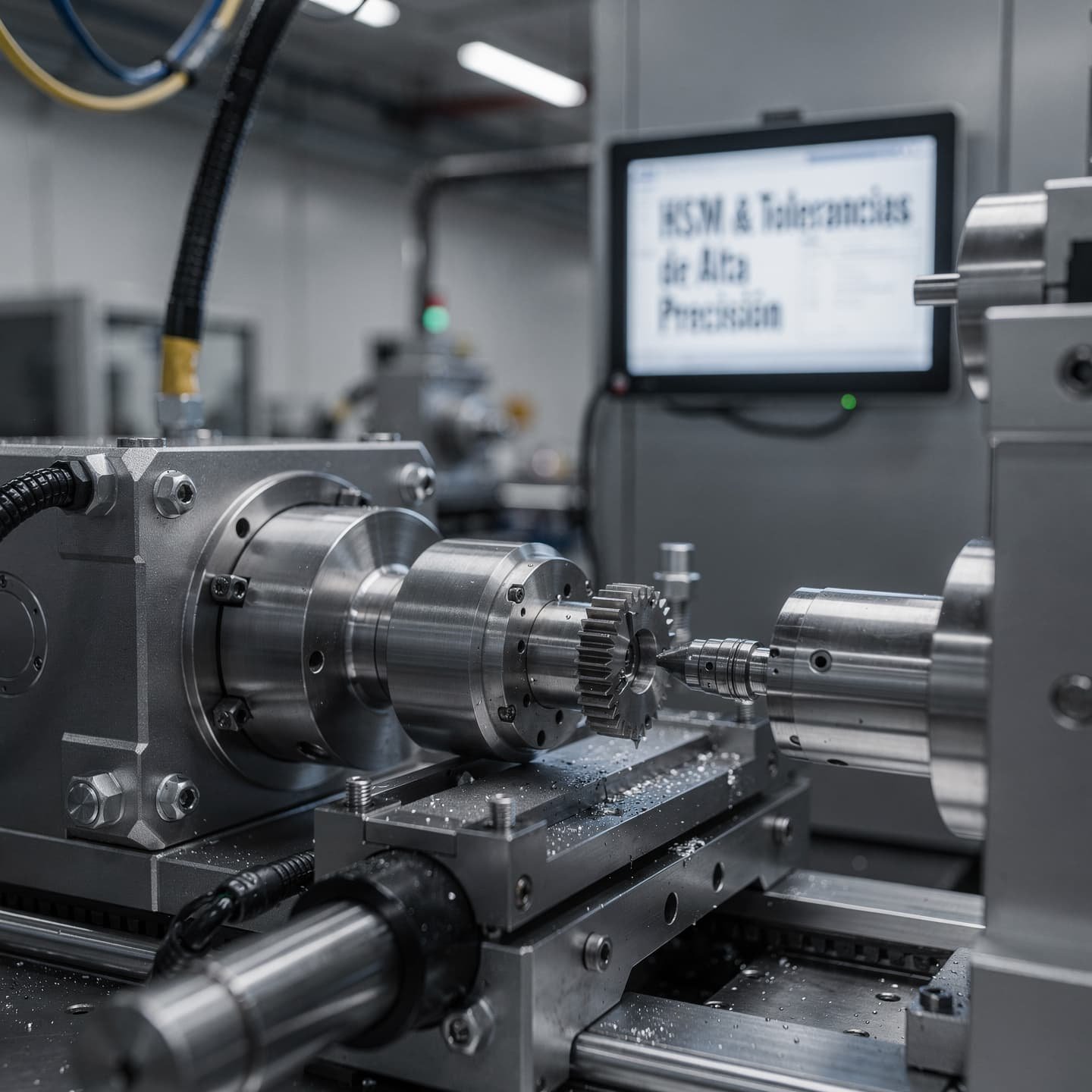
High-Speed Machining & High-Precision Tolerances Engineering (5-axis, treatments, finishes)
covers the design and optimization of advanced machining processes for critical aeronautical components, integrating HSM methodologies and 5-axis CNC control with materials and surface analysis to ensure micrometric tolerances. Core areas include structural dynamics, thermal management of materials, complementary aerodynamics, and CAD/CAM simulation with FEM and CFD tools that support complex processes in parts subjected to high loads and fatigue cycles, essential for platforms such as turbines, fuselages, and UAM systems. The combination of surface finishing techniques and thermal treatments contributes to improving component service life and performance by meeting strict FI, MS, and specific industry standards.
Associated laboratories are equipped with test benches featuring advanced data acquisition, laser metrology, and vibration/acoustic analysis to validate geometric and functional precision in accordance with applicable international regulations and standards such as ARP4754A, ARP4761, as well as ISO 9001 and AS9100 quality certifications. Traceability and safety are ensured through documented protocols, supporting professional roles such as process engineer, metrology technician, numerical control specialist, aeronautical quality engineer, and surface treatments consultant. This training is key to strengthening the value chain in advanced aeronautical manufacturing.
HSM Engineering & High-Precision Tolerances
- Format:
- Duration:
- Time: 1900 H
- Practices: Consult
- Language:
- Credits:
- Registration date: 08-10-2026
- Start date: 02-12-2026
- Available places: 2
2,400 $
Skills and results
What you will learn
- Analyze high-speed machining processes in 5-axis machining centers, optimizing geometric tolerances and tool deflection.
- Define and apply treatments and finishes for precision surfaces, including high-precision grinding, anodizing, coatings, and polishing to meet finish tolerances (Ra/Rz).
- Implement precision metrology and quality control with GD&T, NDT (UT/RT/thermography), and traceability to verify 5-axis and tolerances.
2. Precision Machining Engineering: HSM, Tolerances, 5-Axis, Treatments, and Finishes
- Analyze HSM to reduce machining times and ensure consistent dimensional tolerances and surface finishes.
- Dimension toolpaths and geometries on 5-axis machines, optimizing fixturing and managing geometric tolerances during processing and the application of treatments and finishes.
- Implement quality control and tolerance verification, with approaches to surface finishes and selection of treatments that ensure durability and process repeatability.
3. Comprehensive user-oriented design and validation (from modeling to manufacturing)
You will learn to integrate the entire product development process, from model conception to final validation, applying user-centered methodologies. You will develop competencies in parametric design, ergonomics, simulation, sustainable materials, 3D visualization, and manufacturing management, ensuring efficient, safe solutions aligned with current industry standards.
4. Mastery of HSM and Tolerances: 5-Axis Machining, Treatments, and Cutting-Edge Finishes
- Analyze flap–lag–torsion couplings, whirl flutter, and fatigue.
- Size laminates in composites, joints, and bonded joints with FE.
- Implement damage tolerance and NDT (UT/RT/thermography).
5. Advanced HSM Engineering: Design, Tolerances, 5-Axis, Treatments, and Finishes
- Analyze design and tolerances on 5-axis Advanced HSM, considering treatments and surface finishes.
- Size laminates in composites, joints, and bonded joints with FE.
- Implement damage tolerance and NDT (UT/RT/thermography) to ensure durability and finish quality.
6. Excellence in HSM: 5-Axis, High-Precision Tolerances, Treatments, and Finishes
- Master the fundamentals of high-precision manufacturing, including the selection of materials and optimized processes.
- Interpret and apply strict geometric and dimensional tolerances, essential for the assembly and operation of critical components.
- Deepen knowledge of advanced surface treatments, such as anodizing, PVD/CVD coatings, and thermal treatments, and their impact on durability and performance.
- Explore high-speed machining (HSM) processes, including toolpath optimization, cutting parameters, and their relationship with precision and surface finish.
- Understand and apply surface finishing techniques, such as polishing, burnishing, and shot peening, to achieve the desired aesthetic and functional quality.
Who this program is for:
HSM Engineering & High-Precision Tolerances
- Graduates in Aerospace Engineering, Mechanical, Industrial, Automation, or related fields.
- Professionals from rotorcraft/eVTOL OEMs, MRO, consulting, technology centers.
- Flight Test, certification, avionics, control, and dynamics specialists seeking specialization in high-precision machining.
- UAM/eVTOL engineers, regulators/authorities, and profiles requiring competencies in compliance and manufacturing.
Recommended requirements: Solid knowledge in aerodynamics, control, and structures; proficiency in ES/EN B2+/C1. We consider offering bridging tracks to cover possible gaps.
- Standards-driven curriculum: you will work with CS-27/CS-29, DO-160, DO-178C/DO-254, ARP4754A/ARP4761, ADS-33E-PRF from the very first module.
- Accreditable laboratories (EN ISO/IEC 17025) with rotor test bench, EMC/Lightning pre-compliance, HIL/SIL, vibration/acoustics.
- Master’s thesis oriented to evidence: safety case, test plan, compliance dossier, and operational limits.
- Industry mentoring: instructors with experience in rotorcraft, tiltrotor, eVTOL/UAM, and flight test.
- Flexible modality (hybrid/online), international cohorts, and support from SEIUM Career Services.
- Ethics and safety: safety-by-design approach, cyber-OT, DIH, and compliance as pillars.
1.1 Fundamentals of HSM Engineering: 5-axis and precision in naval components
1.2 5-axis machining strategies for complex parts: trochoidal, contouring, and roughing of difficult areas
1.3 Tool selection and cutting conditions for high-precision finishes
1.4 Marine materials, surface treatments, and coatings for critical components
1.5 Geometric and positional tolerances in naval machinery parts
1.6 Design for manufacturability and maintenance of propulsion systems and shafts
1.7 Data management and traceability: MBSE/PLM for changes and version control
1.8 Advanced metrology: CMM, roughness, planimetry, and finish verification
1.9 Technical risk assessment and technological maturity: TRL/CRL/SRL in HSM processes
1.10 Case study: go/no-go with risk matrix for a critical naval machinery part
2.1 Fundamentals of HSM and 5-axis applied to naval engineering
2.2 High-precision tolerances: ISO 286, GD&T and their application in vessels
2.3 Design for HSM machining: geometries, assemblies, and maintenance
2.4 Preparation of HSM 5-axis machines: stiffness, fixtures, and toolpath
2.5 Tooling and coatings for naval HSM: tools, feeds, and wear
2.6 Surface treatments in marine components: PVD, CVD, AlTiN, and Cermet
2.7 High-precision finishes: grinding, polishing, lapping, and texturing
2.8 Process modeling and vibration control in HSM
2.9 Regulations and certifications in the naval industry for HSM processes
2.10 Case study: analysis of a naval drawing and go/no-go decision
3.1 Introduction to HSM and Precision Engineering: scope, concepts, and relevance in naval engineering
3.2 5-Axis: configuration, kinematics, and tool control
3.3 Geometric tolerances and GD&T applied to high-precision naval components
3.4 Materials and surface treatments in naval HSM: steels, alloys, coatings
3.5 Design for manufacturing: CAD/CAM flow and model preparation for HSM
3.6 Measurement and quality control methods in HSM: CMM, 3D scanning, and traceability
3.7 High-speed cutting strategies: tool selection, geometry, and coolants
3.8 HSM process planning: optimization of feeds, RPM, speeds, and cycle times
3.9 Surface finishes and high-precision treatments: polishing, lapping, nitrocarburizing, PVD/CVD
3.10 Case studies and introductory exercises: reading drawings, simulation, and validation of an HSM process
4.1 Introduction to HSM: definition, history, and benefits in naval engineering
4.2 High-precision tolerances: concepts, linear and geometric tolerances applied to naval parts
4.3 5-Axis: principles, machine configuration, and impact on complex geometries of maritime components
4.4 HSM toolpath generation strategies: trochoidal, envelope, and finishing for high precision
4.5 Materials and cutting tools for HSM: insert selection, coatings, and cutting geometry
4.6 HSM process planning: sequences, speeds, feeds, and heat management
4.7 Tolerance verification and control: measurement with CMM, optics, and sampling plan
4.8 High-end treatments and finishes: surface treatments, coatings, and compatible surface treatments
4.9 Safety, maintenance, and reliability in naval environments: standards and best practices
4.10 Case studies and practical exercises: optimization of a naval engine part using 5-axis HSM
5.1 Introduction to HSM: Principles and Applications in the Naval Industry.
5.2 Fundamentals of High-Precision Tolerances in Naval Components.
5.3 Principles of Design for High-Speed Machining (HSM).
5.4 Selection of Materials and Tools for HSM in Marine Environments.
5.5 Introduction to CNC Programming for HSM: Basic Concepts.
5.6 Design for Manufacturing (DFM) Analysis applied to Naval Components.
5.7 Design of Fixtures and Workholding Systems for HSM.
5.8 Safety Considerations in HSM Environments.
5.9 Introduction to 5-Axis Systems and their Application.
5.10 Examples of HSM Applications in the Naval Industry: Case Studies.
6.1 Introduction to High-Speed Machining (HSM): Principles and Advantages
6.2 Material Selection for HSM: Properties and Naval Applications
6.3 Design for Manufacturing (DFM) in HSM: Key Considerations
6.4 Tolerances in HSM: Definition, Importance, and Selection
6.5 Coordinate Systems and Machine Tool Orientation
6.6 Tool Geometry and Optimal Selection
6.7 Machining Strategies: Roughing, Finishing, and Path Optimization
6.8 Machining Simulation and Results Analysis
6.9 Introduction to 5-Axis in HSM: Principles and Configuration
6.10 HSM Applications in the Naval Industry: Case Studies
7.1 Introduction to HSM (High-Speed Machining) and its Naval Application.
7.2 Principles of Design for High-Speed Machining.
7.3 Material Selection: Suitability for HSM in Naval Environments.
7.4 Design of Parts and Components for HSM and 7-Axis.
7.5 Tolerances: Fundamentals and Quality Control in HSM.
7.6 CAD/CAM Software: Model Preparation and Toolpath Generation.
7.7 Introduction to 7-Axis: Fundamentals and Applications in HSM.
7.8 Tool Selection and Cutting Parameters for HSM.
7.9 Workholding and Fixturing Systems for HSM and Naval Parts.
7.10 Safety Considerations and Best Practices in HSM.
8.1 Introduction to Design for HSM and Precision Manufacturing.
8.2 Principles of Dimensional and Geometric Tolerances (GD&T).
8.3 Fundamentals of High-Speed Machining (HSM).
8.4 Material Selection for HSM: Properties and Applications.
8.5 Design for 5-Axis: Geometries and Key Considerations.
8.6 Introduction to Surface Treatments and Finishes: Types and Purposes.
8.7 CAD/CAM Software for HSM: Introduction and Workflow.
8.8 Selection of Cutting Tools for HSM: Geometry and Materials.
8.9 Optimization of Cutting Parameters: Speed, Feed, and Depth.
8.10 Case Study: Analysis of a Precision Component.
9.1 Introduction to HSM (High-Speed Machining) and its relevance in naval engineering.
9.2 Principles of High-Precision Tolerances applied to critical naval components.
9.3 Design and Programming for 5-Axis Machining.
9.4 Selection and Application of Materials for HSM in the naval environment.
9.5 Cutting Strategies and Toolpath Optimization in HSM.
9.6 Surface Treatment Techniques for Corrosion Resistance in Marine Environments.
9.7 High-Precision Finishing Methods: Polishing, Sharpening, and Superfinishing.
9.8 Dimensional Control and Quality Assurance in HSM Components.
9.9 Case Studies: Specific Applications of HSM in the Naval Industry.
9.10 Innovations and Future Trends in HSM and Tolerances in Naval Engineering.
10.1 Introduction to High-Speed Machining (HSM) and its Benefits
10.2 Principles of Dimensional Control and Geometric Tolerances (GD&T)
10.3 Materials and Selection for HSM: Steel, Aluminum, Titanium, and their Alloys
10.4 Cutting Tools for HSM: Geometry, Coatings, and Selection
10.5 HSM Machine Tools: Design, Stability, and Precision
10.6 Cutting Parameters: Speed, Feed, and Depth in HSM
10.7 Machining Strategies: Roughing, Finishing, and Path Optimization
10.8 CAM Software for HSM: Selection and Parameter Configuration
10.9 Metrology and Dimensional Verification: Techniques and Equipment
10.10 Safety in HSM: Protocols and Best Practices
- Hands-on methodology: test-before-you-trust, design reviews, failure analysis, compliance evidence.
- Software (according to licenses/partners): MATLAB/Simulink, Python (NumPy/SciPy), OpenVSP, SU2/OpenFOAM, Nastran/Abaqus, AMESim/Modelica, acoustics tools, DO-178C planning toolchains.
- SEIUM Laboratories: scale rotor test bench, vibration/acoustics, EMC/Lightning pre-compliance, HIL/SIL for AFCS, data acquisition with strain gauging.
- Standards and compliance: EN 9100, 17025, ISO 27001, GDPR.
Capstone-type projects
- HSM 5-Axis Mastery: high tolerances, finishes, and treatments.
- Precision Machining: HSM, tolerances, 5-axis, finishes.
- HSM Optimization: 5-axis, processes, and finish quality control.
- HSM Mastery: advanced tolerances and finish verification.
DO-160: environmental test plan and mitigation.
- HSM 5-Axis Mastery: high tolerances, finishes, and treatments.
- Precision Machining: HSM, tolerances, 5-axis, finishes.
- HSM Optimization: 5-axis, processes, and finish quality control.
- HSM Mastery: advanced tolerances and finish verification.
DO-160: environmental test plan and mitigation.
- Naval HSM Component: 5-axis design, tolerances, treatments, and precision finishes.
- CNC Optimization: Advanced HSM strategies, CFD analysis, and simulation.
- Naval Manufacturing: High-precision prototyping, validation, and testing.
- Naval HSM Component: 5-axis design, tolerances, treatments, and precision finishes.
- CNC Optimization: Advanced HSM strategies, CFD analysis, and simulation.
- Naval Manufacturing: High-precision prototyping, validation, and testing.
- Precision components: Design, 5-axis HSM manufacturing, ultra-precision tolerances, and finishes for critical systems.
Admissions, fees and scholarships
- Profile: Background in Computer Engineering, Mathematics, Statistics, or related fields; practical experience in NLP and information retrieval systems is valued.
- Documentation: Updated CV, academic transcripts, SOP/purpose essay, project or code samples (optional).
- Process: application → technical profile and experience evaluation → technical interview → practical case review → final decision → enrollment.
- Fees:
- Single payment: 10% discount.
- 3-installment payment: no fees; 30% upon enrollment + 2 equal monthly payments of the remaining 35%.
- Monthly payment: available with a 7% fee on the total; annual review.
- Scholarships: based on academic merit, financial situation, and promotion of inclusion; agreements with industry companies for partial or full scholarships.
Check “Calendar & calls”, “Scholarships & financial aid”, and “Fees & financing” in the SEIUM mega-menu.
Do you have any questions?
Our team is ready to help you. Contact us and we’ll get back to you as soon as possible.
F. A. Q
Frequently Asked Questions
Yes, we hold international certification.
Yes: experimental models, real data, applied simulations, professional environments, real case studies.
It is not mandatory. We offer leveling tracks and tutoring.
Completely. It covers e-propulsion, integration, and emerging regulations (SC-VTOL).
Recommended. There are also internal challenges and consortia.