
Quality Engineering and Metrology for Racing Parts
About our Quality Engineering and Metrology for Racing Parts
Diploma/Comprehensive Program in Product and Experience Engineering
offers a solid and applicable quality foundation across multiple domains (exterior/interior, HMI/UX, Class A surfaces, materials and sustainability, lighting, acoustics, haptics, and technical documentation with AI). The training integrates user-centered design, modeling and simulation, physical/digital prototyping, and lifecycle management (PLM/PDM), connecting conception, validation, and manufacturing to accelerate decision-making and ensure regulatory compliance.
The approach combines technical rigor and business criteria to deliver efficient, safe, and scalable solutions: from requirements definition and ergonomics to change traceability, testing, and homologation. Upon completion, you will be able to lead end-to-end design and validation processes, integrate advanced tools (VR/AR, RAG/NLP, CAD/CAM), and coordinate multidisciplinary teams in high-demand environments.
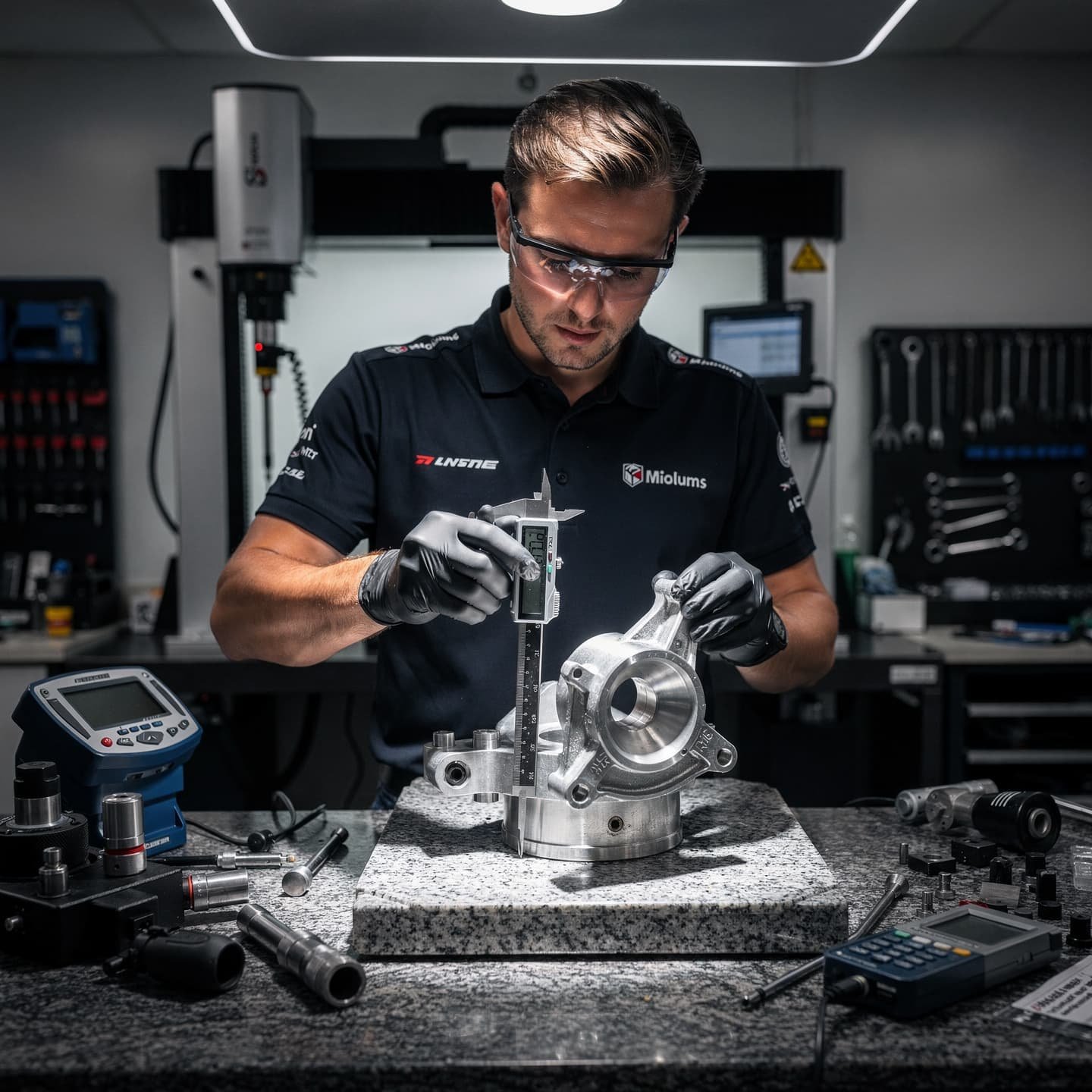
Quality Engineering and Metrology for Racing Parts
- Format:
- Duration:
- Time: 1900 H
- Practices: Consult
- Language:
- Credits:
- Registration date: 08-10-2026
- Start date: 02-12-2026
- Available places: 2
2,800 $
Skills and results
What you will learn
You will learn to create and validate physical and digital prototypes by applying principles of efficient manufacturing, dimensional accuracy, and resource optimization. You will develop competencies in the use of technologies such as 3D printing, CAD/CAM modeling, and assembly simulations, ensuring that each design iteration is viable, functional, and aligned with industrial production standards.
2. Development of physical and digital prototypes based on lean manufacturing criteria.
You will learn to manage the complete product lifecycle using PLM/PDM systems to coordinate design, engineering, production, and maintenance. You will develop skills to structure BOMs, control revisions, manage engineering changes, and ensure document traceability, fostering multidisciplinary collaboration and efficiency in digital industrial environments.
3. Comprehensive user-oriented design and validation (from modeling to manufacturing)
You will learn to integrate the entire product development process, from model conception to final validation, applying user-centered methodologies. You will develop competencies in parametric design, ergonomics, simulation, sustainable materials, 3D visualization, and manufacturing management, ensuring efficient, safe solutions aligned with current industry standards.
4. Application of user-centered design methodologies and technical ergonomics.
You will learn to apply user-centered design processes, combining research (personas, scenarios, journey maps) with technical ergonomics (anthropometry, biomechanics, cognitive load, and ISO standards). You will develop iterative prototypes, usability tests, and eye-tracking/task-time analysis to optimize accessibility, safety, and performance, translating findings into measurable requirements and engineering decisions.
5. Selection and application of sustainable materials and eco-design strategies.
You will learn to identify, evaluate, and apply sustainable materials, considering their life cycle, environmental impact, and technical performance. You will develop competencies in ecodesign strategies oriented toward energy efficiency, recyclability, and waste reduction, integrating sustainability criteria into every stage of the design and production process.
6. Surface optimization and high-precision parametric modeling.
You will learn to design and refine Class A surfaces using advanced parametric modeling techniques, ensuring continuity, geometric precision, and visual quality. You will develop competencies in specialized software to optimize complex shapes, integrate aesthetic and functional criteria, and ensure manufacturing feasibility in high-demand industrial environments.
Who this program is for:
Quality Engineering and Metrology for Racing Parts
- Professionals in logistics, transportation, and supply chain interested in implementing drones to optimize operations.
- Warehouse, distribution center, and transportation company managers and supervisors looking to improve efficiency and reduce costs.
- Engineers and technicians wishing to acquire specialized knowledge in drone logistics, including route planning, fleet management, and maintenance.
- Entrepreneurs and business owners wishing to start or expand their business in the drone logistics sector, exploring new market opportunities.
- Standards-driven curriculum: you will work with CS-27/CS-29, DO-160, DO-178C/DO-254, ARP4754A/ARP4761, ADS-33E-PRF from the very first module.
- Accreditable laboratories (EN ISO/IEC 17025) with rotor test bench, EMC/Lightning pre-compliance, HIL/SIL, vibration/acoustics.
- Master’s thesis oriented to evidence: safety case, test plan, compliance dossier, and operational limits.
- Industry mentoring: instructors with experience in rotorcraft, tiltrotor, eVTOL/UAM, and flight test.
- Flexible modality (hybrid/online), international cohorts, and support from SEIUM Career Services.
- Ethics and safety: safety-by-design approach, cyber-OT, DIH, and compliance as pillars.
1.1 Haptic actuators: technologies, performance, and tactile feedback
1.2 Haptic stimulation patterns: sequences, density, and channel combination
1.3 Usability with gloves: ergonomics, precision, and interaction accessibility
1.4 Humidity and environmental conditions management: impact on actuator performance
1.5 Tangible interface design: mapping between action and sensation and feedback
1.6 Modeling and simulation of haptic response: MBSE/PLM for hardware and software
1.7 Calibration and compensation of haptic systems: linearity, drift, and stability
1.8 Safety, compliance, and testing: standards, certifications, and reliability tests
1.9 Haptic sensor integration: force, touch, and stiffness measurement
1.10 Case study: usability evaluation with gloves and humidity
2.1 Digital twin and usage scenarios: definition, hypotheses, and KPIs
2.2 CAD/CAE data preparation: cleaning, meshing, and simulation parameters
2.3 Rapid prototyping: 3D printing, light CNC, and validation materials
2.4 Virtual validation: VR/AR for reviews, ergonomics, and walkthroughs
2.5 HIL/SIL integration: test benches, signals, and use case orchestration
2.6 DFM/DFA and tolerance stacking: feasibility, cost, and assembly
2.7 Test plan: protocols, acceptance criteria, and traceability
2.8 Data acquisition and analysis: instrumentation, quality, and reproducibility
2.9 Design correction and change management: ECOs, versions, and verification
2.10 Case study: digital twin iteration to pilot-ready prototype
3.1 Deployment architecture: topologies, environments (dev/stage/prod), and separation criteria
3.2 Advanced CI/CD: pipelines, quality gates, signatures, and immutable images
3.3 Quality assurance: functional, non-functional, and cross-validation HIL/SIL testing
3.4 Cybersecurity in production: hardening, secrets, SBOM, and regulatory compliance
3.5 Observability and SRE: metrics, logs, distributed traces, and error budgets (SLO/SLA)
3.6 Configuration and change management: IaC, versioning, feature flags, and safe rollback
3.7 Reliability and resilience: canary, blue/green, autoscaling, and chaos testing
3.8 Data management in deployment: migrations, quality, masking, and retention
3.9 Operations and support: runbooks, actionable alerts, MTTR/MTBF, and incident response
3.10 Case study: canary deployment with automated validation and controlled rollback
4.1 Operational governance: roles, RACI, and review cycles
4.2 Live observability: dashboards, actionable alerts, and SLO/SLA reviews
4.3 Continuous improvement (Kaizen/Lean): waste identification and value streams
4.4 Post-incident analysis: RCA, corrective actions, and effectiveness verification
4.5 Cost and performance optimization: rightsizing, caching, and resource tuning
4.6 Vulnerability management: patching, continuous scanning, and periodic audits
4.7 Controlled experimentation: A/B, feature flags, and impact telemetry
4.8 Operational quality: automated regression testing and synthetic monitoring
4.9 Knowledge management: runbooks, living documentation, and communities of practice
4.10 Evolutionary roadmap: data-driven prioritization, OKRs, and quarterly reviews
5.1 Governance, Risk, and Compliance (GRC): risk appetite, controls, and criticality matrix
5.2 Regulatory compliance: ISO 27001/27701, NIST CSF, GDPR/privacy, and audit evidence
5.3 Zero Trust architecture and IAM: MFA, RBAC/ABAC, PAM, and micro-segmentation
5.4 Data protection and cryptography: encryption in transit/at rest, KMS/PKI/HSM, and tokenization
5.5 Supply chain security: SBOM, artifact signatures, SLSA policies, and dependencies
5.6 Secure SDLC and DevSecOps: SAST/DAST/IAST, containers, immutable images, and quality gates
5.7 Detection and response: SIEM/SOAR, EDR, incident playbooks, and continuous improvement
5.8 Resilience and continuity: BCP/DRP, RTO/RPO, backup/restore testing, and tabletop/chaos exercises
5.9 Vulnerabilities and patching: continuous scanning, CVSS/EPSS prioritization, and remediation SLAs
5.10 Third-party and extended continuity risk: due diligence, contracts, audits, and exit plans
6.1 Fundamentals of applied analytics: metrics, KPIs, and evidence-based decision-making
6.2 Data governance: quality, traceability, and lineage
6.3 Integration of heterogeneous sources: APIs, sensors, and industrial systems
6.4 Descriptive and predictive models: applied statistics and supervised machine learning
6.5 Data visualization and storytelling: dashboards, insights, and executive communication
6.6 Advanced analytics with generative AI: RAG, NLP, and contextual knowledge extraction
6.7 Operational and business indicators: correlation between performance and profitability
6.8 Ethics and compliance in analytics: privacy, biases, and data protection regulations
6.9 Decision automation: intelligent alerts, triggers, and adaptive systems
6.10 Case study: design of an integrated technical and strategic performance dashboard
7.1 Descubrimiento de oportunidades: investigación de usuario, mercado y competencia
7.2 Propuesta de valor y posicionamiento: diferenciadores, JTBD y segmentación
7.3 Priorización de iniciativas: RICE/WSJF, dependencias y capacidad del equipo
7.4 Roadmap vivo: horizontes, apuestas, hitos y gestión de riesgos
7.5 OKR y métricas de resultado: alineación estratégica y foco trimestral
7.6 Gestión de portfolio: balance exploración/ explotación y asignación de recursos
7.7 Go-to-Market: lanzamiento, pricing, empaquetado y habilitación comercial
7.8 Gestión de stakeholders: comunicación ejecutiva, acuerdos y manejo de expectativas
7.9 Medición de impacto: NPS/CSAT, adopción, retención y retorno económico
7.10 Caso práctico: construcción de roadmap anual con OKR y plan de lanzamiento
8.1 Open innovation and tech scouting: opportunity detection and proof of concept
8.2 Intellectual property management: patents, licenses, and freedom to operate (FTO)
8.3 Collaboration with partners: agreements, governance, and win–win models
8.4 Standardization and consortia: interoperability, compliance, and technological maturity (TRL)
8.5 Applied sustainability: ESG objectives, metrics, and actionable reporting
8.6 Circular economy and eco-efficiency: DfR/DfE, recyclability, and footprint reduction
8.7 Responsible supply chain: risk, traceability, and continuity (BCP)
8.8 R&D financing and portfolio: CAPEX/OPEX, grants, and impact-based prioritization
8.9 Scaling from pilots to operations: success criteria, transfer, and adoption
8.10 Case study: sustainable innovation roadmap with KPIs and quarterly milestones
9.1 Change strategy: vision, scope, and stakeholder map
9.2 Effective communication: narratives, channels, and expectation management
9.3 Capability enablement: training, mentoring, and internal certifications
9.4 Organizational design: roles, RACI, and structures for scaling
9.5 Adoption management: user journeys, friction points, and reinforcement plans
9.6 Process standardization: playbooks, SOPs, and version control
9.7 Maturity models: diagnosis, gaps, and evolution plans
9.8 Change metrics: adoption, time-to-value (TtV), and competencies
9.9 Communities of practice: knowledge sharing, repositories, and lessons learned
9.10 Case study: comprehensive change plan with milestones, indicators, and governance
10.1 Project definition: scope, objectives, and alignment with the curriculum
10.2 Requirements analysis and technical specifications
10.3 Conceptual design and digital modeling: methodologies and applied tools
10.4 Development plan: milestones, resources, and schedule
10.5 Technical implementation: module integration, validation, and testing
10.6 Process documentation: traceability, justification, and design decisions
10.7 Results evaluation: metrics, performance, and goal achievement
10.8 Technical presentation and project defense before the evaluation committee
10.9 Professional reflection: lessons learned, innovation, and continuous improvement
10.10 Final delivery: complete dossier, validated prototype, and evolution roadmap
- Hands-on methodology: test-before-you-trust, design reviews, failure analysis, compliance evidence.
- Software (according to licenses/partners): MATLAB/Simulink, Python (NumPy/SciPy), OpenVSP, SU2/OpenFOAM, Nastran/Abaqus, AMESim/Modelica, acoustics tools, DO-178C planning toolchains.
- SEIUM Laboratories: scale rotor test bench, vibration/acoustics, EMC/Lightning pre-compliance, HIL/SIL for AFCS, data acquisition with strain gauging.
- Standards and compliance: EN 9100, 17025, ISO 27001, GDPR.
Capstone-type projects
- Energy–process optimization: digital twin, simulation, and integrated operation; waste management.
Environmental qualification: DO-160/IEC test plan (vibration, temperature, EMI/lightning) and mitigation.
- Energy–process optimization: digital twin, simulation, and integrated operation; waste management.
Environmental qualification: DO-160/IEC test plan (vibration, temperature, EMI/lightning) and mitigation.
- Operating cycle optimization: digital twin, simulation and control; consumption and waste reduction.
Testing and conformity: DO-160/IEC test plan (vibration, thermal, EMI/lightning) with mitigation actions.
- Integrated system optimization: modeling, simulation, and intelligent control; energy management and environmental validation.
DO-160 Testing: structural, thermal, and electromagnetic evaluation; documentation and failure mitigation.
- Process energy efficiency: modeling, simulation, and optimal control; peak and waste reduction.
Environmental validation: DO-160/IEC test plan (vibration, thermal, EMI/lightning) with mitigation measures.
Admissions, fees and scholarships
- Profile: Background in Computer Engineering, Mathematics, Statistics, or related fields; practical experience in NLP and information retrieval systems is valued.
- Documentation: Updated CV, academic transcripts, SOP/purpose essay, project or code samples (optional).
- Process: application → technical profile and experience evaluation → technical interview → practical case review → final decision → enrollment.
- Fees:
- Single payment: 10% discount.
- 3-installment payment: no fees; 30% upon enrollment + 2 equal monthly payments of the remaining 35%.
- Monthly payment: available with a 7% fee on the total; annual review.
- Scholarships: based on academic merit, financial situation, and promotion of inclusion; agreements with industry companies for partial or full scholarships.
Check “Calendar & calls”, “Scholarships & financial aid”, and “Fees & financing” in the SEIUM mega-menu.
Do you have any questions?
Our team is ready to help you. Contact us and we’ll get back to you as soon as possible.
F. A. Q
Frequently Asked Questions
Yes, we hold international certification.
Yes: experimental models, real data, applied simulations, professional environments, real case studies.
It is not mandatory. We offer leveling tracks and tutoring.
Completely. It covers e-propulsion, integration, and emerging regulations (SC-VTOL).
Recommended. There are also internal challenges and consortia.