

Track Sensor and Instrumentation Engineering
About our Track Sensor and Instrumentation Engineering
Track Sensors and Instrumentation Engineering
addresses the advanced design and integration of technologies such as strain gauges, infrared (IR) sensors, thermocouples, and robust vehicular communication networks such as CAN and FlexRay for applications in airports and aerial platforms. This interdisciplinary field combines fundamentals of aerodynamics, structural dynamics, and power electronics, employing analysis methods based on multidisciplinary modeling, real-time calibration, and distributed acquisition protocols that optimize structural and thermal monitoring. Its relevance is key in air traffic management systems and in the precise supervision of operational infrastructure integrity.
Specialized laboratories allow HIL/SIL testing, vibration tests, thermal analysis, and EMC evaluation, ensuring functional safety in accordance with applicable international regulations and certification standards for onboard and ground equipment. Emphasis is placed on process traceability and compliance with quality standards in operational safety. Trained professionals can work as instrumentation engineers, data acquisition specialists, calibration technicians, integration project managers, and aeronautical certification advisors, contributing to the reliability and efficiency of critical systems in aeronautical environments.
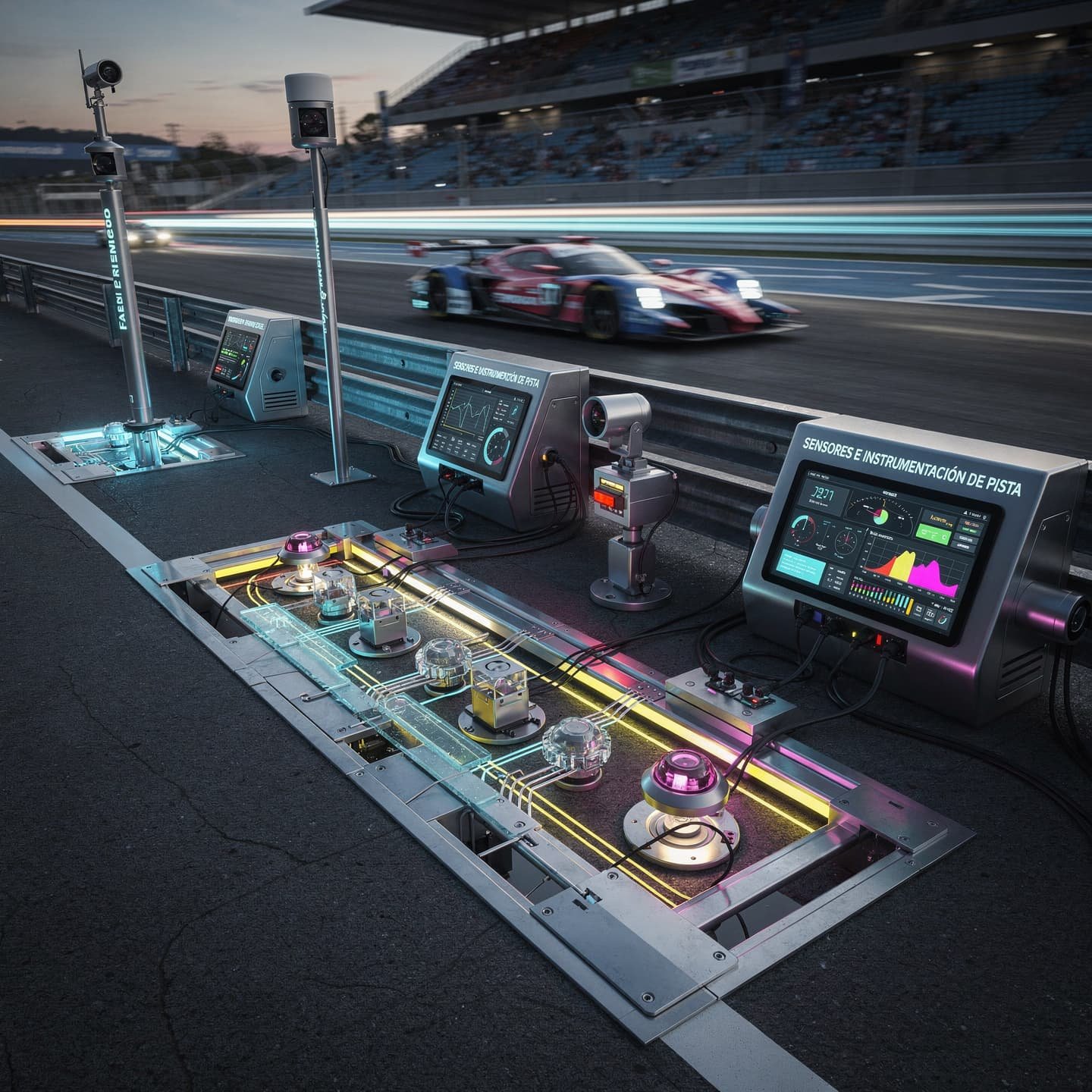
Track Sensor and Instrumentation Engineering
- Format:
- Duration:
- Time: 1900 H
- Practices: Consult
- Language:
- Credits:
- Registration date: 08-10-2026
- Start date: 02-12-2026
- Available places: 2
5,900 $
Skills and results
What you will learn
- Analyze the fundamentals and applications of strain, IR, and thermocouple sensors in structures, including calibration, linearity, and noise management.
- Size sensors and acquisition systems for strain, IR, and thermocouples, with emphasis on precision and robustness against interference.
- Implement CAN and FlexRay networks for sensor data acquisition and transmission, with topologies, synchronization, and performance testing.
2. Advanced Sensor Engineering: Strain, IR, Thermocouple, and CAN/FlexRay Communication.
- Analyze strain sensors, IR thermography, and thermocouples in structural monitoring systems, including data acquisition, signal conditioning, and calibration.
- Size the sensor architecture and CAN/FlexRay communication, including topologies, synchronization, and fault robustness.
- Implement diagnostics and sensor maintenance through NDT (UT/RT/thermography) and data validation to support decision-making.
3. Comprehensive user-oriented design and validation (from modeling to manufacturing)
You will learn to integrate the entire product development process from model conception to final validation, applying user-centered methodologies. You will develop competencies in parametric design, ergonomics, simulation, sustainable materials, 3D visualization, and manufacturing management, ensuring efficient, safe solutions aligned with current industry standards.
4. Expertise in Naval Sensors: Strain, IR, Thermocouples, and Mastery of CAN/FlexRay.
- Master the use of strain sensors to quantify deformations in naval structures, including strain gauges, Digital Image Correlation, and data analysis for fatigue and structural integrity.
- Apply IR sensors and thermography for thermal monitoring of vessels and platforms, including temperature mapping, hotspot detection, and image processing for predictive maintenance.
- Master Thermocouple sensors and CAN/FlexRay communication networks, covering data acquisition, time synchronization, fieldbus integration, and network diagnostics.
5. Naval Sensor Engineering: Strain, IR, Thermocouples, and Mastery of CAN/FlexRay.
- Analyze the selection, installation, and calibration of strain, IR, and thermocouple sensors for naval structures, including signal conditioning, temperature compensation, and integration into CAN/FlexRay networks.
- Size the monitoring architecture and network topologies for naval sensors based on CAN/FlexRay, including time synchronization, redundancy, and experimental validation.
- Implement data processing, diagnostics, and predictive maintenance from strain, IR, and thermocouple readings, with anomaly detection, data quality, and CAN/FlexRay network security.
6. Specialization in Naval Sensors: Strain, IR, Thermocouples, and CAN/FlexRay Networks.
- Analyze the integration of Strain sensors in naval structures: strain gauges, placement, calibration, and strain reading for SHM and predictive maintenance.
- Apply IR and Thermocouple sensors for thermal monitoring: infrared thermography, hotspot detection, temperature mapping, and validation under operational conditions.
- Configure and secure CAN/FlexRay networks for sensor data transmission: topologies, determinism, synchronization, latency, and safety and robustness testing.
Who this program is for:
Track Sensor and Instrumentation Engineering
- Graduates in Aerospace Engineering, Mechanical, Industrial, Automation or related fields.
- Professionals from track sensors and instrumentation OEMs, MRO, consulting, technology centers.
- Track testing, certification, instrumentation, control, and dynamics professionals seeking specialization.
- Regulators/authorities and profiles in UAM/eVTOL requiring competencies in compliance.
Recommended requirements: background in aerodynamics, control, and structures; ES/EN B2+/C1. We offer bridging tracks if you need them.
- Standards-driven curriculum: you will work with CS-27/CS-29, DO-160, DO-178C/DO-254, ARP4754A/ARP4761, ADS-33E-PRF from the very first module.
- Accreditable laboratories (EN ISO/IEC 17025) with rotor test bench, EMC/Lightning pre-compliance, HIL/SIL, vibration/acoustics.
- TFM oriented to evidence: safety case, test plan, compliance dossier, and operational limits.
- Industry mentoring: instructors with experience in rotorcraft, tiltrotor, eVTOL/UAM, and flight test.
- Flexible modality (hybrid/online), international cohorts, and support from SEIUM Career Services.
- Ethics and safety: safety-by-design approach, cyber-OT, DIH, and compliance as pillars.
1.1 Naval Sensors: context, roles, and scope of Strain, IR, Thermocouples, and CAN/FlexRay in marine platforms
1.2 Measurement principles: physical magnitudes, analog and digital signals, resolution, accuracy, and basic calibration
1.3 Sensor architectures on vessels and submarines: distributed topologies, nodes, redundancy, and environmental protection
1.4 Strain gauge: fundamentals, structural configuration, strain acquisition, and temperature compensation
1.5 Infrared (IR) and thermography: radiation principles, detectors, naval applications, and thermal image interpretation
1.6 Thermocouples and marine thermometry: Seebeck effect, cold junction compensation, range selection, and stability in marine environments
1.7 CAN and FlexRay in naval systems: protocols, synchronization, bus management, and basic diagnostics
1.8 Sensor integration with control systems: interfaces, signal conditioning, A/D conversion, and MBSE/PLM for change management
1.9 Safety, resilience, and maintainability of sensors: EMC, fault protection, cybersecurity, and predictive maintenance
1.10 Laboratory and case studies: sensor selection exercises, signal simulations, and acceptance and evaluation criteria
2.1 Strain fundamentals: deformation, resistance, and the relationship between elongation and change in resistance; Wheatstone bridge configuration; strain gauge factor concept.
2.2 Strain gauges: foil, semiconductor, fiber optic (FBG/FPI); selection, installation, and temperature effects.
2.3 Strain signal conditioning and reading: full Wheatstone bridge, instrumentation amplifiers, filtering, sampling, and temperature compensation.
2.4 Thermocouples: Seebeck principle; thermocouple types (K, J, T, S, E) and operating ranges; calibration curves and uncertainty.
2.5 Thermocouple calibration and compensation: calibration methods, correction tables, and response linearization.
2.6 Fundamentals of infrared (IR) sensors: radiation detection, emissivity, spectrum, and selection of discrete IR sensors vs. thermal cameras.
2.7 Applied infrared thermography: thermal imaging principles, resolution, interpretation of temperature maps, and diagnostic criteria in naval systems.
2.8 Interfaces and networks for sensors: introduction to CAN and FlexRay, topologies, message formats, synchronization, and network diagnostics.
2.9 Sensor integration on naval platforms: protection, vibration, EMI/EMC, sealing, operating temperature, and maintenance considerations.
2.10 Case studies and performance evaluation: practical scenarios of Strain, IR, and Thermocouples in marine environments, acceptance criteria, and decision-making.
3.1 Introduction to Sensors and CAN/FlexRay Fundamentals: overview of sensors in naval systems
3.2 Key sensor types: Strain, IR, Thermocouples, and their compatibility with CAN/FlexRay
3.3 Fundamentals of strain sensors: principle, resistivity, and calibration
3.4 Infrared (IR) detection: principles, techniques, and naval applications
3.5 Thermocouples in marine environments: selection, compensation, and protection
3.6 CAN bus: architecture, frames, addresses, synchronization, and errors
3.7 FlexRay: architecture, time-triggered, synchronization, and redundancy
3.8 Interfaces and signal conditioning for CAN/FlexRay: A/D conversion, filtering, and jitter
3.9 Diagnostics and testing in CAN/FlexRay networks: tools, integrity tests, and security
3.10 Case study: design and implementation of a basic sensor network with CAN/FlexRay on a naval platform
4.1 Introduction to Naval Sensor Engineering: purpose, scope, and roles in maritime platforms
4.2 Key sensor types for marine environments: Strain, IR, Thermocouples, and temperature sensors
4.3 Measurement principles and signal conditioning for naval sensors
4.4 Network architectures and communications: CAN, FlexRay, and their applications in naval systems
4.5 Sensor integration on vessels and submarines: requirements, containment, and protection
4.6 Data management and interoperability: acquisition, synchronization, and sampling
4.7 Reliability, diagnostics, and maintenance of sensors in aggressive environments
4.8 Standards, regulations, and operational safety for naval sensors
4.9 Sensor verification and validation methods: bench testing, sea trials, and MBSE simulations
4.10 Case studies: sensor implementation in navigation, control, and combat systems
5.1 Overview of sensors in naval systems: Strain, IR, and Thermocouples
5.2 Fundamentals of strain sensors and their naval application
5.3 Infrared (IR) sensors for thermography and temperature detection
5.4 Thermocouples: principles, selection, and calibration in marine environments
5.5 Introduction to CAN and FlexRay: concepts, profiles, and determinism
5.6 CAN network architectures on naval platforms: topologies, termination, and redundancy
5.7 FlexRay: determinism and use in naval critical systems
5.8 Sensor integration with CAN/FlexRay: signal mapping and synchronization
5.9 Safety, robustness, and compatibility in CAN/FlexRay networks
5.10 Practical laboratory: simulation of sensor reading and CAN/FlexRay bus configuration
6.1 Fundamentals of Naval Sensors: Strain, IR, Thermocouples
6.2 Measurement principles with Strain gauges: gauge factor, configuration in naval structures, and distributed sensing
6.3 Infrared (IR) detection and thermography: concepts, specifications, and applications in naval surveillance and maintenance
6.4 Thermocouples: type selection, range, linearity, installation, and calibration in marine environments
6.5 CAN and FlexRay networks in naval systems: fundamentals, advantages, and limitations for sensors
6.6 Sensor architectures: multiplexing, hierarchical networks, redundancy, and data integrity
6.7 Signal conditioning: amplification, filtering, A/D conversion, and noise and interference management
6.8 Onboard calibration and verification: methods, procedures, and predictive maintenance
6.9 Robustness and environmental considerations: IP protection, temperature, vibration, corrosion, and service life
6.10 Case studies: design of a sensor package (Strain+IR+Thermocouples) with CAN/FlexRay connectivity
7.1 Principios de sensores en entornos navales: variables, linealidad, ruido y calibración de Strain, IR y Termopares
7.2 Sensores de deformación (Strain) en cascos y estructuras críticas: montaje, compensación de temperatura y protección contra vibraciones
7.3 Detección infrarroja (IR) y termografía en plataformas navales: técnicas, resolución, climatología marina y calibración de cámaras
7.4 Termopares y sensores de temperatura en sistemas navales: rangos, seleccion de materiales, protección contra corrosión y calibración
7.5 Fundamentos de redes CAN en sistemas navales: arquitectura, manejo de errores, latencia y redundancia
7.6 Redes FlexRay en aplicaciones navales: determinismo, sincronización, topologías y integración con otros buses
7.7 Integración de sensores y adquisición de datos: muestreo, sincronización temporal, timestamps y estandarización de formatos
7.8 Diseño para fiabilidad y mantenibilidad de sensores navales: robustez, protección IP, pruebas ambientales y mantenimiento predictivo
7.9 Seguridad y ciberseguridad en redes de sensores: autenticación, cifrado, segmentación de redes y hardening de nodos
7.10 Casos de estudio y ejercicios prácticos: monitoreo de casco, sala de máquinas y simulaciones de redes CAN/FlexRay
8.1 Overview of sensors in naval navigation: Strain, IR, and Thermocouples
8.2 Measurement principles: strain, infrared, and thermocouples
8.3 Signal conditioning: amplification, filtering, and linearization
8.4 Calibration and basic sensor traceability
8.5 Introduction to CAN and FlexRay: concepts and naval applications
8.6 Sensor network architectures on vessels
8.7 Environmental robustness: temperature, vibrations, corrosion, and humidity
8.8 Sensor safety and reliability: redundancy and diagnostics
8.9 Relevant regulations and standards for marine sensors
8.10 Case study: design of a basic sensor system for a naval structure
9.1 Introduction to Sensors in Naval Engineering: basic concepts and fundamental applications
9.2 Fundamentals of Strain Measurement: principles, types, and measurement techniques
9.3 Infrared (IR) Detector Technologies: operating principles and utility in naval environments
9.4 Thermocouples: operation, types, and selection for naval applications
9.5 Sensor Communication Networks and Protocols: CAN and FlexRay, standards and architecture
9.6 Sensor Integration in Naval Systems: design, implementation, and practical considerations
9.7 Sensor Calibration and Maintenance: techniques and best practices for reliability
9.8 Security in Sensor Data Transmission: protocols and measures in naval environments
9.9 Case Studies in Naval Sensor Systems: analysis and practical application
10.1 Naval context and sensor fundamentals
10.2 Measurement principles, uncertainty, and sensor characterization
10.3 Strain sensor: principle, materials, and applications in naval structures
10.4 Thermocouples and temperature sensors: principles, selection, and use in marine environments
10.5 Infrared (IR) sensors and thermographic cameras: fundamentals and applications in surveillance and maintenance
10.6 Communication networks and buses: CAN and FlexRay, architecture, speeds, and robustness
10.7 Signal conditioning and data acquisition: from raw signal to usable signal
10.8 Calibration, temperature compensation, and sensor drift
10.9 Sensor integration in naval systems: interfaces, compatibility, and data security
10.10 Sensor reliability, diagnostics, and maintenance: testing, diagnostics, and MTBF
- Hands-on methodology: test-before-you-trust, design reviews, failure analysis, compliance evidence.
- Software (according to licenses/partners): MATLAB/Simulink, Python (NumPy/SciPy), OpenVSP, SU2/OpenFOAM, Nastran/Abaqus, AMESim/Modelica, acoustics tools, DO-178C planning toolchains.
- SEIUM Laboratories: scale rotor test bench, vibration/acoustics, EMC/Lightning pre-compliance, HIL/SIL for AFCS, data acquisition with strain gauging.
- Standards and compliance: EN 9100, 17025, ISO 27001, GDPR.
Capstone-type projects
- Capstone: Integrated Naval Sensors: Mastery of Strain, IR, Thermocouples, and CAN/FlexRay; design, calibration, and validation in marine environments.
DO-160: environmental test plan (vibration, temperature, EMI, lightning/HIRF) and mitigation.
- Capstone: Integrated Naval Sensors: Mastery of Strain, IR, Thermocouples, and CAN/FlexRay; design, calibration, and validation in marine environments.
DO-160: environmental test plan (vibration, temperature, EMI, lightning/HIRF) and mitigation.
- Naval sensors: Strain, IR, Thermocouples; CAN/FlexRay.
- Integration: diagnostics and telemetry.
- Instrumentation: pressure/temperature sensors; CAN/FlexRay.
- Validation: SIL/HIL; naval testing.
DO-160: environmental test plan (vibration, temperature, EMI, lightning) and mitigation.
- Naval sensors: Strain, IR, Thermocouples; CAN/FlexRay.
- Integration: diagnostics and telemetry.
- Instrumentation: pressure/temperature sensors; CAN/FlexRay.
- Validation: SIL/HIL; naval testing.
DO-160: environmental test plan (vibration, temperature, EMI, lightning) and mitigation.
- Sensor integration: Strain, IR, Thermocouples; CAN-FlexRay.
- CAN/FlexRay networks: latency; SIL/HIL.
- Instrumentation: calibration and traceability.
- Metrology: uncertainty and reliability.
DO-160: environmental test plan and mitigation.
Admissions, fees and scholarships
- Profile: Background in Computer Engineering, Mathematics, Statistics, or related fields; practical experience in NLP and information retrieval systems is valued.
- Documentation: Updated CV, academic transcripts, SOP/purpose essay, project or code samples (optional).
- Process: application → technical profile and experience evaluation → technical interview → practical case review → final decision → enrollment.
- Fees:
- Single payment: 10% discount.
- 3-installment payment: no fees; 30% upon enrollment + 2 equal monthly payments of the remaining 35%.
- Monthly payment: available with a 7% fee on the total; annual review.
- Scholarships: based on academic merit, financial situation, and promotion of inclusion; agreements with industry companies for partial or full scholarships.
Check “Calendar & calls”, “Scholarships & financial aid”, and “Fees & financing” in the SEIUM mega-menu.
Do you have any questions?
Our team is ready to help you. Contact us and we’ll get back to you as soon as possible.
F. A. Q
Frequently Asked Questions
Yes, we have international certification.
Yes: experimental models, real data, applied simulations, professional environments, real case studies.
It is not mandatory. We offer leveling tracks and tutoring.
Completely. It covers e-propulsion, integration, and emerging regulations (SC-VTOL).
Recommended. There are also internal challenges and consortia.