ECU Strategy & Control Engineering
About our ECU Strategy & Control Engineering
ECU Strategy & Control Engineering
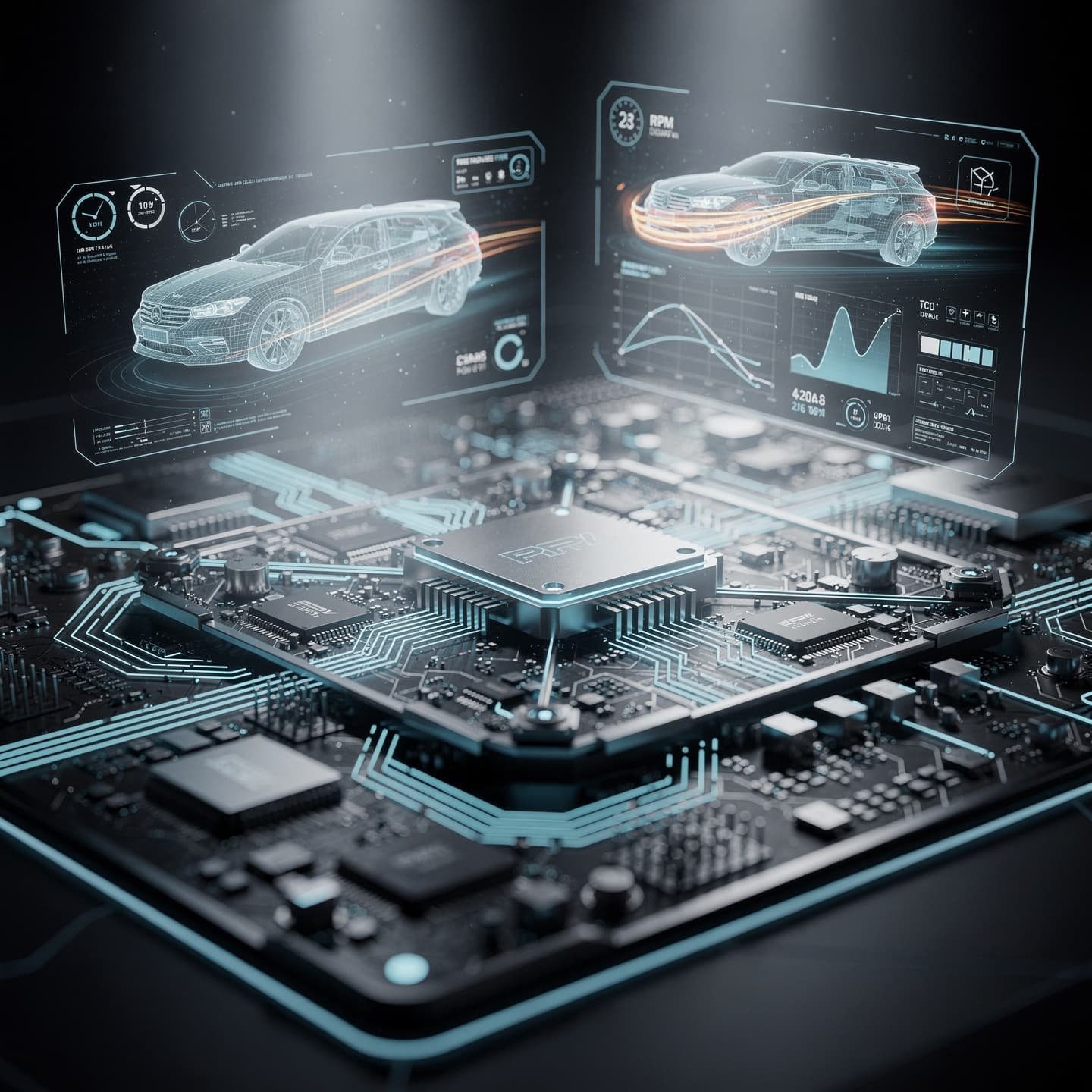
focuses on the advanced optimization of torque maps, traction control (TC), engine braking, and driveability for modern propulsion systems in aerospace and advanced mobility applications. This technical approach integrates dynamic engine models, ECU calibration, and adaptive control algorithms, framed within areas such as engine dynamics, electronic integration, and thermal management, supported by HIL/SIL simulation tools, real-time modeling, and predictive control to ensure efficiency and stability of the propulsion system under international functional safety standards.
Testing is carried out with test benches and data acquisition laboratories with vibroacoustic and EMC measurements, ensuring traceability in accordance with applicable international regulations and electronic certification standards such as ISO 26262 for functional safety and reliability requirements. The training prepares specialists for roles such as ECU calibration engineer, power control technician, HIL validation engineer, and torque strategy manager, strengthening the synergy between software development and mechanical integration in complex propulsion systems.
ECU Strategy & Control Engineering
- Format:
- Duration:
- Time: 1900 H
- Practices: Consult
- Language:
- Credits:
- Registration date: 08-10-2026
- Start date: 02-12-2026
- Available places: 2
2,500 $
Skills and results
What you will learn
- Analyze the interaction between Torque Maps, Traction Control, and Engine Braking to optimize Driveability.
- Design and calibrate Torque Maps and Engine Braking strategies that, together with Traction Control, improve traction, response smoothness, and safety under different driving conditions.
- Validate and optimize ECU performance through driving dynamics tests, simulations, and data collection to ensure consistent Driveability between Torque Maps, Engine Braking, and Traction Control.
2. ECU Engineering: Torque Optimization, Traction Control, Engine Braking, and Driving Experience
- Analyze Torque Optimization and torque management in engines and transmissions, to improve response, efficiency, and driving dynamics under different profiles.
- Implement Traction Control and stability control using sensors and slip control algorithms, to maintain grip and optimize traction on variable surfaces.
- Develop Engine Braking and driving experience through calibration of engine response and its integration with the braking system, aiming for smoothness, predictability, and greater efficiency.
3. Comprehensive user-oriented design and validation (from modeling to manufacturing)
You will learn to integrate the entire product development process from concept to final validation, applying user-centered methodologies. You will develop competencies in parametric design, ergonomics, simulation, sustainable materials, 3D visualization, and manufacturing management, ensuring efficient, safe solutions aligned with current industry standards.
4. ECU Engineering: Torque Maps, Traction Control, Engine Braking, and Driveability Improvement.
- Analyze torque maps and their interaction with traction control and engine braking to optimize ECU response under different driving profiles.
- Design and calibrate traction control and engine braking strategies integrated into the ECU to improve adhesion and stability on curves and variable surfaces.
- Validate and adjust torque maps, traction control, and engine braking through bench and on-road testing for driveability improvement.
5. ECU Mastery: Control Strategies (Torque Maps, TC, Engine Braking, Driving Dynamics)
- Analyze the interaction between Torque Maps, TC, and Engine Braking to optimize driveability and ECU response.
- Design ECU control strategies that ensure stability, controllability, and smooth transitions under variations in load, speed, and road conditions.
- Calibrate and validate in simulation and field testing the performance of torque maps, TC, and driveability techniques, prioritizing safety and efficiency.
6. ECU Engineering: Engine Control Strategies (Torque Maps, TC, Engine Braking, and Driving)
- Analyze the interaction between torque maps, TC (Torque Control), and engine dynamics to obtain a predictable and stable response under different load and speed conditions.
- Evaluate and calibrate engine braking and driveability strategies to improve efficiency, reduce consumption, and smooth transitions between control regimes.
- Design and integrate an ECU framework that coordinates torque maps, TC, engine braking, and driveability, supported by simulation and field testing to ensure performance and safety.
Who this program is for:
ECU Strategy & Control Engineering
- Graduates in Mechanical Engineering, Automotive Engineering, Electronic Engineering, Industrial Engineering or related fields.
- Professionals from automotive OEMs, automotive MRO, consulting, technology centers.
- ECU Testing, calibration, integration, safety, and dynamics professionals seeking specialization.
- Regulators/authorities and profiles in the automotive industry requiring competencies in compliance.
Recommended requirements: background in thermodynamics, control, and electronics; ES/EN B2+/C1. We offer bridging tracks if you need them.
- Standards-driven curriculum: you will work with CS-27/CS-29, DO-160, DO-178C/DO-254, ARP4754A/ARP4761, ADS-33E-PRF from the very first module.
- Accreditable laboratories (EN ISO/IEC 17025) with rotor test bench, EMC/Lightning pre-compliance, HIL/SIL, vibration/acoustics.
- TFM oriented to evidence: safety case, test plan, compliance dossier, and operational limits.
- Industry mentoring: instructors with experience in rotorcraft, tiltrotor, eVTOL/UAM, and flight test.
- Flexible modality (hybrid/online), international cohorts, and support from SEIUM Career Services.
- Ethics and safety: safety-by-design approach, cyber-OT, DIH, and compliance as pillars.
1.1 ECU Domain: Torque Maps and their influence on driveability: key variables (rpm, load, temperature), map architecture
1.2 Torque Map design and calibration: curves, feel, ramps, limits, and interpolation methods
1.3 Traction Control: principles, sensors and grip estimation, torque and braking actions
1.4 Torque and TC integration: coordination during gear changes and power transitions to avoid wheel spin
1.5 Engine Braking: concepts, deceleration, effects on efficiency and dynamics
1.6 Braking management: interaction with ABS/ESC and regenerative braking strategies (EV/HEV)
1.7 Driveability: response linearity, driver feedback, and sensitivity adjustment
1.8 Testing and validation: test bench, simulations, vehicle testing, and map and TC verification
1.9 Safety and compliance: ISO 26262, requirements management, traceability, and software audits
1.10 Case study: go/no-go with risk matrix for map calibration, TC, and driveability
2.1 Introduction to ECU Engineering: Control Strategies
2.2 ECU architectures and map allocation: Torque, Traction Control, and Engine Braking
2.3 Torque Maps: theory, limits, and calibration
2.4 Traction Control (TC): activation strategies, scaling, and constraints
2.5 Engine Braking: integration, limits, and effects on dynamics
2.6 Driving Dynamics: influence of ECU strategies on behavior and response
2.7 Driveability: tuning for perceptibility, smoothness, and safety
2.8 Safety and robustness in ECU: diagnostics, fallbacks, and fault protection
2.9 Development methodologies: MBSE/PLM for strategy design and management
2.10 Case studies: scenario analysis and go/no-go with performance criteria
3.1 Fundamentals of ECU Engineering: System architecture, sensors, actuators, and data flow
3.2 Torque Maps: concepts, representation, calibration, and effect on vehicle dynamics
3.3 Traction Control (TC): principles, strategies, and impact on safety and performance
3.4 Engine Braking: fundamentals, control signals, and influence on consumption and stability
3.5 Driveability: human-machine interface, usability, calibration of sensations
3.6 ECU Engineering: software lifecycle, development and validation methodologies
3.7 Torque Optimization: tuning techniques and performance criteria with safety
3.8 System integration and safety: communications (CAN/Ethernet), functional safety architecture
3.9 Data analysis and simulation: modeling, virtual testing, and MBSE/PLM for ECU
3.10 Case clinic: go/no-go with risk matrix for an ECU project
4.1 Introduction to ECU Engineering: concepts, scope, and impact on driveability
4.2 ECU architectures: microcontrollers, processors, nodes, and buses (CAN, FlexRay, Ethernet)
4.3 Development languages and tools: C/C++, MATLAB/Simulink, AUTOSAR, calibration tools
4.4 ECU software lifecycle: requirements, design, implementation, testing, maintenance
4.5 Hardware–software interface: sensors, actuators, network interfaces, and timing
4.6 Modeling and simulation of ECU systems: Torque Maps, Traction Control, Engine Braking, and Driveability
4.7 Calibration and optimization: methodologies, metrics, safety limits
4.8 Validation and verification: SIL/HIL testing, bench testing, change traceability
4.9 Safety, regulations, and quality: ISO 26262, ASIL, risk management, V&V
4.10 Case studies and core competencies: reading specifications, initial calibration exercises, failure analysis
5.1 Overview of ECU Engineering: scope and objectives of control strategies
5.2 ECU architectures: microcontrollers, DSP, and system-on-chip
5.3 Torque Maps: concepts, input and output axes, interpretability
5.4 Traction Control: fundamentals of adhesion, simplified models, and limits
5.5 Engine Braking: braking principles and their impact on performance and safety
5.6 Driveability: interaction between ECU strategy and driving experience
5.7 Design of control strategies: logic rules, operating conditions, and hierarchy
5.8 Sensor and actuator integration: data acquisition and correspondence with maps
5.9 Safety and diagnostics in ECU: monitoring, faults, and redundancies
5.10 Case studies and evaluation: simulation exercises, bench testing, and acceptance criteria
6.1 ECU Engineering: Dynamic Engine Control — ECU architectures, torque maps, traction control, and engine braking
6.2 Torque Maps: curve optimization for response and smoothness in driveability
6.3 Traction Control (TC): activation strategies, slip limits, and stability
6.4 Engine Braking: coordination with brakes and energy management for smoothness and efficiency
6.5 Driveability: modeling, simulation, and testing for control calibration
6.6 Torque Optimization: interpolation algorithms and adaptability to road conditions
6.7 Sensors and estimation: integration of speed, RPM, temperature, and engine state sensors
6.8 Diagnostics and Maintenance: fault detection in maps and TC, real-time diagnostics
6.9 Safety and Robustness: fail-safe strategies, redundancy, and robustness testing
6.10 Case clinic: go/no-go with risk matrix for dynamic control design decisions
7.1 Introduction to ECU and Control Engineering: scope, objectives, and application context
7.2 ECU architecture: sensors, actuators, and communication networks (CAN/SPI/UART)
7.3 Torque Models and Maps: concepts, units, and basic calibration
7.4 Traction Control: principles, operating modes, and safety limits
7.5 Engine Braking: mechanisms, performance benefits, and dynamics
7.6 Driveability: influence of the ECU on feel, response, and comfort
7.7 Safety and Diagnostics: failure modes, redundancy, and fallbacks
7.8 Validation Methodologies: simulation, test bench, and vehicle testing
7.9 Standards, Metrics, and Certification: quality and performance standards
7.10 Case Clinic: go/no-go with risk matrix for implementation decisions
8.1 Fundamentals of ECU Engineering: architecture, functional blocks, and signal flow (Torque Maps, Traction Control, and Engine Braking)
8.2 Torque Maps: fundamentals, curves, interpolation, and allocation in the ECU
8.3 Traction Control: principles, slip detection, and control strategies
8.4 Engine Braking: mechanisms, effects on stability, and coordination with driveability
8.5 Driveability: how the ECU shapes pedal response and driving feel
8.6 Driving Dynamics: influence of the ECU on grip, inertia, and torque distribution
8.7 Control Strategies: decision logic, operating modes, and state transitions
8.8 Sensors and Actuators: signal acquisition and coupling with engines, brakes, and actuators
8.9 Safety and Diagnostics: monitoring, faults, redundancy, and ECU system robustness
8.10 Case Study: design and validation of Torque and TC maps in simulator
9.1 Introduction to ECU Engineering: Functions and key components
9.2 Torque Maps: Theory, interpretation, and practical applications
9.3 Traction Control (TC): Principles, configurations, and optimal tuning
9.4 Engine Braking: Operation, benefits, and control strategies
9.5 Driveability Improvement: Feel, response, and customization
10.1 Torque Maps: fundamentals, calibration, and adaptability
10.2 Traction Control Strategies: slip limits, intervention modes, and coordination with maps
10.3 Engine Braking: techniques for torque and braking management, wear effects
10.4 Driveability: modeling, simulation, and validation
10.5 Driveability: drivability, perceptible response, and fine-tuning
10.6 Sensor and feedback integration: wheel speed, IMU, torque sensors, and filtering
10.7 Verification and validation methods: bench testing, HIL testing, and road testing
10.8 Safety and resilience: fault detection, redundancy, and fallback strategies
10.9 Performance and efficiency optimization: ramp strategies, dynamic limiters, and light predictive control
10.10 Case study: design, implementation, and verification of a Torque and TC map for a specific engine
- Hands-on methodology: test-before-you-trust, design reviews, failure analysis, compliance evidence.
- Software (according to licenses/partners): MATLAB/Simulink, Python (NumPy/SciPy), OpenVSP, SU2/OpenFOAM, Nastran/Abaqus, AMESim/Modelica, acoustics tools, DO-178C planning toolchains.
- SEIUM Laboratories: scale rotor test bench, vibration/acoustics, EMC/Lightning pre-compliance, HIL/SIL for AFCS, data acquisition with strain gauging.
- Standards and compliance: EN 9100, 17025, ISO 27001, GDPR.
Capstone-type projects
- Blade optimization: BEMT+CFD; bench/tunnel; BVI acoustics.
- AFCS/SCAS: hover/attitude hold, envelope protection, SIL/HIL.
- Tiltrotor: conversion corridor and margins.
- Aeroelasticity: modal; whirl flutter; mitigations.
DO-160: environmental test plan (vibration, temperature, EMI, lightning) and mitigation.
- Blade optimization: BEMT+CFD; bench/tunnel; BVI acoustics.
- AFCS/SCAS: hover/attitude hold, envelope protection, SIL/HIL.
- Tiltrotor: conversion corridor and margins.
- Aeroelasticity: modal; whirl flutter; mitigations.
DO-160: environmental test plan (vibration, temperature, EMI, lightning) and mitigation.
- Torque Maps: TC; braking; experience.
- ECU: Torque; TC; traction; simulation.
- Advanced ECU: Torque; TC; dynamics.
- Strategies: engine; experience; sensors.
DO-160: environmental testing and mitigation.
- Torque Maps: TC; braking; experience.
- ECU: Torque; TC; traction; simulation.
- Advanced ECU: Torque; TC; dynamics.
- Strategies: engine; experience; sensors.
DO-160: environmental testing and mitigation.
- ECU Domain: Control Strategies: Torque Maps, TC, Engine Braking, and Driving Dynamics.
- ECU Engineering: Torque Optimization and Traction Control with SIL/HIL validation.
- Advanced ECU: Torque Maps, TC, Braking, and Driveability Improvement.
- Calibration and Safety: ECU integration, bench testing, and field simulation.
- DO-160: environmental test plan and mitigation.
Admissions, fees and scholarships
- Profile: Background in Computer Engineering, Mathematics, Statistics, or related fields; practical experience in NLP and information retrieval systems is valued.
- Documentation: Updated CV, academic transcripts, SOP/purpose essay, project or code samples (optional).
- Process: application → technical profile and experience evaluation → technical interview → practical case review → final decision → enrollment.
- Fees:
- Single payment: 10% discount.
- 3-installment payment: no fees; 30% upon enrollment + 2 equal monthly payments of the remaining 35%.
- Monthly payment: available with a 7% fee on the total; annual review.
- Scholarships: based on academic merit, financial situation, and promotion of inclusion; agreements with industry companies for partial or full scholarships.
Check “Calendar & calls”, “Scholarships & financial aid”, and “Fees & financing” in the SEIUM mega-menu.
Do you have any questions?
Our team is ready to help you. Contact us and we’ll get back to you as soon as possible.
F. A. Q
Frequently Asked Questions
Yes, we hold international certification.
Yes: experimental models, real data, applied simulations, professional environments, real case studies.
It is not mandatory. We offer leveling tracks and tutoring.
Completely. It covers e-propulsion, integration, and emerging regulations (SC-VTOL).
Recommended. There are also internal challenges and consortia.