
Master’s in EMC/EMI for Electric Vehicles and EVSE
About us Master’s in EMC/EMI for Electric Vehicles and EVSE
The Master’s in EMC/EMI in Electric Vehicles and EVSE
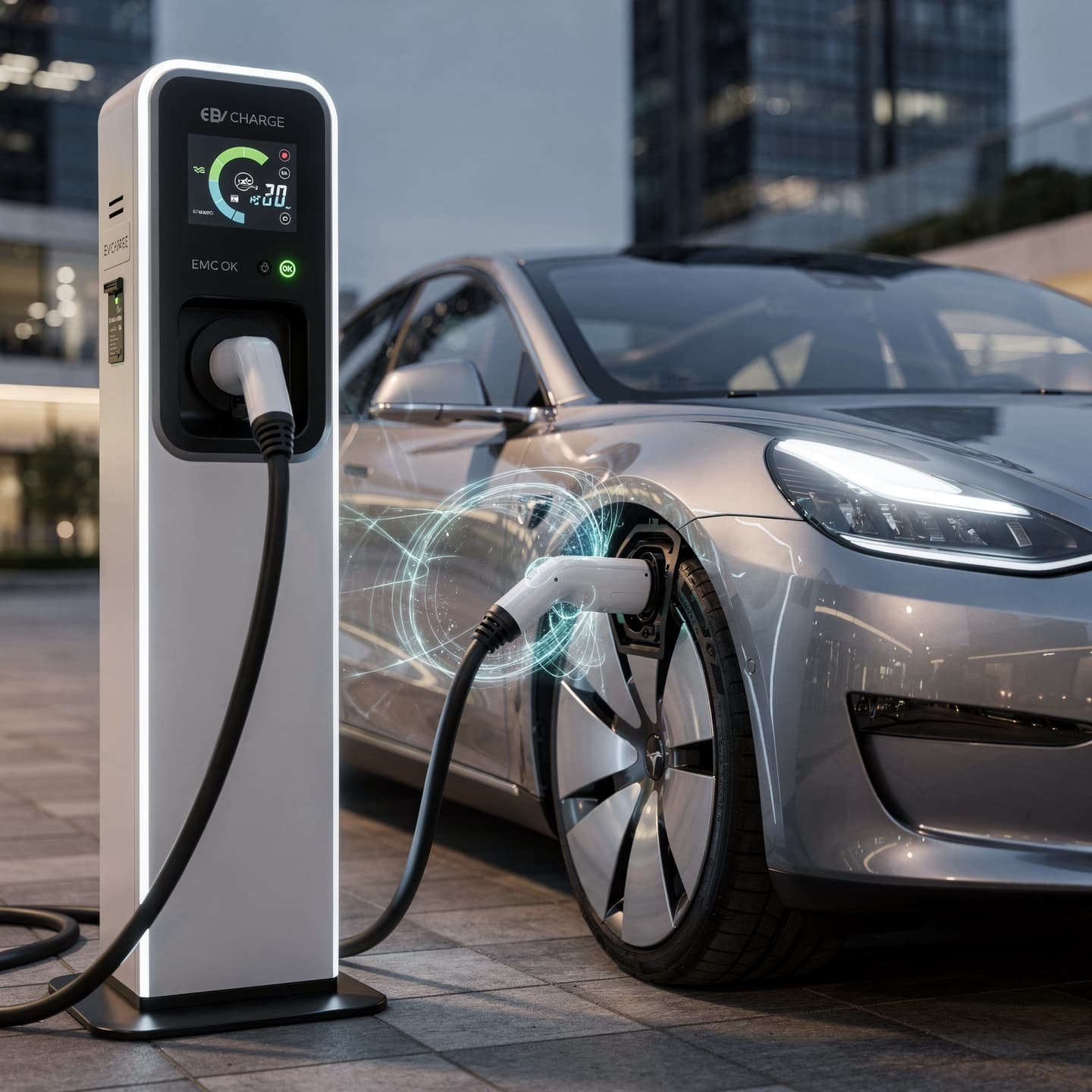
is an advanced program specialized in electromagnetic compatibility (EMC) and electromagnetic interference (EMI) applied to the electric vehicle and to charging infrastructure (EVSE, wallbox, fast chargers). Throughout the master’s program you will learn to identify noise sources, design compatible architectures and hardware, plan tests, interpret laboratory reports, and propose mitigation solutions that ensure compliance with automotive and grid standards. The focus is on the complete EMC/EMI ecosystem in EV and EVSE: traction inverters, DC-DC converters, on-board chargers, DC fast chargers, HV/LV wiring, wallboxes, and public stations.
The program combines solid EMC/EMI theory, study of international standards, analysis of real-world failure cases, filter design, shielding and grounding, as well as testing methodologies and interaction with accredited laboratories. The objective of the Master’s in EMC/EMI in Electric Vehicles and EVSE is for you to be able to take on the role of EMC engineer in electric vehicle and electric charger projects, leading critical design and electromagnetic validation decisions.
Master’s in EMC/EMI for Electric Vehicles and EVSE
- Format: Online
- Duration: 19 months
- Time: 1900 H
- Practices: Consult
- Language: ES / EN
- Credits: 60 ECTS
- Registration date: 04-07-2026
- Start date: 28-08-2026
- Available places: 8
5.900 $
Skills and results
What you will learn
You will understand the fundamentals of electromagnetic compatibility in the context of the electric vehicle and EVSE: what EMC is, what EMI is, how emissions are generated, and how the immunity of sensitive systems is affected. You will see why EV EMC is more demanding than in traditional internal combustion vehicles, due to power electronics, HV batteries, and electric chargers. You will learn to differentiate between conducted and radiated emissions, between differential and common-mode noise, and how all of this impacts the electrical architecture of the EV and the charging station.
You will master the map of EMC/EMI standards applicable to electric vehicles and EVSE: automotive standards, grid standards, emission limits, immunity tests, compatibility tests with the electrical infrastructure and with other vehicle equipment. You will learn to read an OEM specification from the EV EMC perspective, to translate those requirements into design criteria, and to prepare an EMC test plan for an electric vehicle subsystem or for an EVSE electric charger.
You will delve into the sources of EV EMI: traction inverters, DC-DC converters, on-board chargers, fast chargers, battery modules, BMS, electric motors, relays and contactors, communication buses, and control electronics. You will study how high-frequency switching, voltage slopes, and parasitic currents generate EV EMC issues, and how these can couple into wiring, structures, and unintended antennas both in the electric vehicle and in the EVSE.
You will learn to design hardware, wiring, and architecture with EMC/EMI in mind from the very beginning. You will see best practices for power PCB layout, return paths, separation between power and signal traces, HV and LV wiring design in the vehicle, grounding topologies, and placement of filters and shields. You will work on how all of this integrates into EV EMC and into the electromagnetic compatibility of AC and DC electric chargers.
You will specialize in EMC/EMI in EVSE: domestic wallboxes, semi-fast AC chargers, DC fast chargers, and public charging solutions. You will study how these devices connect to the grid, what compatibility requirements they must meet, what interference they can generate in the installation and in other equipment, and how to design filters and protections so that an EVSE is electromagnetically compatible. You will understand the relationship between EVSE EMC and the EV EMC of the connected vehicle.
You will delve into the sources of EV EMI: traction inverters, DC-DC converters, on-board chargers, fast chargers, battery modules, BMS, electric motors, relays and contactors, communication buses, and control electronics. You will study how high-frequency switching, voltage slopes, and parasitic currents generate EV EMC issues, and how these can couple into wiring, structures, and unintended antennas both in the electric vehicle and in the EVSE.
To whom is our:
Master’s in EMC/EMI for Electric Vehicles and EVSE
The Master’s in EMC/EMI in Electric Vehicles and EVSE is aimed at engineers and technicians in electronics, electrical engineering, telecommunications, automotive, energy, and related fields who want to specialize in electromagnetic compatibility applied to the electric vehicle and to EVSE electric chargers. It is especially suitable for professionals who already work in power electronics design, OBC, inverters, converters, wallboxes, fast chargers, or in EV system integration, and who wish to deepen their knowledge of EV EMC and EVSE EMC as a key discipline. A basic knowledge of circuits, signals, power electronics, and handling of technical tools (spreadsheets, basic simulation) is recommended. The ideal profile combines an interest in EMC/EMI with motivation for the EV ecosystem and for robust system design in complex environments.
SEIUM proposes the Master’s in EMC/EMI in Electric Vehicles and EVSE as a direct response to a common shortcoming: many master’s programs address electric vehicles, batteries, or power electronics, but few focus on EV EMC and EV EMI as a primary design and industrialization problem. This program places electromagnetic compatibility at the center of development, covering both the electric vehicle and the EVSE, as well as the grid interface. The approach combines technical rigor, standards, practical design, review of real failures, reading of laboratory reports, and projects oriented toward the day-to-day work of an EMC/EMI in EV and EVSE engineer. The flexible online format allows the master’s to be combined with professional activity, incorporating real company cases and documentation into the classroom, with the goal that graduates can bring immediate value to automotive EMC and EVSE EMC projects.
1.1 Basic concepts of electromagnetic compatibility (EMC) and EMI
1.2 Conducted and radiated emissions, immunity, and coupling modes
1.3 Differences between classical EMC and EV EMC in electric vehicles
1.4 EMC particularities of power electronics in EV and EVSE
1.5 Key elements of the ecosystem: electric vehicle, battery, electric chargers, grid
1.6 Distribution of EMC responsibilities among OEM, Tier 1, and EVSE manufacturer
1.7 EV EMI risks: communication degradation, functional failures, safety
1.8 System EMC concepts: overall view of the EV platform
1.9 Examples of real EMC/EMI problems in electric vehicles
1.10 Objectives and competences of the Master’s in EMC/EMI in Electric Vehicles and EVSE
2.1 General overview of automotive EMC standards applicable to EV
2.2 Specific standards for EVSE EMC and electric chargers connected to the grid
2.3 Conducted and radiated emission limits in electric vehicles
2.4 Immunity tests: bursts, discharges, radiated fields, transients
2.5 Compatibility requirements with low-voltage and medium-voltage grids
2.6 OEM specifications and cascade of requirements toward suppliers
2.7 Interpretation of EMC EV and EVSE limit tables
2.8 Preparation of an EMC/EMI compliance matrix for a project
2.9 Relationship between EMC and functional/electrical safety in EV
2.10 Examples of compliance gaps and their consequences
3.1 Traction inverters as the main source of EV EMI
3.2 DC-DC converters, on-board chargers, and auxiliary power electronics
3.3 HV battery, BMS, and contactors: transients and switching
3.4 Communication buses (CAN, LIN, Ethernet) and EMI vulnerability
3.5 Basic equivalent circuit models for EV EMC
3.6 Coupling by capacitance, inductance, and radiation in the vehicle
3.7 Common and differential modes in HV and LV cables
3.8 Diagnostic methods in prototypes: current probes, field loops
3.9 Case studies of EV EMI and their analysis
3.10 Conclusions to guide EMC design from the architecture
4.1 Good PCB layout practices in power and control electronics
4.2 Separation of power, control, and communication domains
4.3 Management of ground planes and reference points in automotive EMC
4.4 Design of HV and LV wiring with EV EMC in mind
4.5 Physical routing in the vehicle: loops, proximity, crossings
4.6 Selection of connectors and shields for sensitive lines
4.7 Integration of EMC filters in power and control modules
4.8 Examples of good and bad designs from the EMC perspective
4.9 Documentation of design rules for hardware teams
4.10 EMC review checklist for electric vehicle projects
5.1 Typical EVSE architectures: wallbox, public AC, fast DC
5.2 EMI sources in EVSE: converters, relays, communications
5.3 EVSE EMC requirements versus the grid and versus the vehicle
5.4 Design of input and output filters in electric chargers
5.5 Shielding and grounding in EVSE racks and enclosures
5.6 Coexistence of communications (PLC, Ethernet, Wi-Fi) with power in EVSE
5.7 Cases of EV–EVSE incompatibility due to EMC issues
5.8 Specific mitigation strategies for high-power EVSE
5.9 Design coordination between charger manufacturer and EV OEM
5.10 Best practices in EVSE EMC for infrastructure projects
6.1 Types of EMI filters for EV and EVSE: LC, C-L-C, common mode
6.2 Selection and sizing of common-mode and differential-mode chokes
6.3 Use of ferrites, beads, and suppression components in EV EMI
6.4 Shielding: materials, geometries, and connection points
6.5 Grounding strategies: star, mesh, hybrid
6.6 Snubbers and slew-rate control techniques in power electronics
6.7 Impact of EMC solutions on cost, weight, and efficiency
6.8 Validation of mitigation solutions in prototypes
6.9 Documentation of EMC design fixes for series production projects
6.10 Catalog of typical electromagnetic compatibility solutions in EV and EVSE
7.1 Circuit simulation tools for EMI analysis (SPICE and similar)
7.2 Lumped models of cables, filters, and noise sources
7.3 Introduction to field simulation (2D/3D) for shielding and antennas
7.4 Simulation of EMC filters and attenuation evaluation
7.5 Modeling of current return paths and ground distribution
7.6 Examples of simulation-to-measurement correlation in EV EMC
7.7 Limitations of EMC simulation and how to interpret them
7.8 Practical pre-compliance strategies using simulation
7.9 Documentation of internal EMC models and libraries
7.10 Recommended workflow: design–simulation–test–optimization
8.1 Types of EMC laboratories for electric vehicles and EVSE
8.2 Semi-anechoic chambers, GTEM chambers, TEM cells, LISN, TEM cells
8.3 Preparation of samples and test setups according to standards
8.4 Reading an EMC test plan for EV and EVSE
8.5 Interpretation of laboratory reports: graphs, margins, failures
8.6 Diagnostics in the laboratory: field probes, EMC scanning
8.7 Effective communication with laboratories and OEMs in EV EMC projects
8.8 Management of non-compliances and corrective action plans
8.9 Strategies to reduce time and cost of EMC/EMI campaigns
8.10 Traceability and archiving of evidence for homologation
9.1 Planning an EMC project from concept to production
9.2 Integration of EMC/EMI into the gate reviews of EV development
9.3 Relationship with hardware, software, mechanical, and quality teams
9.4 EMC risk management and criticality matrices
9.5 Cost of non-quality EMC in electric vehicles and electric chargers
9.6 Relationship with suppliers of EMC components (filters, ferrites, cables)
9.7 Technical negotiation with OEMs and clients on EV EMC
9.8 Success metrics in automotive EMC projects
9.9 Lessons learned and construction of internal EMC/EMI guides
9.10 Career opportunities as an EV EMC and EVSE EMC specialist
10.1 System vision: EV + EVSE + grid from the EMC/EMI perspective
10.2 Selection of the case for the final project (passenger EV, fleet, fast charger, etc.)
10.3 Definition of EMC requirements for the chosen system
10.4 Proposal of architecture and EMC/EMI design measures
10.5 Outline of the test plan and homologation strategy
10.6 Identification of EMC risks and mitigation plan
10.7 Preparation of diagrams, lists of EMC components, and justification
10.8 Preparation of the technical dossier for the final project
10.9 Presentation and defense before an academic–technical committee
10.10 Professional projection in EV EMC, EV EMI, and EVSE EMC
The methodology of the Master’s in EMC/EMI in Electric Vehicles and EVSE combines live online classes, on-demand content, calculation exercises, analysis of standards, basic simulations, and applied projects. You will work with technical spreadsheets to size filters and estimate noise levels, with circuit simulation tools and simplified models to study EV EMC and EVSE EMC, and with examples of real EMC laboratory reports (adapted for the teaching environment). The “laboratory” is conceived as a virtual environment where you will learn to interpret emission curves, compliance margins, field maps, and test records, and where you will document electromagnetic compatibility solutions for the electric vehicle and electric chargers. Everything is oriented so that you can apply what you have learned immediately in your professional environment.
Capstone-type projects
Conceptual design of EMC filters for an EV or EVSE
Definition of a critical line (HV cable, charger AC line, DC bus), proposal of an EMC/EMI filter topology, basic sizing, and justification of component selection for an electric vehicle or electric charger case.
Conceptual design of EMC filters for an EV or EVSE
Definition of a critical line (HV cable, charger AC line, DC bus), proposal of an EMC/EMI filter topology, basic sizing, and justification of component selection for an electric vehicle or electric charger case.
Study of HV/LV routing and wiring oriented to EV EMC
Analysis of a simplified HV and LV wiring scheme in an EV, identification of possible loops, coupling areas, and EMC issues, and proposal of improvements in routing, shielding, and grounding.
Reading and interpretation of an EMC laboratory report
Work on a sample report (adapted) of EV EMC or EVSE EMC tests, identification of non-compliance cases, analysis of probable causes, and proposal of design fixes at the hardware or architecture level.
Integrating EMC/EMI project in Electric Vehicles and EVSE
Development of a complete project where the EMC/EMI strategy for an EV+EVSE system is defined: requirements, architecture, mitigation measures, test plan, and technical dossier. The objective is to generate a solid portfolio piece as a specialist in EV EMC and EVSE EMC.
Admissions, fees and scholarships
The Master’s in EMC/EMI in Electric Vehicles and EVSE is aimed at professionals and graduates with a technical background in electronics, electrical engineering, telecommunications, automotive, or energy, who wish to specialize in electromagnetic compatibility applied to electric vehicles and electric chargers. The admission process may include a review of the CV, a motivation letter, and in some cases an interview, in order to ensure that the candidate has the necessary background to take advantage of the technical level in EV EMC, EV EMI, and EVSE EMC. SEIUM may offer scholarships and financial aid for working professionals, students with outstanding academic records, and international candidates, as well as installment payment plans that facilitate access to high-value-added training in automotive EMC and EVSE EMC without sacrificing quality or technical depth.
Do you have any questions?
Our team is ready to help you. Contact us and we’ll get back to you as soon as possible.
F. A. Q
Frequently Asked Questions
It is not essential to have already worked in EMC, but it is advisable to have a background in electronics and power systems. The master’s introduces the fundamentals and then focuses on EV EMC, EV EMI, and EVSE EMC, so with a solid technical background and dedication you will be able to keep up with the pace.
The approach is mixed. Approximately half of the content focuses on EV EMC (electric vehicle) and the other half on EVSE EMC (electric chargers, wallboxes, fast DC), because in practice both worlds are closely connected.
Simulation tools and methodologies are used, including circuit simulation, simplified models, and an introduction to field simulation concepts. The objective is for you to learn transferable methodologies, beyond any specific tool, to apply them to automotive EMC and EVSE EMC.
Yes. The program is delivered in online mode, with live sessions, recorded materials, and flexible projects, so that you can combine it with a current position in automotive, energy, infrastructure, or power electronics.
Yes. The projects are designed to demonstrate your ability to analyze, design, and justify EV EMC, EV EMI, and EVSE EMC solutions, which is highly valuable in selection processes for electromagnetic compatibility specialist positions.
Yes. Even if you come from power electronics, EMC/EMI in electric vehicles and electric chargers poses specific challenges (standards, laboratories, diagnostics, negotiation with OEMs) that this master’s addresses in detail. It will allow you to close the loop between power design and EV/EVSE EMC compliance.