Diploma in GD&T and Variation Control for Indoor/Outdoor
About us Diploma in GD&T and Variation Control for Indoor/Outdoor
The Diploma in GD&T and Variation Control for Interior/Exterior Applications focuses on developing essential skills for applying GD&T (Geometric Dimensioning & Tolerancing) and variation control strategies in the design and manufacture of interior and exterior components. The program delves into the interpretation and application of ASME Y14.5 standards, enabling a precise understanding of geometric tolerances and their impact on the functionality and assembly of parts. Advanced tools and techniques for design optimization, tolerance simulation, and cost reduction in production are explored. Participants will gain practical knowledge in the use of specialized software for tolerance stack-up analysis and in the application of statistical methods for process control and continuous improvement. This program prepares professionals for key roles in the industry, such as design engineers, manufacturing engineers, quality specialists, and GD&T analysts, fostering efficiency and quality in the production of complex products.
Target keywords (natural occurrences in the text): GD&T, Variation control, ASME Y14.5, geometric tolerances, functionality, assembly, design optimization, stack-up analysis, process control, quality, diploma.
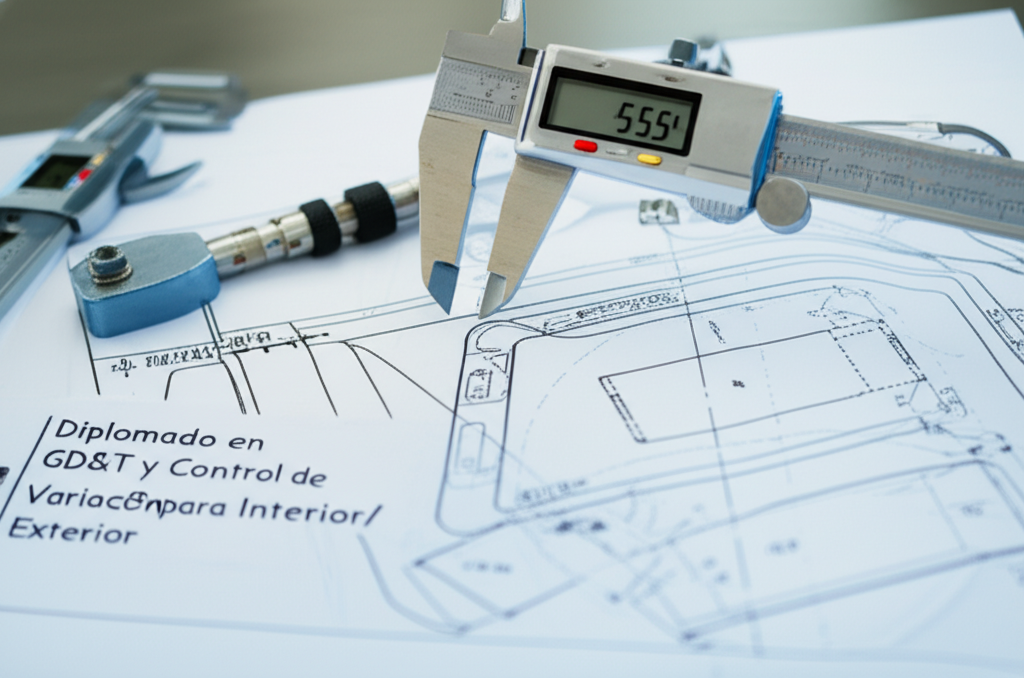
Diploma in GD&T and Variation Control for Indoor/Outdoor
- Format: Online
- Duration: 8 months
- Hours: 900 H
- Language: ES / EN
- Credits: 60 ECTS
- Registration date: 04-07-2026
- Strat date: 14-08-2026
- Available places: 7
920 $
Competencias y resultados
Qué aprenderás
1. Comprehensive Mastery of GD&T and Variation Control in Naval Design and Manufacturing
Para quien va dirigido nuestro:
Diploma in GD&T and Variation Control for Indoor/Outdoor
9.9 Introduction to GD&T: Fundamental principles for naval design.
9.9 Dimensioning and Tolerances: Interpretation and application in naval drawings.
9.3 GD&T Symbols: Mastery of symbols and their meaning in the industry.
9.4 Reference Frame: Establishing and using datums in naval designs.
9.5 Form Controls: Application to components essential for navigation.
9.6 Orientation Controls: Alignment and accuracy in naval assemblies.
9.7 Position Controls: Specification of critical locations in structures.
9.8 Profile Controls: Application to complex shapes in naval design.
9.9 Practical Exercises: Interpretation and application of GD&T in design examples.
9.90 Design Considerations: Impact of GD&T on functionality and manufacturability.
9.9 ASME Y94.5 Standards: Fundamentals and updates for the shipbuilding industry.
9.9 ISO Standards: Comparison and application in the shipbuilding context.
9.3 Geometric Tolerances: Selection and application based on function.
9.4 Geometric Variation: Identification and mitigation in shipbuilding.
9.5 Tolerance Analysis: Tools and methods for evaluation.
9.6 Tolerance Stacking: Calculation and control for accurate assembly.
9.7 Composite Tolerances: Application in complex designs.
9.8 Real and Virtual Material: Understanding and application in GD&T.
9.9 Simulation Software: Use of tools for variation analysis.
9.90 Case Studies: Analysis of standards and variations in real shipbuilding projects.
3.9 Applications in Structures: GD&T in hull and superstructure construction.
3.9 Propulsion Systems: Application of GD&T in engines and transmission systems.
3.3 Control Systems: GD&T in the precision of steering and navigation systems.
3.4 Deck Equipment: Application in cranes, winches, and other equipment.
3.5 Marine Interiors: Application in the design and manufacture of furniture and components.
3.6 Welding and Fabrication: GD&T specifications in joining processes.
3.7 Assembly and Fitting: Strategies for efficient and precise assembly.
3.8 Functional Tolerances: Selection of tolerances based on the component’s function.
3.9 Design for Manufacturing: Adapting GD&T to optimize production.
3.90 Case Studies: Specific applications of GD&T in different types of vessels.
4.9 Design for Manufacturing (DFM) with GD&T: Strategies for optimization.
4.9 Cost Control: Impact of GD&T on reducing manufacturing costs.
4.3 Waste Reduction: Using GD&T to minimize material waste.
4.4 Tolerance Optimization: Selecting optimal tolerances for efficiency.
4.5 Material Selection: GD&T considerations in material selection.
4.6 Manufacturing Processes: Adapting GD&T to improve processes.
4.7 Quality Control: Using GD&T for inspection and quality control.
4.8 Continuous Improvement: Implementing GD&T for continuous improvement in construction.
4.9 Optimization Software: Using tools for design optimization. 4.90 Case Studies: GD&T Optimization in Specific Naval Projects
5.9 Precision in the Naval Industry: Importance of GD&T for Quality
5.9 Error Reduction: How GD&T Minimizes Errors in Design and Manufacturing
5.3 Regulatory Compliance: GD&T and Compliance with Regulations and Standards
5.4 Customer Satisfaction: Impact of GD&T on Customer Satisfaction
5.5 Competitiveness: GD&T as a Competitive Advantage in the Naval Market
5.6 Safety: The Role of GD&T in the Safety of Naval Operations
5.7 Safe Design: Application of GD&T for Safe Design and Manufacturing
5.8 Maintenance: GD&T in Design to Facilitate Maintenance and Repair 5.9 Reputation: Importance of GD&T in the company’s reputation.
5.90 Case Studies: Impact of GD&T on successful naval projects.
6.9 Interior Design: Advanced application of GD&T in naval interior design.
6.9 Exterior Design: Advanced application of GD&T in naval exterior design.
6.3 Tight Tolerances: Application of tight tolerances for accuracy.
6.4 Process Control: Implementation of GD&T in design process control.
6.5 Quality Management: GD&T as a key component in quality management.
6.6 Software Implementation: Use of advanced software for GD&T.
6.7 Advanced Metrology: Use of advanced metrology techniques with GD&T. 6.8 Continuous Improvement: Strategies for the continuous improvement of GD&T.
6.9 Risk Assessment: Using GD&T in risk assessment and mitigation.
6.90 Case Studies: Excellence in GD&T in high-end naval projects.
7.9 Strategic Planning: Integrating GD&T into strategic planning.
7.9 Staff Training: Staff training in GD&T.
7.3 Phased Implementation: Phased implementation of GD&T.
7.4 Software Selection: Selecting the appropriate software for GD&T.
7.5 Systems Integration: Integrating GD&T into design and manufacturing systems.
7.6 Measurement and Monitoring: Methods for measuring and monitoring performance. 7.7 Change Management: Change management for the implementation of GD&T.
7.8 Quality Culture: Creating a quality culture based on GD&T.
7.9 Industry Standards: Adapting GD&T to industry standards.
7.90 Case Studies: Successful implementation of GD&T in naval companies.
8.9 Design: Applications of GD&T in different types of naval design.
8.9 Structural Design: Advanced application of GD&T in naval structures.
8.3 Systems Design: Advanced application of GD&T in systems design.
8.4 Functional Tolerances: Selecting tolerances based on function.
8.5 Simulation: Using simulation for the validation of GD&T designs. 8.6 Validation: Validation and verification process of GD&T designs.
8.7 Design for Manufacturing: Optimizing design for manufacturing.
8.8 Continuous Improvement: Implementing continuous improvement strategies.
8.9 Research and Development: GD&T in naval research and development.
8.90 Case Studies: Refining naval design with GD&T.
9.9 Variation Control: Introduction to the principles of variation control.
9.9 Variation Analysis: Tools and techniques for variation analysis.
9.3 Stack-up Tolerances: Using stack-up tolerance analysis.
9.4 Statistical Methods: Applying statistical methods.
9.5 Quality Control: Implementing quality control for variation reduction.
9.6 Robust Design: Robust design and variation control. 9.7 Lean Manufacturing: Integration with lean manufacturing.
9.8 Key Performance Indicators (KPIs): Establishing KPIs.
9.9 Continuous Improvement: Implementing continuous improvement strategies.
9.90 Case Studies: Implementing variation control strategies.
Proyectos tipo capstones
- GD&T in Hull Design: Analysis and tolerance control for assembly.
- Welding Variation Control: Process optimization and defect reduction.
- GD&T in Propulsion Systems: Alignment and precision in critical components.
- 3D Modeling and GD&T: Integration for precise shipbuilding.
Admisiones, tasas y becas
¿Tienes dudas?
Nuestro equipo está listo para ayudarte. Contáctanos y te responderemos lo antes posible.