
Diploma in Urban Geotechnics for Deep Excavations
Sobre nuestro Diploma in Urban Geotechnics for Deep Excavations
The Diploma in Urban Geotechnics for Deep Excavations focuses on the study and application of advanced techniques for the design, construction, and monitoring of deep excavations in urban environments. It covers geotechnics, soil mechanics, and structural engineering applied to these projects, including slope stability analysis, retaining wall design, and the use of technologies such as piles, sheet piling, and anchors. Emphasis is placed on geotechnical risk management and the implementation of safe and efficient construction solutions. The diploma program provides practical knowledge in geotechnical modeling using specialized software, laboratory and field tests for soil characterization, and the interpretation of stratigraphic profiles. Real-world case studies are analyzed, and the application of current regulations in the design and construction of excavations is promoted. Graduates will be prepared to work as geotechnical engineers, construction supervisors, and specialized consultants in urban infrastructure projects.
Target keywords (natural occurrences in the text): deep excavations, urban geotechnics, soil mechanics, slope stability, retaining walls, piles, sheet piling, geotechnical modeling, geotechnical engineering, diploma in geotechnics.
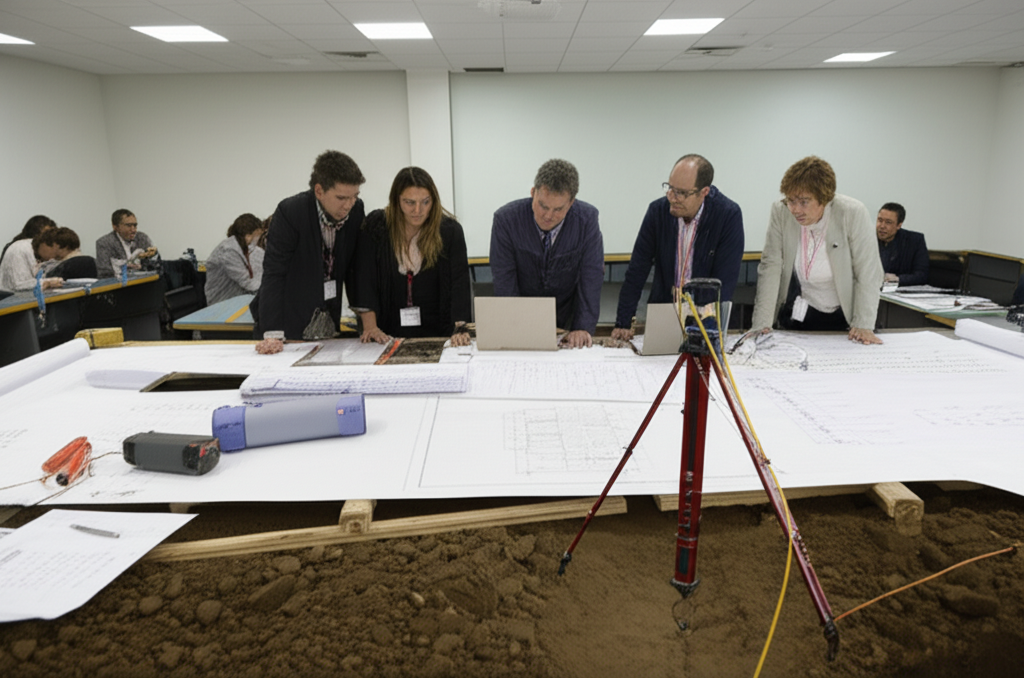
Diploma in Urban Geotechnics for Deep Excavations
- Modalidad: Online
- Duración: 8 meses
- Horas: 900 H
- Idioma: ES / EN
- Créditos: 60 ECTS
- Fecha de matrÃcula: 30-04-2026
- Fecha de inicio: 10-06-2026
- Plazas disponibles: 3
1.249 $
Competencias y resultados
Qué aprenderás
1. Advanced Geotechnical Analysis for Deep Urban Excavations
- Determine the geotechnical properties of soil and subsoil in densely populated urban environments.
- Evaluate the stability of slopes and retaining walls in deep excavations.
- Use specialized software to model and analyze the behavior of soil and retaining structures.
- Identify and mitigate the risks associated with the presence of groundwater and other geotechnical factors.
- Understand and apply local regulations and standards related to deep urban excavations.
- Design support and reinforcement systems to ensure the safety and stability of excavations.
- Conduct environmental and social impact studies of excavations.
- Supervise and control the execution of excavation works, ensuring compliance with designs and technical specifications.
2. Mastering Urban Geotechnical Engineering: Deep Excavations and Their Challenges
2. Mastery of Urban Geotechnical Engineering: Deep Excavations and Their Challenges
- Understand the fundamental principles of soil mechanics applied to urban environments.
- Identify and analyze the different types of soils present in urban areas, including their geotechnical properties.
- Evaluate the geotechnical risks associated with deep excavations, such as settlement, slope instability, and effects on adjacent structures.
- Master geotechnical investigation techniques, including drilling, laboratory testing, and in-situ testing, to characterize the subsoil.
- Design and analyze earth retention systems for deep excavations, such as diaphragm walls, piles, sheet piles, and anchoring systems.
- Implement geotechnical analysis models to predict the behavior of soil and structures during excavation, using specialized software.
- Manage groundwater during excavation, including the design of drainage systems and seepage control.
- Supervise and control the execution of deep excavations, ensuring safety and compliance with geotechnical designs.
- Address the specific challenges of deep excavations in urban environments, such as the presence of existing infrastructure, noise, and vibrations.
- Understand and apply building codes and regulations related to urban geotechnics.
3. Comprehensive user-oriented design and validation (from modeling to manufacturing)
You will learn to integrate the entire product development process, from initial model conception to final validation, applying user-centered methodologies. You will develop skills in parametric design, ergonomics, simulation, sustainable materials, 3D visualization, and manufacturing management, ensuring efficient, safe solutions that meet current industry standards.
4. Geotechnical Strategies for Urban Excavations: Foundations and Deep Structures
- Understand the principles of soil mechanics and geology applied to urban environments.
- Evaluate the geotechnical risks associated with excavations in urban areas, including differential settlement and slope stability.
- Design and analyze shallow and deep foundations, considering structural loads, soil characteristics, and site conditions.
- Select and size retaining walls, anchoring systems, and other excavation support elements, ensuring stability and safety.
- Apply soil improvement techniques, such as consolidation, grouting, and stabilization, to optimize the geotechnical properties of the ground.
- Interpret geotechnical reports, including laboratory tests and field tests, to obtain accurate information about subsurface conditions.
- Use specialized software for geotechnical analysis and the design of retaining and foundation structures.
- Study case studies of successful and problematic urban excavations, analyzing the geotechnical strategies employed and the results obtained.
- Understand the relevant regulations and standards for the design and construction of geotechnical structures in urban environments.
- Manage the execution of excavation projects, supervising geotechnical work and ensuring quality and safety.
5. Geotechnical Assessment and Comprehensive Design for Deep Urban Excavations
5. Geotechnical Evaluation and Comprehensive Design for Deep Urban Excavations
- Understand the principles of geotechnical engineering applied to urban environments, including soil-structure interaction.
- Analyze the geotechnical investigation methods necessary to characterize the subsoil, such as boreholes, laboratory tests, and in-situ tests.
- Evaluate the different types of deep excavations, considering their advantages, disadvantages, and specific applications.
- Design excavation support systems, including diaphragm walls, piles, sheet piles, and anchors, optimizing stability and safety.
- Estimate and monitor slope stability in excavations, applying calculation methods and specialized software.
- Manage the Geotechnical risk associated with excavations, identifying hazards, assessing the probability of occurrence, and establishing mitigation measures.
- Analyze the effects of excavations on the urban environment, considering settlements, movements of adjacent structures, and the impact on existing infrastructure.
- Apply drainage techniques to control groundwater and minimize the effects of hydrostatic pressure in excavations.
- Use geotechnical analysis software to simulate the behavior of soil and retaining structures, optimizing the design.
- Implement a integrated approach in the design of deep excavations, considering technical, economic, environmental, and safety aspects.
6. Urban Geotechnical Engineering: Deep Excavations, Analysis, Design, and Comprehensive Construction
You will learn to integrate the entire product development process, from initial model conception to final validation, applying user-centered methodologies. You will develop skills in parametric design, ergonomics, simulation, sustainable materials, 3D visualization, and manufacturing management, ensuring efficient, safe solutions that meet current industry standards.
Para quien va dirigido nuestro:
Diploma in Urban Geotechnics for Deep Excavations
- Civil engineers, geologists, architects, and construction professionals with an interest in geotechnical engineering.
- Professionals working on urban infrastructure projects, including the design and execution of deep excavations.
- Geotechnical consultants, foundation specialists, and construction company personnel.
- Project engineers, site managers, and technical area managers who require advanced knowledge in urban geotechnical engineering.
- Standards-driven curriculum: you will work with CS-27/CS-29, DO-160, DO-178C/DO-254, ARP4754A/ARP4761, ADS-33E-PRF from the first module.
- Accreditable laboratories (EN ISO/IEC 17025) with rotor bench, EMC/Lightning pre-compliance, HIL/SIL, vibrations/acoustics.
- Evidence-oriented TFM: safety case, test plan, compliance dossierand operational limits.
- Mentored by industry: teachers with experience in rotorcraft, tiltrotor, eVTOL/UAM and flight test.
- Flexible modality (hybrid/online), international cohorts and support from SEIUM Career Services.
- Ethics and security: safety-by-design approach, cyber-OT, DIH and compliance as pillars.
1.1 Introduction to Advanced Geotechnical Engineering in Urban Excavations
1.2 Soil and Rock Characterization: Testing and Interpretation
1.3 Constitutive Geotechnical Models: Selection and Application
1.4 Slope Stability Analysis: Methods and Tools
1.5 Soil-Structure Interaction: Modeling and Evaluation
1.6 Settlement and Deformation Analysis
1.7 Design of Retaining Systems: Diaphragm Walls and Piles
1.8 Drainage and Groundwater Control Design
1.9 Case Studies: Excavation Analysis and Evaluation
1.10 Standards and Regulations: Compliance and Best Practices
2.2 Introduction to Urban Geotechnical Engineering and Deep Excavations
2.2 Geotechnical Investigation of the Urban Subsoil: Methods and Techniques
2.3 Geotechnical Properties of Soils and Rocks in Urban Environments
2.4 Preliminary Geotechnical Modeling and Stability Analysis
2.5 Conceptual Design of Excavations: Selection of Construction Methods
2.6 Geotechnical Design Criteria: Limit States and Safety Factors
2.7 Applicable Design Codes and Standards
2.8 Case Studies: Analysis of Successful Urban Excavations
2.9 Introduction to Finite Element Analysis Methodology
2.20 Geotechnical Risk Assessment and Mitigation Measures
3.3 Introduction to Geotechnical Design in Urban Excavations
3.2 Preliminary Geotechnical Studies and Soil Characterization
3.3 Geotechnical Modeling and Numerical Simulation
3.4 Excavation Stabilization Methods: Diaphragm Walls and Piles
3.5 Design of Support Systems: Anchors and Bracing
3.6 Foundation Design for Adjacent Structures
3.7 Drainage and Groundwater Control Design
3.8 Stability and Risk Analysis in Deep Excavations
3.9 Excavation Design with Seismic Considerations
3.30 Documentation and Quality Control in Construction
4.4 Detailed Geotechnical Exploration and Characterization in Urban Areas
4.2 Soil and Rock Analysis for Deep Excavations
4.3 Advanced Geotechnical Modeling: Methods and Applications
4.4 Design of Retaining Structures: Diaphragm Walls, Piles, etc.
4.5 Slope Stability and Protection of Adjacent Buildings
4.6 Geotechnical Risk Assessment and Mitigation
4.7 Foundation Design in Complex Urban Environments
4.8 Excavation Management: Settlement and Deformation Control
4.9 Geotechnical Monitoring: Instrumentation and Data Analysis
4.40 Case Studies: Real-World Applications and Lessons Learned
5.5 Introduction to Geotechnical Analysis for Urban Excavations
5.5 Collection and Evaluation of Geotechnical Data
5.3 Characterization of Soil and Rock in Urban Environments
5.4 Preliminary Geotechnical Modeling and Parameter Definition
5.5 ​​Special Considerations: Impact of Adjacent Structures
5.6 Stability and Deformation Analysis in Excavations
5.7 Design of Temporary and Permanent Support Systems
5.8 Selection of Appropriate Construction Methods
5.5 Introduction to Advanced Geotechnical Modeling
5.5 Modeling Software and Tools: Selection and Application
5.3 5D and 3D Modeling: Comparison and Applications
5.4 Simulation of Soil-Structure Interaction
5.5 ​​Sensitivity Analysis and Model Calibration
5.6 Modeling of Dynamic Effects: Earthquakes and Vibrations
5.7 Design Optimization through Geotechnical Modeling
5.8 Model Validation with Field Data
3.5 Planning and Conceptual Design of Deep Excavations
3.5 Selection of Construction Methods: Diaphragm Walls, Piles
3.3 Design of Support Systems: Anchors, Bracing
3.4 Structural Design of Deep Excavations
3.5 Groundwater Management in Excavations
3.6 Quality Control and Construction Assurance
3.7 Case Studies: Successes and Challenges in Construction
3.8 Safety and Risk Management in Excavations
4.5 Selection of Geotechnical Strategies: Foundations
4.5 Foundation Design for Deep Structures
4.3 Soil Reinforcement: Techniques and Applications
4.4 Slope Stabilization and Excavation Protection
4.5 Design of Waterproofing Barriers
4.6 Geotechnical Risk Management in Construction
4.7 Implementation of Geotechnical Monitoring in Construction
4.8 Damage Control and Environmental Impact Mitigation
5.5 Detailed Geotechnical Evaluation for Excavations
5.5 Comprehensive Geotechnical Design: Foundations, Walls
5.3 Risk Analysis and Contingency Planning
5.4 Design of Drainage Systems and Water Control
5.5 Seismic Design and Stability in Excavations
5.6 Soil-Structure Interaction Management
5.7 Design Optimization and Cost Reduction
5.8 Performance Evaluation and Lessons Learned
6.5 Geotechnical Analysis in the Urban Context
6.5 Design of Deep Excavations for Different Soil Types
6.3 Construction Techniques in Urban Environments
6.4 Risk Management and Safety in Construction
6.5 Geotechnical Monitoring and Quality Control
6.6 Environmental Aspects and Sustainability in Excavations
6.7 Case Studies: Excavations in Dense Urban Areas
6.8 Development of an Integrated Project: Design and Construction
7.5 Risk Identification and Planning
7.5 Soil Property Assessment
7.3 Construction Method Selection
7.4 Design of Retaining Systems
7.5 Design of Drainage and Water Control Systems
7.6 Geotechnical Monitoring and Evaluation
7.7 Soil Performance Analysis
7.8 Construction Success Analysis
8.5 Introduction to Design Optimization
8.5 Geotechnical Modeling for Optimization
8.3 Sensitivity and Parametric Analysis
8.4 Optimization Techniques in Geotechnical Design
8.5 Cost and Resource Optimization
8.6 Safety Optimization
8.7 Case Studies: Optimal Design
8.8 Evaluation of Results and Conclusions
6.6 Introduction to Urban Geotechnical Engineering: Fundamental Concepts and Challenges
6.2 Geotechnical Investigation: Advanced Techniques for Deep Excavations
6.3 Soil and Rock Analysis: Key Properties for Geotechnical Design
6.4 Design of Retaining Walls and Support Structures
6.5 Slope Stability and Risk Analysis in Excavations
6.6 Deep Foundations: Piles, Diaphragm Walls, and Construction Methods
6.7 Seismic Design in Deep Urban Excavations
6.8 Geotechnical Monitoring and Quality Control on Site
6.9 Case Studies: Practical Applications and Lessons Learned
6.60 Standards and Regulations: Legal Aspects of Urban Geotechnical Engineering
7. Soil Analysis and Characterization for Deep Excavations
2. Detailed Geotechnical Investigation: Tests and Field Trials
3. Constitutive Geotechnical Models and Design Parameters
4. Geotechnical Analysis and Simulation Software
7. Slope Stability and Geotechnical Risk Analysis
6. Evaluation of Ground Settlements and Deformations
7. Influence of Groundwater on Excavations
8. Seismic Considerations in Geotechnical Analysis
2. Fundamental Concepts of Geotechnical Modeling
3. 2D and 3D Modeling for Urban Excavations
4. Selection and Calibration of Constitutive Models
7. Soil-Structure Interaction Modeling
6. Sensitivity and Parametric Analysis in Geotechnical Models
7. Interpretation of Results and Model Validation
8. Practical Modeling Applications in Real-World Cases
9. Optimization Design through Geotechnical Modeling
70. Design of Retaining Systems: Diaphragm Walls and Sheet Piles
77. Design of Support Systems: Anchors and Bracing
72. Construction Methods: Excavation and Shoring Sequences
73. Quality Control in Excavation Construction
74. Instrumentation and Monitoring During Excavation
77. Risk Management and Safety in Excavation Works
76. Case Studies: Design and Construction of Successful Excavations
77. Legal and Regulatory Aspects in Excavation Construction
78. Selection of Geotechnical Strategies: Walls, Piles, and Diaphragm Walls
79. Design of Foundations for Adjacent Structures
20. Displacement Control and Protection of Existing Structures
27. Geotechnical Risk Management and Impact Mitigation
22. Ground Stabilization and Soil Treatment
23. Design of Drainage and Groundwater Control
24. Cost and Schedule Optimization in Excavation Projects
27. Integration of Geotechnical Strategies into Structural Design
26. Preliminary and Detailed Geotechnical Investigation
27. Geotechnical Risk Assessment and Excavation Planning
28. Conceptual and Detailed Design for Excavations
29. Design of Retaining and Support Systems
30. Selection of Construction Methods and Excavation Sequences
37. Instrumentation, Monitoring, and Control of Excavations
32. Cost-Benefit Analysis and Project Feasibility
33. Sustainability Assessment in Urban Excavations
34. Geotechnical Site Characterization and Environmental Study
37. Slope Stability Analysis and Retaining Wall Design
36. Design of Foundations and Buried Structures
37. Selection of Construction Methods and Excavation Sequences
38. Monitoring and Control of Displacements and Settlements
39. Geotechnical Risk Management and Contingency Planning
40. Integration of Geotechnical Engineering with Structural and Urban Design
47. Case Studies: Successful Urban Excavations and Challenges
42. Risk Analysis and Impact Assessment in Excavations
43. Design of Efficient Containment and Support Systems
44. Selection of Construction Methods and Optimized Excavation Sequences
47. Displacement Control and Protection of Adjacent Structures
46. Implementation of Geotechnical Instrumentation and Monitoring
47. Quality Management and Control in Construction
48. Excavation Planning and Resource Management
49. Cost and Schedule Analysis in Excavation Projects
70. Optimization of Containment System Design
77. Advanced Geotechnical Modeling and Simulation
72. Sensitivity Analysis and Design Optimization
73. Cost Reduction and Efficiency Improvement
74. Optimization of Material and Resource Use
77. Design of Foundations and Buried Structures
76. Design Optimization under Seismic Conditions
77. Integration of Optimization into the Design Process
78.
8.8 Geotechnical Modeling: Introduction and Fundamentals
8.8 Geotechnical Modeling Software: Tools and Applications
8.3 Geotechnical Parameters: Insertion and Calibration in Models
8.4 Stability Analysis: Slopes and Retaining Walls
8.5 Soil-Structure Interaction: Advanced Modeling
8.6 Design Optimization: Variables and Constraints
8.7 Sensitivity Analysis and Design Scenarios
8.8 Seismic Design in Geotechnical Models
8.8 Case Studies: Practical Applications of Modeling
8.80 Model Validation: Comparison with Real Data
9. Soil and rock property analysis for excavations.
9. Detailed geotechnical investigation: methods and techniques.
3. Interpretation of geotechnical data and its application.
4. Geotechnical risk assessment in urban environments.
5. Geotechnical modeling and numerical simulation.
6. Environmental impact of excavations and mitigation.
9. Slope and retaining wall stability.
3. Design of support systems: piles, anchors, etc.
4. Settlement and deformation control.
5. Geotechnical monitoring and risk management.
6. Legislation and regulations for deep excavations.
7. Case studies and failure analysis.
3. Selection of construction methods for excavations.
4. Design of drainage and water control systems. 5. Calculation of earth pressures and structural design.
6. Integration of geotechnical design with other disciplines.
7. Seismic considerations in excavation design.
8. Technical documentation and construction specifications.
4. Selection of foundations and support structures.
5. Global and local stability analysis.
6. Geotechnical risk mitigation strategies.
7. Design of diaphragm walls and piles.
8. Quality control and on-site supervision.
9. Project management and resource planning.
5. Geotechnical investigation of the subsoil.
6. Stability and deformation analysis.
7. Design of containment and support systems.
8. Selection of construction methods and equipment.
9. Integration of foundations and structures.
90. Environmental and social impact assessment.
6. Evaluation of soil and rock properties.
7. Stability analysis and retaining wall design.
8. Selection of construction techniques and equipment.
9. Quality control and construction supervision.
90. Risk management and safety in construction.
99. Cost and schedule analysis.
7. Planning and management of excavation projects.
8. Risk analysis and mitigation measures.
9. Selection of construction methods and technologies.
90. Quality control and construction supervision.
99. Coordination with other professionals and stakeholders.
99. Optimization of costs and schedules.
8. Advanced geotechnical modeling and simulation.
9. Optimization of excavation design.
90. Sensitivity and scenario analysis.
99. Software tools and applications.
99. Model validation and verification. 93. Decision-making based on modeling.
9. Design of shallow and deep foundations.
90. Design of retaining and support structures.
99. Soil-structure interaction in excavations.
99. Durability and service life considerations.
93. Selection of materials and construction techniques.
94. Evaluation of long-term performance.
9.1 Preliminary Geotechnical Analysis: Data Collection and Study
9.2 Soil and Rock Characterization: Laboratory Tests and Analysis
9.3 Geotechnical Modeling: Creation of Geological and Geotechnical Models
9.4 Design of Deep Excavations: Stability, Support, and Safety
9.5 Construction Methods: Selection and Application of Excavation Techniques
9.6 Risk Assessment: Identification and Mitigation of Geotechnical Hazards
9.7 Quality Control: Supervision and Verification of the Construction Process
9.8 Monitoring and Measurements: Tracking Ground Behavior
9.9 Foundation Design: Selection and Sizing of Piles and Walls
9.10 Structural Analysis: Design of Retaining and Support Structures
- Hands-on methodology: test-before-you-trust, design reviews, failure analysis, compliance evidence.
- Software (depending on licenses/partners): MATLAB/Simulink, Python (NumPy/SciPy), OpenVSP, SU2/OpenFOAM, Nastran/Abaqus, AMESim/Modelica, acoustics tools, planning toolchains DO-178C.
- SEIUM Laboratories: scale rotor bench, vibrations/acoustics, EMC/Lightning pre-compliance, HIL/SIL for AFCS, data acquisition with strain gauging.
- Standards and compliance: EN 9100, 17025, ISO 27001, GDPR.
Proyectos tipo capstones
- Deep Excavation in Urban Areas: Geotechnical analysis, containment design, 3D modeling, optimization, and risk management.
- Urban Structural Design: Deep foundations, selection of construction methods, and environmental impact assessment.
- Comprehensive Geotechnical Engineering: BIM implementation, geotechnical monitoring, validation, and quality control.
- Deep Excavation in Urban Areas: Geotechnical analysis, containment design, 3D modeling, optimization, and risk management.
- Urban Structural Design: Deep foundations, selection of construction methods, and environmental impact assessment.
- Comprehensive Geotechnical Engineering: BIM implementation, geotechnical monitoring, validation, and quality control.
- Geotechnical Analysis: Soil evaluation and containment design.
- Structural Design: Selection and dimensioning of support systems.
- 3D Modeling: Geotechnical simulation and stability analysis.
- Construction Plan: Construction sequence and risk control.
- Environmental Impact Study: Mitigation and sustainability.
- Stability Analysis: 3D geotechnical modeling, failure scenarios, slope optimization.
- Retaining Wall Design: Diaphragm walls, piles, anchors, selection and dimensioning.
- Settlement Assessment: Prediction, mitigation, and monitoring in adjacent structures.
- Seismic Analysis: Soil response, design of resistant foundations.
- Geotechnical Analysis and Design: Slope Stability, Diaphragm Walls, and Support Systems.
- Risk Assessment: Identification and Mitigation of Urban Impacts.
- Numerical Modeling: 2D/3D Simulation, Finite Element Analysis (FEA).
- Design Optimization: Selection of Construction Methods and Costs.
Admisiones, tasas y becas
- Profile: Background in Computer Engineering, Mathematics, Statistics, or related fields; practical experience in NLP and valued information retrieval systems.
- Documentation: Updated CV, academic transcript, SOP/statement of purpose, project examples or code (optional).
- Process: Application → Technical evaluation of profile and experience → Technical interview → Review of case studies → Final decision → Enrollment.
- Fees:
- Single payment: 10% discount.
- Payment in 3 installments: No fees; 30% upon registration + 2 equal monthly payments of the remaining 35%.
Monthly payment: available with a 7% commission on the total; annual review.
Scholarships: based on academic merit, financial need, and promoting inclusion; agreements with companies in the sector for partial or full scholarships.
See “Calendar & Calls for Applications,” “Scholarships & Grants,” and “Fees & Financing” in the SEIUM mega-menu.
¿Tienes dudas?
Nuestro equipo está listo para ayudarte. Contáctanos y te responderemos lo antes posible.