
Railway Simulation Software Course
About ourRailway Simulation Software Course
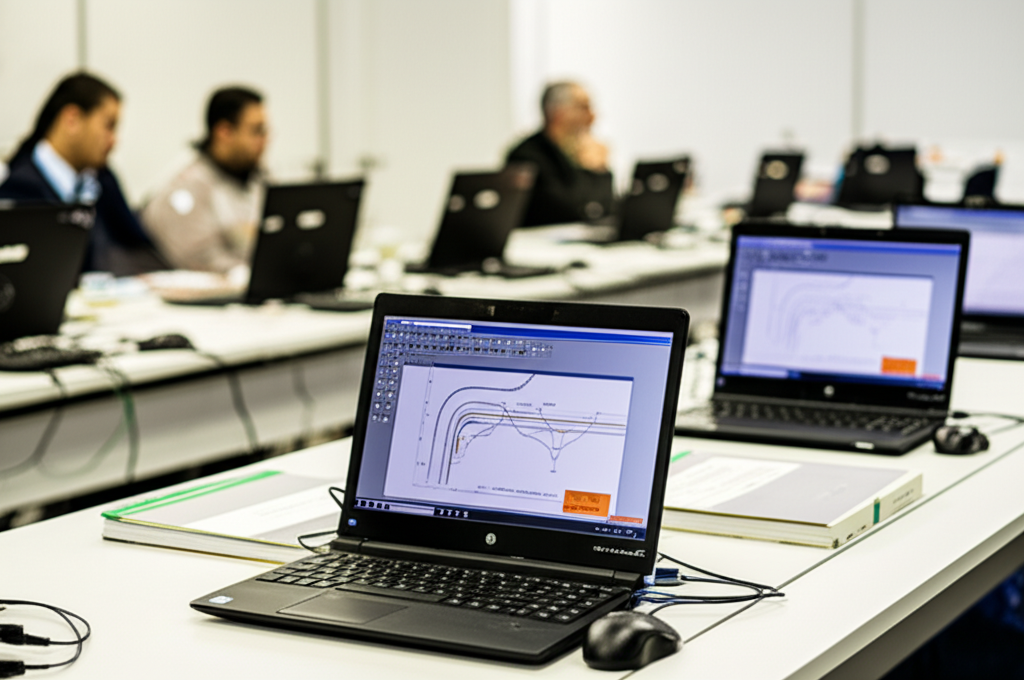
The Railway Simulation Software (OpenTrack) Course focuses on the use of this powerful tool for simulating railway systems. It covers the modeling and analysis of vehicle and track dynamics, using numerical simulation and performance analysis techniques. It centers on optimizing train design and operation, considering factors such as wheel-rail interaction, component wear, and railway safety. The course enables professionals to evaluate train behavior under various conditions and scenarios, including route planning and traffic management.
The program provides practical skills in using OpenTrack, including track modeling, vehicle modeling, and simulation results analysis. Participants gain experience in data interpretation and simulation-based decision-making, with the goal of improving the efficiency, safety, and durability of railway systems, while adhering to relevant technical and regulatory standards. This program prepares professionals such as railway engineers, track designers, and systems analysts.
Keywords (naturally occurring in the text): Railway simulation, OpenTrack, vehicle dynamics, wheel-rail interaction, performance analysis, railway safety, track modeling, route planning.
Railway Simulation Software Course
- Modalidad: Online
- Duración: 4 meses
- Horas: 300 H
- Idioma: ES / EN
- Créditos: 60 ECTS
- Fecha de matrícula: 30-05-2026
- Fecha de inicio: 02-07-2026
- Plazas disponibles: 3
750 $
Competencies and outcomes
What you will learn
1. Mastery of OpenTrack: Advanced Railway Simulation and Analysis
Here is the requested content:
- Modeling and simulation of complex railway systems in OpenTrack.
- Analysis of railway vehicle dynamics, including the effects of suspension, wheels, and track.
- Evaluation of the performance and safety of railway operations.
- Optimization of track and vehicle designs to improve efficiency and reduce wear.
- Application of OpenTrack for railway project planning and management.
2. Railway Simulation with OpenTrack: Track Design and Optimization
2. Railway Simulation with OpenTrack: Track Design and Optimization
Modeling and simulation of railway track designs using OpenTrack.
Analysis of wheel-rail interaction: forces, wear, and stability.
Optimization of track geometry to minimize wear and improve safety.
Evaluation of the impact of different types of rail vehicles on the track.
Design of curves and transitions to optimize speed and passenger comfort.
Analysis of the track’s dynamic response to static and dynamic loads.
Implementation of strategies for noise and vibration reduction.
Evaluation of the track’s lateral and longitudinal stability.
Simulation of failure scenarios and safety analysis.
Use of OpenTrack for planning and optimization of railway projects.
3. Comprehensive user-oriented design and validation (from modeling to manufacturing)
You will learn to integrate the entire product development process, from initial model conception to final validation, applying user-centered methodologies. You will develop skills in parametric design, ergonomics, simulation, sustainable materials, 3D visualization, and manufacturing management, ensuring efficient, safe solutions that meet current industry standards.
4. OpenTrack Simulation: Analysis, Modeling and Optimization of Railway Networks
- Master railway network modeling in OpenTrack.
- Understand the theoretical foundations of railway simulation.
- Analyze the dynamic behavior of trains in different scenarios.
- Optimize railway network design to improve efficiency and capacity.
- Evaluate the impact of infrastructure and operational changes on network performance.
- Generate reports and visualizations to communicate simulation results.
- Apply OpenTrack for railway project planning and design.
- Learn to use OpenTrack’s advanced tools for complex analysis.
- Simulate different types of rail traffic, including passenger and freight.
- Develop problem-solving skills in the railway sector.
5. Analysis of Railway Simulations: Design and Optimization with OpenTrack
Here is the requested content:
- Comprehensive evaluation of railway track simulations using OpenTrack.
- Design and configuration of railway models in OpenTrack software.
- Optimization of track layouts, speeds, and operating parameters in simulations.
- Analysis of wheel-rail interaction and its impact on safety and efficiency.
- Identification and mitigation of problems such as derailments and premature wear.
- Study of the influence of track geometry and material on train behavior.
- Use of OpenTrack for simulating different types of trains and scenarios.
- Interpretation of results and generation of technical reports for decision-making.
6. OpenTrack Railway Simulation: Modeling, Analysis and Optimization of Transportation Systems
You will learn to integrate the entire product development process, from initial model conception to final validation, applying user-centered methodologies. You will develop skills in parametric design, ergonomics, simulation, sustainable materials, 3D visualization, and manufacturing management, ensuring efficient, safe solutions that meet current industry standards.
Who our [course/program] is aimed at:
Railway Simulation Software Course
- Engineers from various disciplines: Railway Engineering, Civil Engineering, Transportation Engineering, Mechanical Engineering, or related fields.
- Railway professionals: Transport operators, consultants, railway infrastructure construction and maintenance companies.
- Railway network planners and designers seeking to optimize their designs and analyses.
- Students and recent graduates interested in railway simulation and OpenTrack software.
Recommended requirements: Basic knowledge of railway infrastructure, train dynamics, and simulation concepts. Experience using simulation or CAD software is valued.
- Standards-driven curriculum: you will work with CS-27/CS-29, DO-160, DO-178C/DO-254, ARP4754A/ARP4761, ADS-33E-PRF from the first module.
- Accreditable laboratories (EN ISO/IEC 17025) with rotor bench, EMC/Lightning pre-compliance, HIL/SIL, vibrations/acoustics.
- Evidence-oriented TFM: safety case, test plan, compliance dossierand operational limits.
- Mentored by industry: teachers with experience in rotorcraft, tiltrotor, eVTOL/UAM and flight test.
- Flexible modality (hybrid/online), international cohorts and support from SEIUM Career Services.
- Ethics and security: safety-by-design approach, cyber-OT, DIH and compliance as pillars.
1.1 Introduction to Railway Simulation and OpenTrack: Key Concepts
1.2 OpenTrack Interface and Basic Functionalities
1.3 Track Section Modeling: Geometry and Characteristics
1.4 Railway Vehicle Modeling: Types and Parameters
1.5 Simulation Configuration: Scenarios and Variables
1.6 Results Analysis: Interpretation and Visualization
1.7 Introductory Case Studies: Practical Examples
1.8 Fundamentals of Railway Dynamics
1.9 Introduction to Optimization in Railway Systems
1.10 Best Practices and Initial Considerations
2.1 Introduction to OpenTrack and its interface
2.2 Fundamentals of railway modeling
2.3 Creating basic models: tracks, vehicles, and environment
2.4 Configuring key parameters: speed, acceleration, and braking
2.5 Initial simulation and visualization of results
2.6 Error analysis and troubleshooting basic problems
2.7 Introduction to OpenTrack documentation and resources
2.8 Guided practice and practical exercises
2.9 Designing railway layouts with OpenTrack
2.10 Modeling different track types: straight sections, curves, and transitions
3.1 Introduction to Rail Performance Analysis with OpenTrack
3.2 Key Performance Parameters: Speed, Travel Time, Capacity
3.3 Modeling Trains and Rail Networks for Analysis
3.4 Traffic Simulation and Timetable Design
3.5 Analyzing the Influence of Infrastructure on Performance
3.6 Optimizing Track Design to Improve Performance
3.7 Evaluating the Impact of Different Train Types
3.8 Analyzing Energy Efficiency and Operating Costs
3.9 Case Studies: Performance Analysis in Real-World Scenarios
3.10 Conclusions and Next Steps in Performance Optimization
4.1 Introduction to Railway Network Modeling in OpenTrack
4.2 Importing and Preparing Data for Simulation
4.3 Building Track and Station Models
4.4 Modeling Trains and Railway Fleets
4.5 Simulating Railway Operations
4.6 Capacity and Bottleneck Analysis
4.7 Optimizing Schedules and Routes
4.8 Evaluating the Impact of Design on the Network
4.9 Sensitivity Analysis and Scenarios
4.10 Presenting Results and Decision Making
5.1 Introduction to Railway Simulation Analysis with OpenTrack
5.2 Data Preparation and Initial Modeling in OpenTrack
5.3 Railway Track Design Analysis in OpenTrack
5.4 Optimization of Track Geometry and Transition Curves
5.5 Evaluation of Train Dynamics and Curve Behavior
5.6 Simulation of Wheel and Rail Wear
5.7 Analysis of Wheel-Rail Interaction and Lateral Forces
5.8 Optimization of Track Superstructure
5.9 Interpretation of Results and Report Generation
5.10 Case Studies: Practical Application of Simulation Analysis
6.1 Introduction to OpenTrack: Interface and Basic Functionalities
6.2 Modeling Railway Components: Tracks, Trains, and Signals
6.3 Configuring Simulation Scenarios
6.4 Running and Visualizing Initial Simulations
6.5 Interpreting Preliminary Results
6.7 Track Layout Design: Geometry and Alignment
6.8 Modeling Curves and Transitions
6.9 Optimizing Superelevation and Widening
6.10 Analyzing Wheel-Rail Interaction
7.1 Introduction to Railway Simulation Analysis
7.2 Importance of OpenTrack in Railway Analysis
7.3 Data Collection and Preparation for Simulation
7.4 Configuring Railway Models in OpenTrack
7.5 Running and Monitoring Simulations
7.6 Results Analysis: Speed, Acceleration, and Braking
7.7 Results Analysis: Stresses on Tracks and Components
7.8 Optimizing Railway Design through Simulation
7.9 Evaluating Network Performance and Capacity
7.10 Reporting and Conclusions
8.1 Introduction to Railway Simulation with OpenTrack
8.2 OpenTrack Interface and Basic Functionalities
8.3 Modeling Elementary Railway Components
8.4 Creating and Simulating Simple Scenarios
8.5 Interpreting Basic Results and Preliminary Analysis
8.6 Geometric Design of Railway Tracks in OpenTrack
8.7 Modeling Curves, Transitions, and Superelevation
8.8 Optimizing Track Layouts to Improve Performance
8.9 Analysis of Stresses and Tensions in Tracks
8.10 Evaluating Wheel-Rail Interaction
9.1 Introduction to OpenTrack: Interface and Functionalities
9.2 Basic Concepts of Railway Simulation
9.3 Importance of Modeling and Simulation in Design
9.4 Data Types and Input Requirements
9.5 Getting Started: Creating a Simple Model
9.6 Geometric Design of Tracks: Horizontal and Vertical Alignment
9.7 Track Components: Rails, Sleepers, Ballast
9.8 Modeling Curves, Transitions, and Superelevation
9.9 Importing and Exporting CAD Data
9.10 Designing Stations and Junctions
10.1 Railway Track Design and Modeling in OpenTrack
10.2 Railway Dynamics Simulation
10.3 Track Design Optimization
10.4 Curve and Superelevation Analysis
10.5 Train and Locomotive Modeling
10.6 Railway Traffic Simulation
10.7 Wheel-Rail Interaction Analysis
10.8 Railway Station Design
10.9 System Performance Optimization
10.10 Final Project: Railway Design and Optimization
- Hands-on methodology: test-before-you-trust, design reviews, failure analysis, compliance evidence.
- Software (depending on licenses/partners): MATLAB/Simulink, Python (NumPy/SciPy), OpenVSP, SU2/OpenFOAM, Nastran/Abaqus, AMESim/Modelica, acoustics tools, planning toolchains DO-178C.
- SEIUM Laboratories: scale rotor bench, vibrations/acoustics, EMC/Lightning pre-compliance, HIL/SIL for AFCS, data acquisition with strain gauging.
- Standards and compliance: EN 9100, 17025, ISO 27001, GDPR.
Capstone-type projects
- Railway Traffic Simulation: Route optimization, capacity analysis, and congestion management in OpenTrack.
- Track Design: Modeling and geometric optimization of railway tracks for efficiency and safety with OpenTrack.
- Performance Analysis: Simulation of train flows, evaluation of travel times, and energy consumption.
- Railway Traffic Simulation: Route optimization, capacity analysis, and congestion management in OpenTrack.
- Track Design: Modeling and geometric optimization of railway tracks for efficiency and safety with OpenTrack.
- Performance Analysis: Simulation of train flows, evaluation of travel times, and energy consumption.
- Traffic Simulation: OpenTrack modeling, optimization of train schedules and track capacity.
- Design Analysis: OpenTrack, evaluation of curves, gradients, and superhighways.
- Network Optimization: OpenTrack simulation, bottleneck analysis, and performance improvement.
- Safety Study: OpenTrack, scenario analysis, and risk mitigation.
- Track Optimization: Design and optimization of railway tracks in OpenTrack.
- Performance Analysis: Simulation and optimization of railway system performance.
- Network Modeling: Modeling and analysis of complex railway networks.
- Design Optimization: Optimization of design and performance with OpenTrack.
- Railway route planning optimization: OpenTrack simulation to minimize travel times and energy consumption.
- Railway network capacity analysis: OpenTrack modeling and simulation to identify bottlenecks and improve efficiency.
- Timetable and frequency optimization: Implementation of OpenTrack to simulate and optimize train timetables and frequencies.
- Railway station design and optimization: Use of OpenTrack to simulate and improve passenger and train flow.
- Railway safety assessment: OpenTrack simulation to analyze and improve safety in railway operations.
Admissions, fees, and scholarships
- Profile: Background in Computer Engineering, Mathematics, Statistics, or related fields; practical experience in NLP and valued information retrieval systems.
- Documentation: Updated CV, academic transcript, SOP/statement of purpose, project examples or code (optional).
- Process: Application → Technical evaluation of profile and experience → Technical interview → Review of case studies → Final decision → Enrollment.
- Fees:
- Single payment: 10% discount.
- Payment in 3 installments: No fees; 30% upon registration + 2 equal monthly payments of the remaining 35%.
Monthly payment: available with a 7% commission on the total; annual review.
Scholarships: based on academic merit, financial need, and promoting inclusion; agreements with companies in the sector for partial or full scholarships.
See “Calendar & Calls for Applications,” “Scholarships & Grants,” and “Fees & Financing” in the SEIUM mega-menu.
Do you have any questions?
Our team is ready to help you. Contact us, and we will respond as soon as possible.
F. A. Q
Frequently asked questions
Yes, we have international certification
Yes: experimental models, real data, applied simulations, professional environments, real case studies.
It is not mandatory. We offer leveling tracks and tutoring.
Completely. It covers e-propulsion, integration, and emerging regulations (SC-VTOL).
Recommended. There are also internal challenges and consortiums.
Yes. Online/hybrid modality with planned labs and visa support (see “Visa & Residence”).